
When 32-year-old Kate Schwarting of New York was diagnosed with Crohn’s disease in June 2009 she was less than surprised. The symptoms that had insidiously weaved their way into her life had finally reached a point where their impact on her daily life was undeniable. A colonoscopy confirmed it.  At the time she was diagnosed, Kate was immersed in her undergraduate studies that were divided between Geoscience and Studio Art and took on the role of caregiver for her mother. This week Kate shares how art has benefited her patient journey and offers up helpful ways you can incorporate art into your life, even if all you can draw are stick figures (like me!):
While in college, I was focused on understanding my passion for science and art. I was passionate about discovering the possibility for art to express the unseen, and build an emotional bridge for relating to complex scientific problems. But all of this was set against a backdrop of Crohn’s flares, fistulas, strictures, hospitalizations (for both myself and my mother), and doctor appointments.
These constant disruptions often left me feeling like I was struggling to move towards my goals, preserving my identity when it’s so easy for illness to be all consuming, and caused me to frequently reflect and reevaluate my relationship with the art and science that I studied.
How Crohn’s brought me closer to understanding the benefits of art
As a student involved with the arts, it was common for me to have a few spare art materials. Over the course of 10 years of dealing with Crohn’s, I had several flares that resulted in extended hospitalizations, periods where I was at home recovering, or as a caregiver for a parent that made me aware of how important it was to have spare materials with me.
Being sick and in the hospital, or even stuck at home away from your daily routine, is stressful and isolating at best. Having these tools allowed me to cope, escape, and create meaning. It gave me a sense of accomplishing something positive and tangible in a setting where a significant amount of time is spent anxiously waiting for results, procedures and to feel better. 
Not only have I noticed how much it helps me to have this diversion, I have also noticed the impact it has on those around me. In situations that are emotionally heavy with the burden of illness, a brief conversation with another patient, nurse or doctor about art seems to uplift everyone’s mood and passing along this joy had an exponentially good effect on my own outlook.
How a flare inspired meaningful artwork
During a flare in 2016 I began to investigate how to create meaningful artwork relating to both the microbiology and to my experiences with my own body. I was drawn to the microbiome. Trillions of bacteria exist in everyone through a symbiotic relationship in the digestive system. 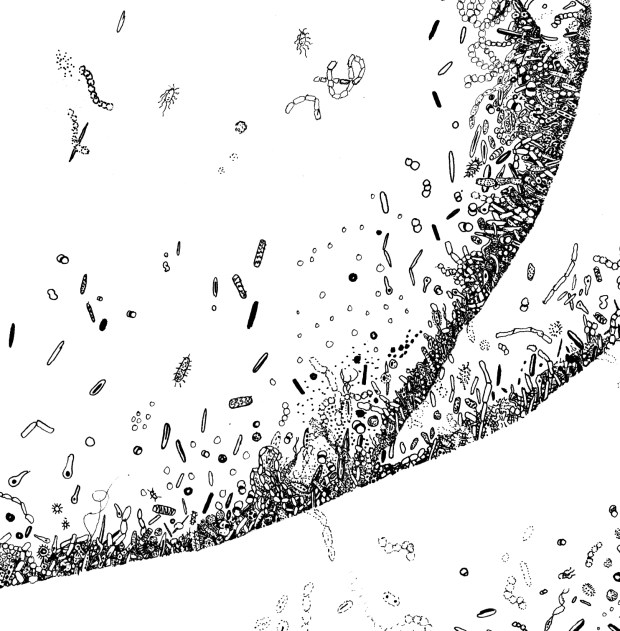 The microbiome is a hot spring of unanswered questions in relation to its role in IBD, as well as many other conditions. Applying the methods I have used in other projects, I researched the different types of bacteria and their shapes and used them to create a series of abstract drawings that relate to the digestive system and allow people to develop a sense of the complexity of the human body.
5 tips for incorporating art into your life
–Create a pack of art supplies. Get a small sketch book, a pouch including a woodless pencil, travel sized watercolor palette and brush, assorted pens, and a ruler. Add to this whatever materials you prefer.
–Start simple. Use mindfulness to find inspiration around you, whether it’s a color, a pattern, or texture
–Be mindful of self criticism! As put best by Bob Ross, Let happy accidents happen!
–Experiment! Art at its core relies on the very basic act of creating and requires no prior artistic training to get started. It is a place to abandon judgement and focus on an exclusively human experience.
–Share! I found it helped hold me to my goal of setting aside time to relax and create art by making an art related post once a day or every other day depending on how I felt to Instagram and also helped me find a supportive community during times where I was feeling the most isolated. I’d love to see what you create! Feel free to use the hashtag #chronicallycreative when sharing your work!
You can follow Kate on Instagram and Twitter at: @microbioscapes.

 Sharon Pevsner of California shares how reflection, renewal, and readjustment helps her take on the unpredictability and the challenges IBD brings to her family. I’ll let her take it away…
 Therapy, exercise, massage, friends, a night away. The reason airlines tell you to put on your own air mask before helping your child is because if you aren’t stable, your child won’t be either. I have bad days. Labs that are horrible can throw me into despair. I go back to faith. In Hebrews 11.1 “Faith is the assurance of things hoped for, the conviction of things not seen.” I allow myself a day to be sad and angry and then I rise again. My son is a warrior and I will be too.


 We know our bodies, we know our triggers, and we are the ones who are ultimately going to have to pay if symptoms arise. Comments like “Oh, I didn’t think you could eat that?” or “Isn’t that going to land you in the bathroom?” are completely unnecessary. Focus on passing that side dish of mashed potatoes rather than giving us the side eye at the dinner table.
 Bringing “safe” foods or eating ahead of time at home provides comfort and allows us to enjoy more of the party. Please don’t take offense if we eat very little, or nothing at all.
 Please trust we know the side effects of the medications we are on; we know the risks of the surgery we may have to get; we know it all. Please don’t tell us to start taking a supplement you found online. Yes, we’ve heard of: CBD oil, turmeric, probiotics, the list goes on. Please don’t question the safety of our biologic. Our disease is our reality. Unless you live it, it’s not yours.
 Just as with food, everyone with IBD responds differently to alcohol. We understand a glass of wine here or a beer there at a celebration may not seem like a big deal, but one drink can be enough to cause us extreme abdominal pain. Feel free to ask us, but if we decline the offer please don’t pester us, ask us if we’re pregnant, or try and make us succumb to peer pressure. We’d much rather be sober and present at the party without pain.

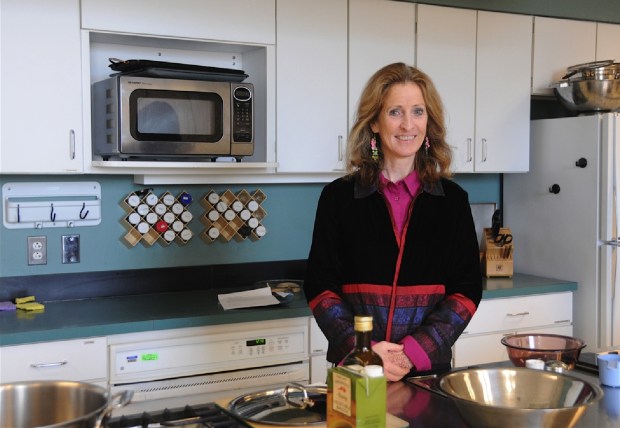 She is involved in research and clinical care, and she created the IBD Anti-Inflammatory Diet which is being investigated through the MELODY Trial. Barbara explains how through the MELODY Trial, the team is aiming to intervene in the transmission of a pro-inflammatory microbiome from women with Crohn’s to their babies.





 If you’ve never attended a Crohn’s and Colitis Foundation event for your local chapter—whether it’s a patient symposium, an education event, a walk, or a Gala, I highly recommend you check them out. While it’s great to connect on social media or over the phone, nothing compares to physically being in the same room with people who are passionate about the same cause, who understand your reality, and are driven towards the same mission as you.
 For many of us in the IBD community, we deal with what is called Iron Deficient Anemia or IDA. With Crohn’s and ulcerative colitis, long-term irritation and inflammation in our intestines can interfere with our body’s ability to use and absorb iron properly. IDA is considered an extraintestinal manifestation of IBD.
 I provided the patient perspective. It was a great opportunity, but also taught me a lot about the prevalence of IDA with the IBD community, and the importance about being proactive and getting yourself the boost you need so you can feel your best each day. As a mom of two little ones, my anemia along with my Crohn’s can be a heavy burden to bear. That’s why I do my best to stay on top of managing my illness and taking all the supplements necessary to try and combat my malabsorption problems. I hope this article inspires you to do the same and realize you are never alone in your struggles.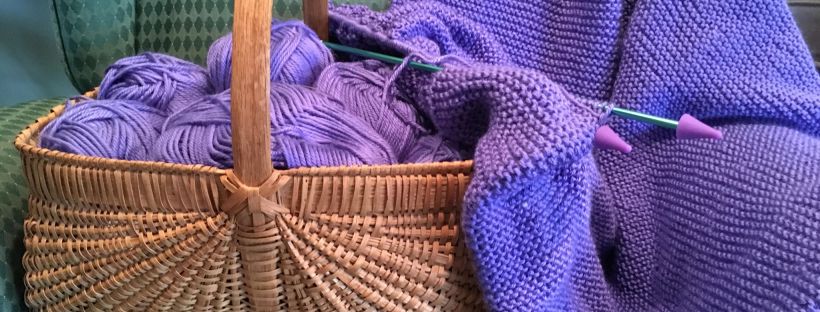
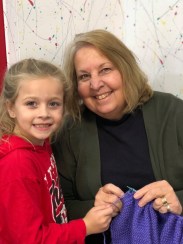 When seven-year-old Penny was diagnosed with Crohn’s in January 2017, her grandmother, Mary, started knitting her a purple blanket. She chose the color purple because it’s not only Penny’s favorite color, but also the color that represents Inflammatory Bowel Disease (IBD).


 At the same time, Mary says she’s impressed by Penny and how she is taking all the baggage that comes with Crohn’s in stride at such a young age: the daily medications, the infusions, the lifestyle changes.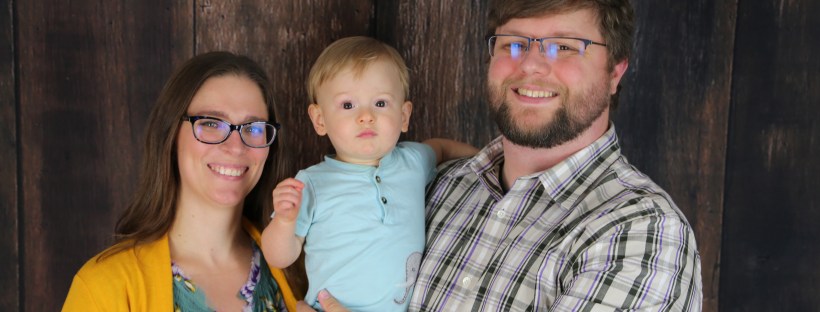
 Addy’s son, William, is now 13 months old. This week—she shares a guest post about her journey to bring him into this world and the challenges and victories she’s experienced as a new mom with IBD. I’ll let her take it away.
 After my second-high blood pressure reading that week, a nurse advised me to come into labor and delivery. When I arrived, I was diagnosed with gestational hypertension and started the induction process the next morning at 37 weeks.
 When William was born, I was thrilled, and so fortunate, to have a successful early breastfeeding relationship with him. When I started flaring again, breastfeeding became a significant challenge. I’d be with William during a late-night feeding, get a few minutes in, then have to wake my husband to keep William safe while I quickly ran to the bathroom. Obviously, this made William more than a little upset to start eating only to be pulled away. I also became increasingly worried that he wasn’t getting the nutrition he needed from me because I wasn’t absorbing nutrients the way I needed to. I upped my supplements and kept close tabs on his weight but continued breastfeeding. At this point, I knew I needed to do something different with my medications. What I was doing clearly wasn’t working.
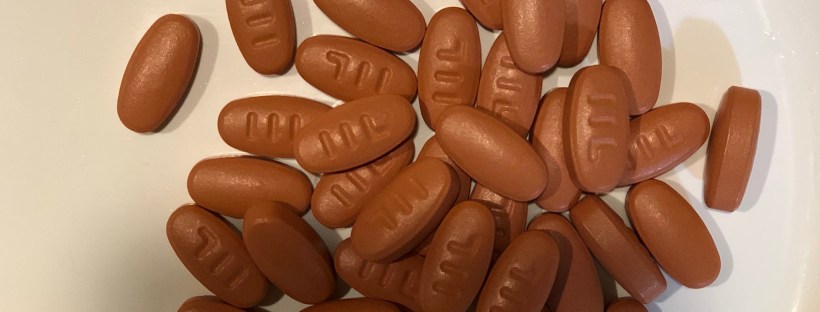
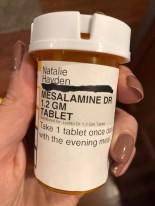 Chances are, if you have IBD, you’ve either been on or are currently taking this as part of your daily treatment regimen. Out of the approximately 1.6 million Americans who have IBD, more than 250,000 are currently on this type of medication. That may seem all fine and dandy, but did you know 5-ASA’s are not FDA approved for Crohn’s patients?
 NH: Given that there’s no evidence that 5-ASA medications are beneficial to Crohn’s patients (and not FDA approved), why are they being prescribed to more than 250,000 patients?
 On Thursday, October 10, I had an amazing opportunity to sit alongside my husband and do a Facebook Live for


 lights camera crohn's