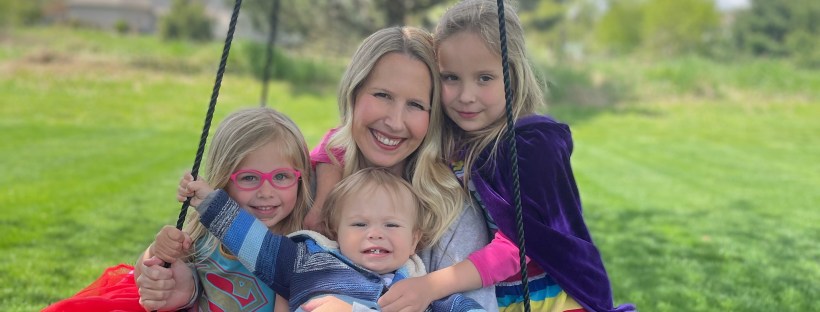
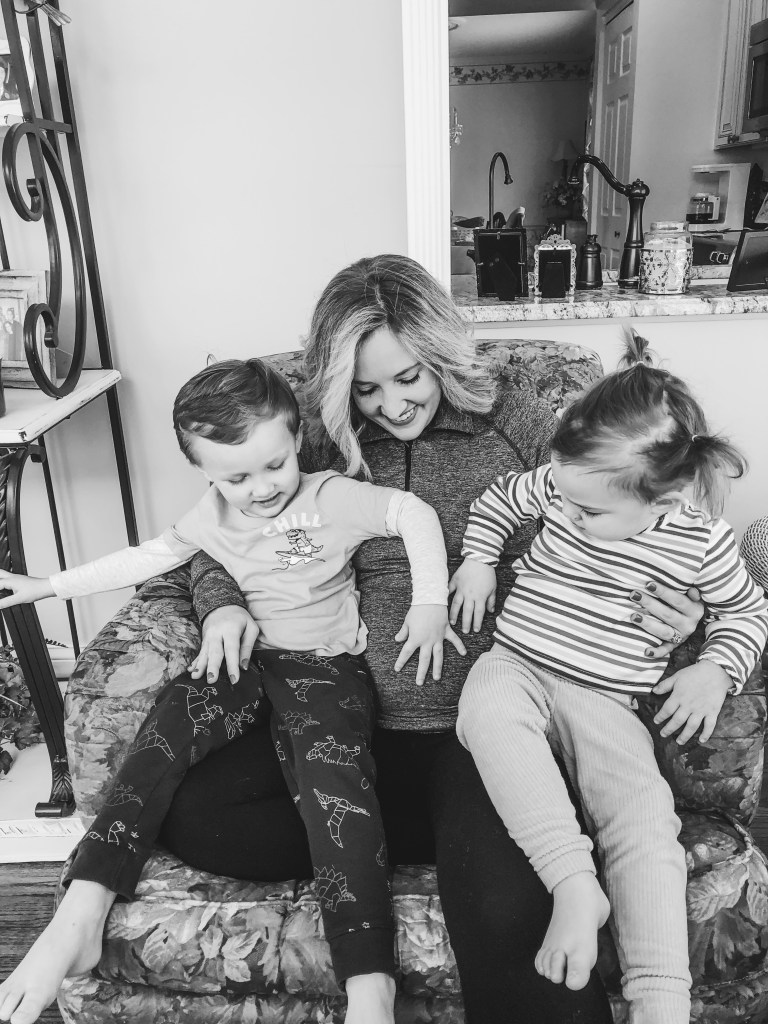
For IBD mom, Suzy Burnett, reflecting on the past year and half of living through the COVID-19 pandemic causes her to feel flooded with emotions. She knew having three children under the age of five at age 41, while dealing with the ebbs and flows of Crohn’s disease, would be challenging. She delivered her son, Guy, just as COVID cases were starting to soar. Now, she’s able to look back on how her family adapted and thrived, despite the difficult circumstances of living through a global pandemic with a chronic illness. I’ll let her take it away…
Like many families, we’ve worn masks, stayed at home, literally have seen no one except our wonderful neighbors, and made sacrifices to ensure the safety of ourselves and others. We made the difficult decision not to send our 5-year-old to kindergarten, rather, enroll her in virtual 4k from the confines of our home. Our 3-year-old also didn’t attend preschool a few mornings a week like we had originally planned. We have noticed the lack of socialization has impacted her the most. Our 15-month-old is just now meeting family and friends for the first time. He takes stranger danger to a whole new level, but we know he’ll warm up in due time.
My husband, like so many others, started working from home. What was once thought to be a temporary safety precaution, has become a permanent situation. He continues to work in a room without doors while the wee ones race around playing superheroes. Noise canceling headphones have become a lifesaver. All of us together at home, day after day, month after month. Our bond has grown deeper, and our Burnett Party of 5 has survived. I can honestly say we live fuller, laugh harder, hold each other longer, and love deeper.
Dealing with the lifting of the mask mandate
Just as we were beginning to get used to our personal version of Groundhog’s Day, the mask mandate was lifted. This is a huge milestone, but with that brings excitement along with anxiety. My husband and I are both vaccinated, but our 3 young children will have to continue to wait their turn. To say we’re trepidatious about starting to acclimate back into society is an understatement. We’ve been in our little bubble on Welcome Drive for more than a year. I don’t think things will ever get back to “normal,” per say, but we’re looking forward to what our “new normal” will be. It’s a new beginning, a fresh start to be more present, and we have the opportunity to give precedence to things that matter most in life. Things will be a little different than before, and we will always remember and carry the weight that was and will forever be COVID.
We will continue to have our groceries delivered as well as basic necessities, because it’s unclear who is vaccinated, and I’m not going to rely on the honor system of strangers to keep my kiddos safe. However, I am beyond the moon ecstatic that our girlies will both be doing outdoor soccer and playdates with other vaccinated families. My husband will continue to work from home, but this is a change we welcome and greatly appreciate. It has given us time as a family we never knew we were missing. Our oldest daughter, Lucy, will finally be attending kindergarten…….wait for it….IN PERSON. I am so proud of her. She’s sacrificed so much these past several months. She’s handled herself with grace and class far beyond her years. We’re planning our first family trip in over two years, and I am completely overwhelmed at the mere thought of the happiness this will bring.
Coming out stronger than before
It has been months of peaks and valleys, but our mountain remains strong. On top of enduring the pandemic, we lost our family cat, Miles. He was a furry friend to our littles when they couldn’t see their own friends. My dear Grandma Connors was called amongst the angels, and now she protects us from above. I also recently almost lost my sister due to a post birth hemorrhage, but now she rests safely at home with her baby boy. And I am recovering from a nasty bout of C.difficile. Yes, the one time I left the house I picked up a bacteria from the hospital. Through it all though, we’re stronger than ever before because of our strong family foundation.
My point in saying all of this is that we all go through our own struggles. Life is so unexpected, and often we can’t choose what we’re dealt. We can, however, choose how we handle the storm. We’re so grateful for our health, happiness, and each day we’re given. Take NOTHING for granted because every day is a gift. Everyone has been impacted one way or another these past few years, and now it’s up to you to see where your ship will go as you navigate life with IBD and in general. As the tides of the ocean swiftly change, so will the moments in life. Savor the moments.
Being diagnosed with IBD as a pediatric patient looked different in the 1970’s. For 54-year-old Brett L., the start of his patient journey began when he was only nine. The year was 1976. He started experiencing fevers, bloody diarrhea, vomiting, and abdominal pain. As he puts it—the symptoms started a year-long quest to find an answer. A quest that involved frustratingly long waits at doctor offices, endless tests, and medical trials. He was ultimately diagnosed with acute ulcerative colitis at the age of 10. Now, in 2021, Brett has unique insight and perspective to share with our community.
Patient “Number 1”
As you can imagine, Brett spent many years on high dose steroid and sulfur pills. The side effects of the steroids (moon face, weight gain, bloating, mood swings, and ravenous hunger, etc.) added insult to injury. From 7th through 9th grade, Brett missed nearly 60 days of school each year due to severe flare ups and hospitalizations. By the time he was 13, Brett’s parents were desperate for a cure as his condition worsened. With no relief from traditional medicine, they sought out additional care from holistic doctors, nutritionists, even an angel healer at one point! Nothing helped to manage Brett’s IBD.
“In 1981, I was 14. I’d been battling debilitating and severe flare ups that made me so weak I had to crawl to the bathroom or walk doubled over in pain. Each hospitalization was taking its toll. Over the years, though I was growing, I had lost 30 pounds. It was at this point that my doctor proposed something that had never been performed on a pediatric IBD patient—a total colectomy and “pull through” operation that would leave me fully reconnected and waiting for the ileostomy closure…allowing me to eventually go the bathroom normally again after a recovery period of a year or so. It was risky surgery back then. But not having it was a risk too. I agreed, and we went ahead with the surgery.” said Brett.
Brett was deemed “patient number 1” for this pediatric procedure and his case study was published in medical journals. To this day he remembers waking up from surgery in the pediatric ICU at Westchester County Medical Center in Valhalla, NY. He recalls counting 18 tubes and lines connected to his body and thinking that he couldn’t believe he chose to do this to himself. The surgery lasted 14.5 hours and the incision ran from his pubic bone to his sternum—the entire length of his abdomen.
Living with an ileostomy as a teen
“I learned to manage the ileostomy with some upsetting and messy mishaps at the very beginning. And in class sometimes the stoma would make embarrassing sounds. I learned to feel it coming and cover it with my hand to quiet it. But without a colon, I was now a healthy 14-year-old. The doctors said that upon examining what was left of my colon, they estimated I had about two weeks left before a fatal perforation,” said Brett.
A year later his ileostomy was reversed, and he was able to go to the bathroom “normally”, again. While he’s grateful for this—it hasn’t been all sunshine and rainbows. Brett says he initially had an abscess at the closure of the stoma. Ever since, he has gone to the bathroom more than normal people. In recent years Brett developed a challenging case of chronic pouchitis that at its worst caused pain and had him going 20-30 times a night.
The good news is that “after about 4 years of this, I finally seem to have treated and solved it myself, with psyllium husk powder at breakfast and lunch times, and 3 Lomotil pills with dinner. I’ve also reduced fluid intake during meals and become more careful about not overeating. I learned some of this in my online research about immediate post-op colectomy patients. The doctors had a hard time helping me with this, but I seem to have resolved it myself.”
From past to present
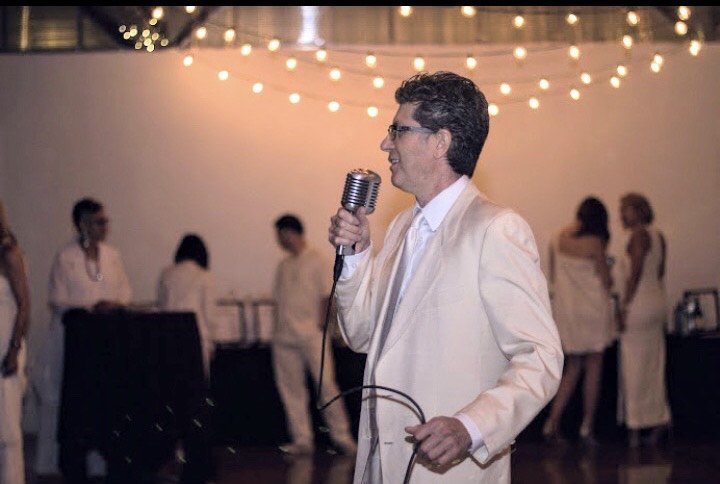
Today, Brett is a healthy 54-year-old man and his pouchitis has never been more under control. Through all the ups and downs with IBD, he’s lived a fulfilling life as a professional singer, and as an executive of multiple companies.
“In my career I’ve been an investigator, a head of marketing and sales, I’ve grown startup companies, and have traveled the world for business and pleasure. I’ve earned an advanced degree from an ivy league school, and I have an amazing 16-year-old daughter who is a gifted, performing singer-songwriter in her own right.”
Brett believes his ulcerative colitis has made him more appreciative of life and the little things.
“I have always been that person who lingers over sunsets, gazes at the moon, and stops and notices the teeny flowers poking through the cracks in the sidewalk, or street art, and the coincidental things one comes across as noteworthy or remarkable. I notice and really drink in the happy, good moments because I know what it’s like to not be able to be out and experience these things. I know I am fortunate to be here to tell my story.”
Here are some helpful nuggets of knowledge Brett would like both those with IBD and their caregivers to know:
Don’t let fear of IBD stop you from living your life and having fun, or asking that person out, or going out with friends, when you are feeling well. As soon as I was feeling well enough to get back out there after a flare up, I lived life to the fullest and played like every other kid. You deserve to be there just as much as every other kid, teen, or adult does. When you are feeling well, try to make the most of that wellness, and not let the fear of what might happen stop you from living.
You are not “less than”, because you have an illness. In fact, you may even have an added level of maturity because of your illness that others do not, because of your need to contend with it, and interact more with adults and medical professionals and present your situation to them in a coherent and meaningful way. Look for the silver linings in everything. Notice the small pleasures, they help you get through the down times.
To parents—your child is a survivor. It takes a lot to keep them down. They will have ups and downs with their IBD. But 2021 is the best time ever to have to live with this diagnosis. Current treatments and even surgeries have changed the game and the patient experience, for the better and the future is even more promising. IBD can be traumatic. Children and adults can benefit from seeing a therapist to help cope with the lifelong nature and complications of the disease.
Chronic illness can feel all-consuming, especially while you’re trying to balance work and your personal life. According to 32-year-old Allison Wade of Texas, living with ulcerative colitis since 2008 prepared her for the struggle of infertility after living through a four-year flare. Yes, you read that right. Allison was hopeful her and her husband, Nick, could begin their journey to growing their family. Unfortunately, just as she felt the relief of getting her IBD under control, she found out she would be dealing with another condition where there is not a “one size fits all solution.”
This edition of IBD Motherhood Unplugged looks at juggling the mental and emotional struggle of coping with and mourning your body failing you not only with ulcerative colitis, but also infertility, while also being your own advocate for your care plan. As Allison says the question of “WHY” she’s unable to achieve something that women have been doing forever, haunts her.
Allison is a healthcare worker. Her world came crashing down during the pandemic when she found out bringing a baby into this world would be more complicated than she ever thought.
“When I received news that I was in remission after the four-year flare, I was told we needed to get pregnant right away to capitalize on my IBD finally being under control. I underwent an HSG procedure to make sure that I didn’t have any adhesions or blockages in my fallopian tubes due to the chronic inflammation in my colon. We were told everything was normal,” explains Allison. “I also had blood work completed to ensure that I was truly ovulating and that was also normal. We tried for a year and were not successful.”
Allison and her husband met with a fertility specialist in April 2020. The nearest fertility specialist was two hours away, so they set up a telemedicine visit. During the initial consultation they were told it sounded like they were dealing with unexplained infertility.
“My cycles were like clockwork, I was getting positive ovulation tests, my hormone levels after ovulation suggested that I was truly ovulating, there was no reason as to why I had never seen two lines on a pregnancy test.”
The fertility game plan
Allison and Nick set up a game plan with their fertility team that involved three rounds of Intrauterine Insemination (IUI) plus Clomid. If she was not pregnant after that, the next step was IVF. Allison says she felt overwhelmed but was confident that they were going to be pregnant after the first month. Looking back, she says she was naïve to think that way.
“Emotionally, each month is a roller coaster that comes and goes quickly. Each month that passes you feel the gravity of emotions that come with each negative pregnancy test. Financially, it has been difficult because insurance does not cover my fertility treatments and rarely covers my medications. Let me just tell you that every ultrasound and every blood draw adds up. I have to remind myself regularly of how it will all be worthwhile in the end.”
Keeping stress in check
As anyone with IBD knows, managing stress is imperative for helping to keep symptoms at bay. Along with the worry about getting pregnant, Allison has the fear of flaring with her ulcerative colitis.
She explains, “The biggest area of stress has been managing all the appointments and arranging my work schedule on the days I have to unexpectedly drive to Houston for a 15-minute ultrasound. I am very lucky that my job has been understanding through this time.”
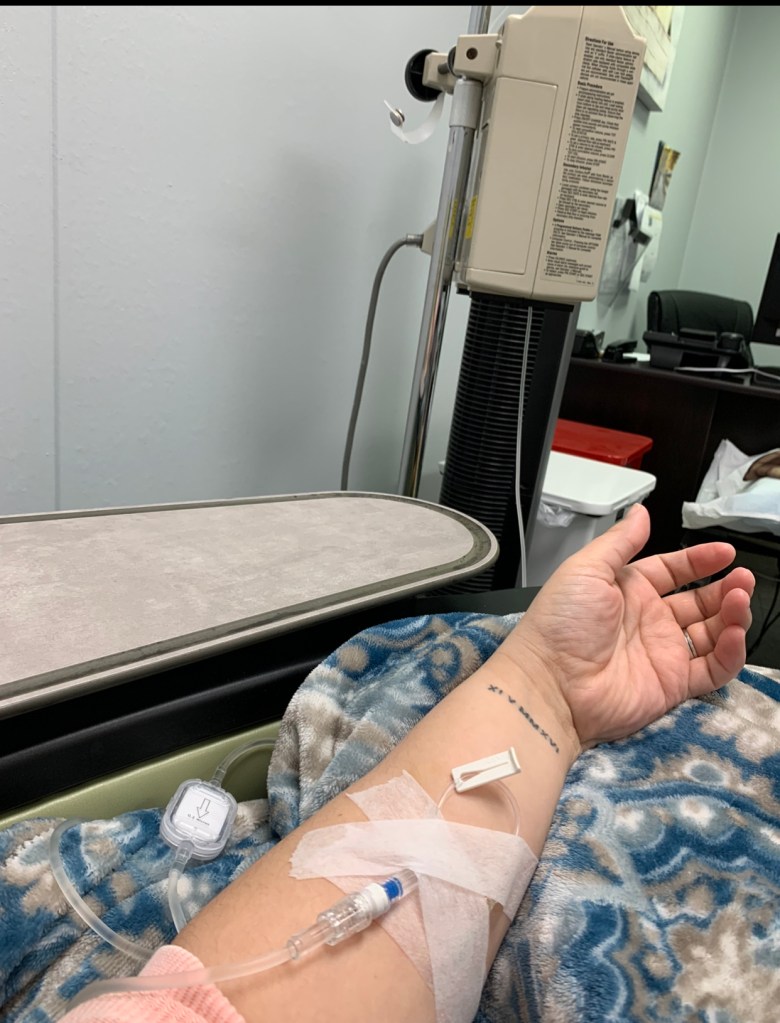
Not to mention she also has to take time away from work to receive her Remicade infusion.
“I would advise other IBD women to find ways to manage all the stress and emotions that come along with infertility and chronic illness. I highly recommend seeking counseling services. It is nice to have someone to talk to who is not emotionally involved in the outcome. It is a difficult time for all women, however when you also have IBD, I feel like you are now adding all these supplements, medications, and appointments to your existing list of treatments for your IBD. Find a way to organize everything so that you’re able to manage everything without getting too overwhelmed.”
Utilizing Natural Procreative Technology instead of IVF
After two failed IUIs, Allison knew IVF was on the horizon. She didn’t feel as though all her concerns were being addressed or that her needs fit into the typical cookie cutter approach.
“I felt like we were being rushed to IVF without any real answers as to why my body was unable to conceive. My husband and I were not emotionally or financially prepared to begin the process of IVF, so we decided to get a second opinion and look at other options.”
This is where Natural Procreative Technology or NaPro comes into play. Allison liked that NaPro doctors look to diagnose the root cause of what is causing your infertility, in hopes that you can conceive naturally without the use of IUI or IVF. The success rates are comparable and often exceed those of IVF, without the increased risk of multiple pregnancies or birth defects.
The Creighton Model of FertilityCare System™(CrMS) is the method of observing and charting important biomarkers in the female cycle. The charting and observational work is the basis of evaluation and treatment in NaPro Technology. Allison has been charting her cycles for the last six months.
“When I went to my first NaPro appointment, the doctor spent an hour talking to me in the office and my husband on Facetime. She answered every question and explained that she would be as aggressive as we wanted her to be,” says Allison. “She wanted me to chart my cycles and to get extensive blood work completed after ovulation to look at my hormone levels. She also spoke to me about diet, stress, activity levels, and she started me on several supplements. When I left that appointment, I was so happy because I felt like she was treating me holistically and was going to find the cause of my infertility.”
Keeping her eyes focused on the future
Allison is going to have exploratory surgery next month to look for scar tissue or adhesions that may be the result of chronic inflammation from her IBD, which could be contributing to her struggle to get pregnant. She is due for her Remicade the same week as her surgery, so she must push her infusion back until her incisions are healed. As a woman with IBD, going through infertility, this is the reality that is often not discussed or thought about.
“While I try to remain as optimistic as possible about creating a baby that is genetically ours and that I can carry, our hearts would definitely be open to both surrogacy and adoption. My dream has always been to be a mother and I will do everything that is possible to achieve that dream.”
She’s a physician in Ethiopia looking to pave the way for those with IBD. She understands the need because she was diagnosed with Crohn’s in August 2017 at age 22 while she was a fourth-year medical student. After suffering from debilitating symptoms for eight months, she finally received a diagnosis. Dr. Fasika Shimeles Teferra says in her home country and in developing countries, she had always been taught that inflammatory bowel disease was non-existent. She felt isolated and alone as she embarked on her journey with chronic illness. There were no resources. No support. She had no clue where to turn when it came to being understood and knowing how to navigate nutrition.
In her school of medicine, an IBD diagnosis was morbid. She was told if she continued to learn about her illness, she’d die from the stress.
“Despite my medical background, I expected death to be imminent. The breaking point which later turned out to be a turning point for me, was when I was suffering from ovarian cyst torsion, explained Dr. Teferra. “Even though I was in remission at the time, every OBGYN who saw me in the ER refused to operate on me. One doctor refused to operate on me because I’m a “complicated patient with IBD”. He wanted to wait to see if pain meds will help solve it.”
Luckily, one doctor decided to operate on her, but unfortunately, she lost her left fallopian tube and ovary in the process. At age 23, she lost half her chance of being able to conceive a child. Her Crohn’s relapsed a few weeks later and depression set in. (Note: Luckily, she is due with her first child in June!)
“I went to my doctor and told him I was quitting med school (I was 5th year at the time and just starting my medical internship). But what he said changed me forever and made me feel less alone. He told me he was treating multiple IBD cases and that my disease was much more common in Ethiopia than most thought. He also told me Crohn’s was manageable with medication.”
Holding onto new hope
With a renewed sense of hope, Dr. Teferra started advocating for herself and looking for local support groups to connect with others who lived with IBD. The problem—she couldn’t find any! She joined a Facebook group based in the United States and recognized the need for support in Ethiopia.
“I reached out to a couple of gastroenterologists here in Addis and told them I wanted to start a support group in Amharic focusing on sharing experiences, supporting one another. My hope was to help others who were struggling with coping with their diagnosis. I thought sharing my story would make a difference in someone’s life.”
Launching Crohn’s and Colitis Ethiopia to make a difference
After speaking with multiple doctors, Dr. Teferra decided to start an organization that would not only focus on support groups, but also advocacy work for policy makers. The last published data on IBD in Ethiopia dates back to 1990s! She recognized this lapse in research led to major gaps in treatment for IBD patients. This inspired her to launch Crohn’s and Colitis Organization Ethiopia in January 2020. When the COVID-19 pandemic hit in March 2020, it put everything on hold as the world stood at a standstill.
Even though the organization exists, Dr. Teferra is struggling to garner participation in support groups, because sadly the stigma of IBD leaves many in Ethiopia to suffer in silence and shame. She says fellow IBD patients prefer to communicate directly with her, so she has taken it upon herself to meet them and their families to better explain their condition and how to live a full life with it.
“I try and explain to the patient and their family how they can best take care of themselves and how family members can offer compassionate and empathetic support along the way,” said Dr. Teferra. “Many people discontinue their medication the moment they experience a side effect. I’m also passionate about discussing family planning and breastfeeding. Because of my medical background, I am able to give reliable information about IBD and I am able to use my story to guide the narrative.”
Dr. Teferra also has a registered dietitian who serves as a board member for Crohn’s and Colitis Organization Ethiopia. The nutritionist can provide guidance about how to enjoy Ethiopian cuisine and manage diet in the context of cultural foods.
But Dr. Teferra is only one person and can’t address the growing need for support and care. Even though local gastroenterologists have her contact information, and she tries to meet with as many people as possible, as you can imagine, it gets to be a lot.
Bringing IBD to Prime Time in Ethiopia
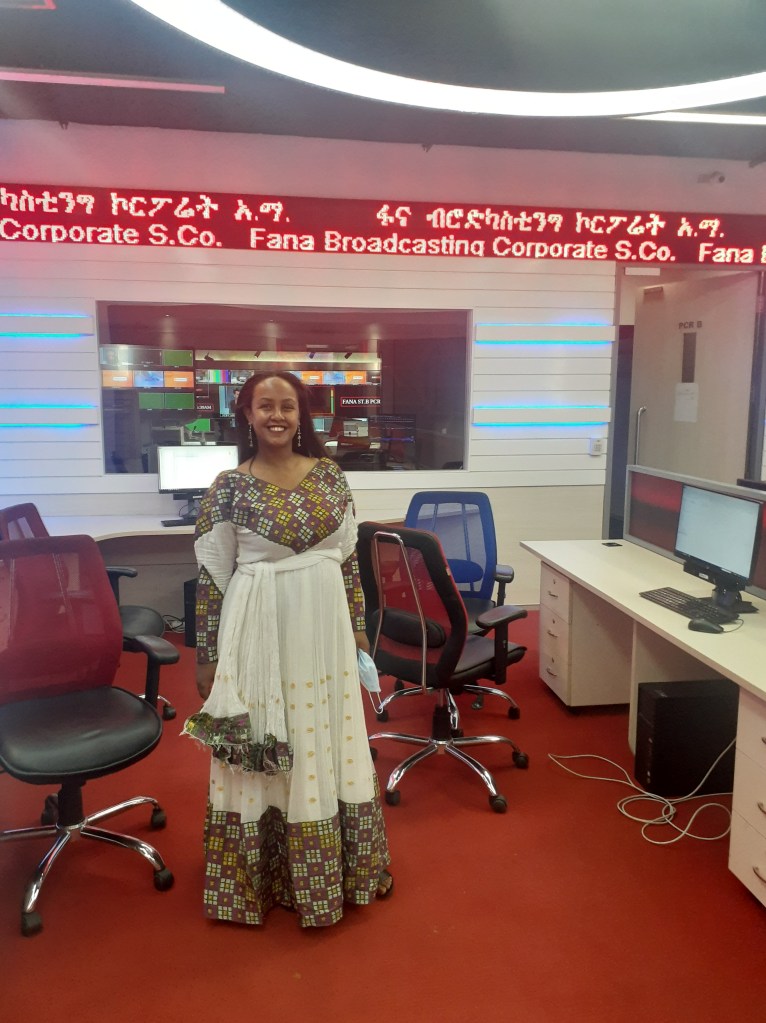
During an interview about COVID-19 on national television in Ethiopia, Dr. Teferra took it upon herself to also speak about IBD.
“Since it was Primetime, I was able to reach multiple people at once and I was able to send out the message that those with IBD are not alone. I plan to use such platforms to continue to share facts about IBD and that it does exist in Addis. In the meantime, I am working hard to find a researcher who can work on this with us. We cannot challenge policy makers without evidence, and we cannot change the minds of the medical community without research.”
Dr. Teferra says gastroenterologists in Ethiopia can testify that IBD cases are increasing daily. There is lack of medicine, lack of education, and lack of understanding. Many patients struggle to afford medication and choose to discontinue it because of lack of availability.
Overall, Dr. Teferra main mission with Crohn’s and Colitis Organization Ethiopia is to improve the quality of life and health literacy of people living with IBD in Ethiopia and provide the patient community with a better understanding of their condition by empowering them to take charge of their own health.
Connect with Dr. Fasika Shimeles Teferra on Twitter: @DrFasika.
As an IBD mom I see it as a responsibility and an opportunity to participate in research studies while I am pregnant and as my children grow. I’m currently 20 weeks pregnant (tomorrow!) with my third baby and this time around I’m enrolled in the Pregnancy in Inflammatory Bowel Disease and Neonatal Outcomes (PIANO) study. The project was conceived, lead, and executed by Dr. Uma Mahadevan, Professor of Medicine at the University of California San Francisco in 2007.
Since the project launched, more than 1,800 women have participated in the registry. Of that number, over 900 stayed on biologics throughout their pregnancies. I’m thrilled to be a part of this initiative. If my pregnancies and children can provide clarity for a future generation of IBD moms, the extra effort on my part is more than worth it. Thanks to women before me who have been on a biologic and been a part of research while pregnant, I have peace of mind knowing that staying on my Humira is best for me and for baby.
Without studies that indicate how babies in utero respond to medication exposures we would be in the dark about what is best for mom and baby not only during pregnancy, but with breastfeeding.
“There is so much misinformation about pregnancy and IBD including being told not to conceive at all or to stop medication. This is incorrect and dangerous. PIANO was started to provide reliable data for women with IBD considering pregnancy so they and their providers can make an informed choice for themselves and their babies,” said Dr. Mahadevan. “Every pregnant woman with IBD has benefited from the generosity of PIANO moms who contributed their outcomes, good or bad, to the pool of knowledge we have. Every PIANO mom who contributes benefits not herself, but future mothers with IBD. It is an invaluable and precious gift.”
What PIANO measures
There are four main areas the PIANO study looks at:
Whether the level of biologic drug transferred across the placenta to the infant by the time of birth predicts the risk of infection or other adverse outcomes
Whether the achievement of developmental milestones is affected by medication exposure
Whether the rates of birth defects, adverse pregnancy outcomes and complications of labor and delivery are affected by IBD medications
Whether second trimester drug levels can be used to adjust drug and minimize transfer across the placenta to the baby
Since I am just now reaching the halfway point of my pregnancy, I have only had to fill out questionnaires. You are required to do so during each trimester, at the end of your pregnancy, and then at 4, 9, and 12 months post-delivery. Along with that, you can provide follow up until your child is 18, once a year. During this trimester I will also provide blood work and a fecal calprotectin. On delivery day, bloodwork will be taken from me, my baby, and my umbilical cord. Depending on my son’s blood work at delivery, I may be asked for more when he’s 3 and 6 months. If at any time I am not comfortable with him getting his blood drawn, I can always opt out. The cord blood is similar to the baby blood at birth so that is adequate. I can also choose to stop the annual questionnaire at any time.
If a woman receives the COVID-19 vaccine during pregnancy, the PIANO study is also measuring the antibody levels found in the cord blood (on the day of birth) to confirm that the benefit transfers to the baby. Breastmilk will also be measured for the transfer of protective antibody against COVID.
The Findings Thus Far
In a presentation this past fall, Dr. Mahadevan shared findings from PIANO.
“We looked at pregnancy, birth and developmental outcomes in the infants at one year, based on exposure to drug, and found no increase in negative outcomes and no reduction in developmental milestones. Biologic‑exposed infants did have some statistically increased improvement in developmental milestones compared to the unexposed group. Overall, what this study suggests is that women with inflammatory bowel disease should continue their biologics and thiopurines throughout pregnancy to maintain remission, given no evidence of harm, and evidence that disease activity can increase miscarriage.”
The study also found that disease activity can increase preterm labor and birth, all the more reason for women to stay on their medication and not try and go med-free while pregnant.
Looking to the Future
Currently, there is no end date for the study. As long as there is funding, the project will continue. Dr. Mahadevan says with all the new medications coming down the pipeline there is a need for safety data. She says, “The infrastructure of PIANO allows us to study new medications as they come to market, even before they are approved for IBD.”
To participate in the study women must have IBD and live in the United States. Interested in learning more or getting enrolled? Email PIANO@ucsf.edu or call 415-885-3734.
Motherhood is so much more than a word—it’s an expectation and an identity. It’s a right of passage many girls dream of when they think about their future and what their family will look like. But family planning, pregnancy, and motherhood are far from a given, especially for those with chronic illness. As an IBD mom of two with one on the way, I’ve recognized that while my story and my experience may comfort and guide others—it’s only that, one story. I fully understand I am extremely lucky not to have the struggle of infertility or physical limitations to hold me back from having children, despite my Crohn’s.
This week kicks off IBD Motherhood Unplugged, an ongoing series that will be shared periodically in the months and years ahead on Lights, Camera, Crohn’s. The series will feature guest posts from women with Crohn’s and ulcerative colitis who may not physically be able to carry a child, who battle infertility, who grow their family through adoption and surrogacy, who have children following loss—the list goes on and on. Ultimately, I want everyone to feel seen, heard, and understood. There’s not one cookie cutter approach to becoming a mom or having a family.
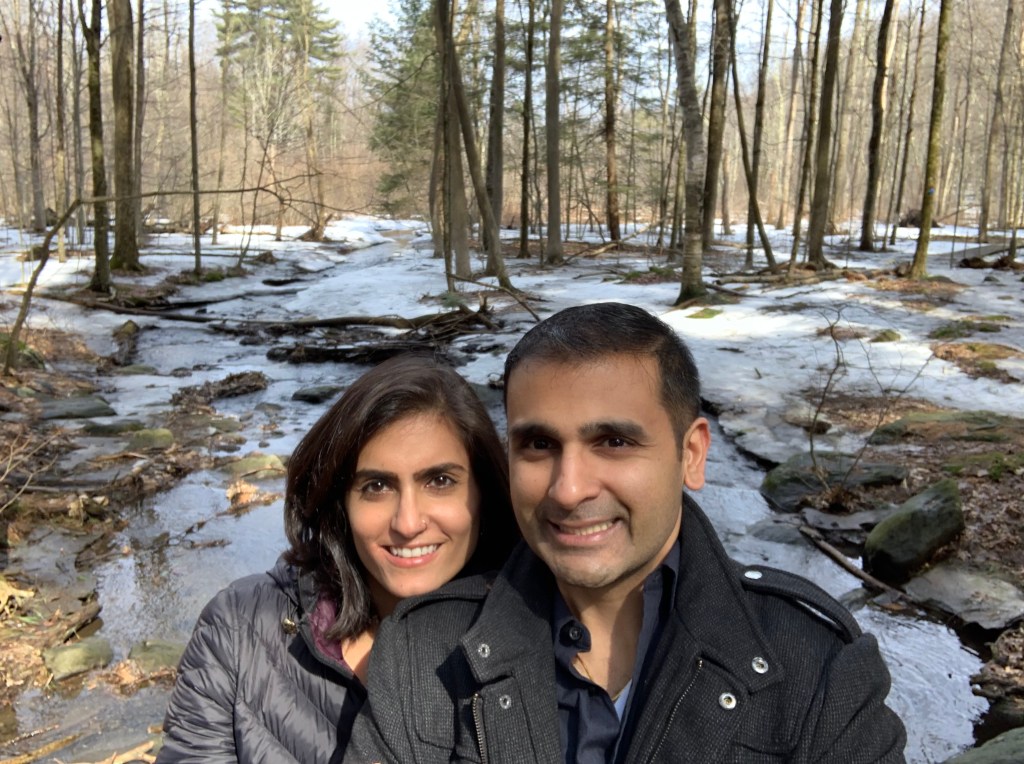
The first article is by my dear friend and fellow patient advocate and thought leader Tina Aswani Omprakash. Tina is a 37-year-old woman in New York, living with perianal, fistulizing Crohn’s Disease. She’s endured more than 20 surgeries and lives with a permanent ileostomy. Since she was a child, she thought she could put off motherhood and did so through many years of virulent disease. At one point, as a young adult, she needed to go on a disability and be taken care of by her mom. When she got married to the love of her life, Anand, nearly 11 years ago, the questions started.
“Being of South Asian descent, the nosy, busybody aunties at weddings and cultural events would always find ways to jeer and sneer at the fact that I hadn’t had a child yet. And after I started Stelara 5.5 years ago and tasted remission for the very first time in a decade, I too began to wonder: is it time for me to consider my own child?”
I’ll let Tina take it away and explain her struggles with family planning and finding out pregnancy wasn’t in the cards. Her heartfelt words and openness about feeling excluded from being an IBD mom, shed light on an important topic and aspect of our illness that is often not discussed or talked about. We hope in sharing this—if you are going through the same situation, struggles, or worries, that you know you are not alone.
Genetic counseling, surrogacy, and reproductive endocrinologists, oh my
In April 2016, I went to see a reproductive endocrinologist, who did a transvaginal ultrasound. Based on his medical expertise, he thought he could retrieve maybe three of my eggs, which was incredible news given everything I had been through surgically. He had proposed 2-3 rounds of IVF for hormone stimulation and egg retrieval but there was no guarantee that the eggs retrieved would be viable to be combined with my husband’s sperm. He didn’t think carrying the baby was a good option for me given all the scarring from surgery and fistulae. Moreover, fertility is often affected by j-pouch surgery and later excision. As such, he offered me the option of surrogacy and asked me to seek genetic counseling due to the hereditary nature of my Crohn’s Disease.
Anand and I went through months of genetic counseling, an expensive process that didn’t lend to any substantial findings. Crohn’s, as many doctors have explained to me, is spread out over several genes and one gene cannot be targeted necessarily as a form of gene therapy. That left us both stumped as his family has a history of an autoimmune condition called ankylosing spondylitis and I have various skin and bowel autoimmune conditions on my side of the family.
During this time, we also looked into the surrogacy process. Since the reproductive endocrinologist recommended that I not consider a pregnancy myself given all the surgeries, fistulae, and pelvic cysts I’ve had, we obliged. But considering all the legal and surrogacy fees, we were looking at $100,000 for one surrogate pregnancy (at least), which was an extraordinary sum of money for us. So, we decided to table having a child for the time being and think over adoption, another expensive proposition.
Tick, tock, tick, tock…
Two years passed and we came to realize that there is no easy solution. During that time, the IBD Parenthood Project shared excellent knowledge for women with IBD to conceive and carry a pregnancy to term safely. And I thought, let me ask my GI doctor now about his thoughts. Unfortunately, he reiterated the same thoughts as the reproductive endocrinologist shared: for someone with my surgical and fistula history and aggressive family history of Crohn’s disease, it may be best not to try. He also said the risk of me using hormones for egg retrieval would risk a blood clot in a patient with my history.
Part of me was still in denial that motherhood may never be a possibility. Within weeks of my conversation with my GI doctor, I was diagnosed with mild endometriosis by a premier OB/GYN surgeon in NYC. I asked him, “What do my options for pregnancy and fertility look like now?” And he said very openly and honestly, “Bleak at best. Let’s say you do carry the pregnancy and don’t lose the baby, Tina, will I have to cut through bowel and scar tissue to get to your baby?” After a brief pause, he said, “I would recommend adoption if having a child is something you really want to consider.”
While, on one hand, I genuinely appreciated his honesty, on the other hand, the statement, “cut through bowel and scar tissue to get to your baby” seared through my mind for months after and has left its mark even today. I needed to hear it; I needed my bubble to pop. But the statement no doubt cuts and ravages every minutiae of my being as a woman. Not having the privilege to choose to have a baby was suddenly taken from me in that one fell swoop and it left my head spinning.
Losing Motherhood to Crohn’s Disease
My God-given right as a woman was taken from me in that instant. As if having six fistulae and Crohn’s wreaking havoc on my pelvis and reproductive system wasn’t enough, let’s take Tina down another notch. Let’s take away her right to choose to have a child.
Even though voluntary childlessness is always a choice, now I didn’t even have that choice. Childlessness was thrust upon me like a stab wound in the back. All I was left with were unaffordable options of surrogacy or adoption.
So why not adoption? It’s simply too expensive and I do wonder about whether I’ll be able to even take care of the child given my constant roller coaster of health issues and medical appointments. Hiring full-time help seems out of reach, too.
Include Women Who Aren’t Mothers
That day with the endometriosis surgeon was nearly three years ago. And I’ve done a lot of work in therapy to process much of it. But I can’t say I don’t feel left out every time I see a mom scolding her child or complaining about her child(ren)’s mischievousness because I, like many other women with chronic illnesses, will never be able to experience the joys and sorrows of motherhood.
As happy as I am for my friends with children, there is a deep void I’m reminded of every time someone else gets pregnant, hosts a baby shower, or sends along amazingly cute photos of their child(ren). I will never be able to have that, no, but I wish I could still be included in the mommy paradigm as a cool aunt or as a godmother. But I’m often not, and that makes me feel sad and excluded.
Dealing with the Cultural Aspects
In American culture, it’s hard enough as it is to be a woman of my age without a child, but in Indian culture, you’re really considered a pariah of sorts. I’m often asked the question of when I will bear a child now that Anand and I have been married for so many years. I usually find ways to dodge those questions by changing the subject or by simply saying, “whenever the time is right.” It’s not a conversation I want to be having with acquaintances nor do I want to be fodder for gossip.
But when it comes to my close friends saying, “Tina, gosh, you would have made an amazing mother, you have so much good to impart on to the world,” it feels good and bad all at once. I’m flattered that someone would think I could do a fine job as a mother but saddened by the fact that I will never know that for myself.
Becoming a Mother Hen
Alas, today in 2021, I continue to focus on my advocacy work and my graduate program, in attempts to focus my attention elsewhere. And in the words of my therapist, “if I cannot be a mother to a child, I can at least be a mother hen to my IBD community, helping to educate and guide patients of underserved populations who would otherwise feel bewildered.” I take a lot of solace in that and recognize that I wasn’t supposed to be here today with all the near-death experiences I’ve had with my brand of Crohn’s disease. All I can express is my gratitude for being alive today, for being able to do this work, and for being able to be a mother hen in my own way to my community.
To my fellow IBD women & chronic illness warriors: please know you are not alone. Please know it’s okay to be sad, angry, and terrified. Many of us are struggling deeply with the idea of motherhood as our clocks keep ticking. Do your research, learn what your options are and make the best decision with your specialist(s) regarding conception and pregnancy. And if having a child is not in the cards, that’s okay too. Never forget (and I need this reminder too) – not having a child doesn’t make you less of a woman.
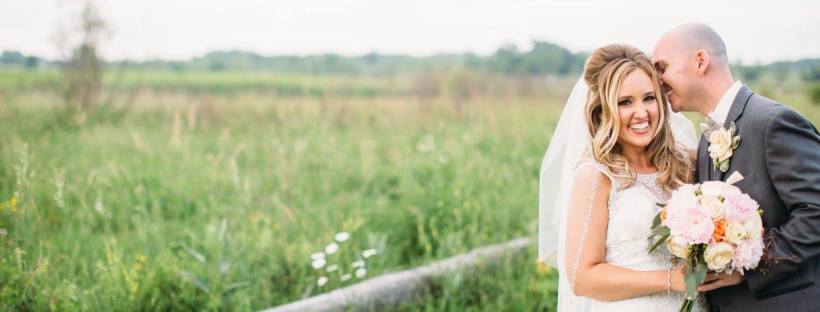
Before the dating world was about swiping right or left, I met my husband online. It’s something I was a little embarrassed about sharing for a long time, especially while being a morning news anchor. The year was 2013, while online dating was becoming more common, it was still a little taboo. At the time, my Crohn’s disease was a secret from the public. Much like the backstory of my health, I wanted to keep my love story under wraps much of the same way.
So, when I signed up for eHarmony on a whim after attending my co-anchor’s wedding, rather than putting my location as Springfield, IL (where I lived and did the news), I told a little white lie on my profile and said I lived in St. Louis. I know, I know…a little shady! But hear me out. I chose to do this to disguise my identity and vowed to myself that I’d be upfront and honest with whoever I spoke with about where I lived from the initial conversation. I also told myself I’d hold off on sharing that I had Crohn’s until I met someone worth my time and deserving of my energy. It wasn’t something I would share over email or on the phone prior to meeting.
Finding Love in Three Days
I was on eHarmony three days before I met Bobby. Yes, three days. I feel incredibly fortunate that after years of dating and not finding the right person that all it took was a couple emails and some phone calls. As soon as Bobby and I started talking I gave him an “out” and said I understood if he wasn’t interested in long distance (90 miles apart), but he said he didn’t care and wanted to meet me. He drove to Springfield on a Wednesday after his workday and took me to dinner. Little did we know that would be our last first date.
From there he visited me the following week and we went out for Mexican. Two dates in, I didn’t feel ready to disclose I had IBD. But as the days turned to weeks and I started feeling closer to him, I knew it was something I had to get off my chest.
Disclosing to My Boyfriend (now husband) That I Have Crohn’s
On our third date (almost a month of talking/hanging out) we went to a boathouse and had lunch outside on a gorgeous St. Louis August afternoon. I was nervous, but at this point in my patient journey (8 years in) I felt confident about my IBD elevator speech. After the appetizer arrived, I let him know I had Crohn’s disease. I explained what it was, how it had affected me, the medication I was on, but more so than what I was saying, I was paying more attention to his verbal and non-verbal cues. I had been with guys in the past who ghosted me in times of major health emergencies. I had been made to feel like my chronic illness was a joke or an excuse. And I wasn’t going to put up with any of that bs again or be made to feel like a burden.
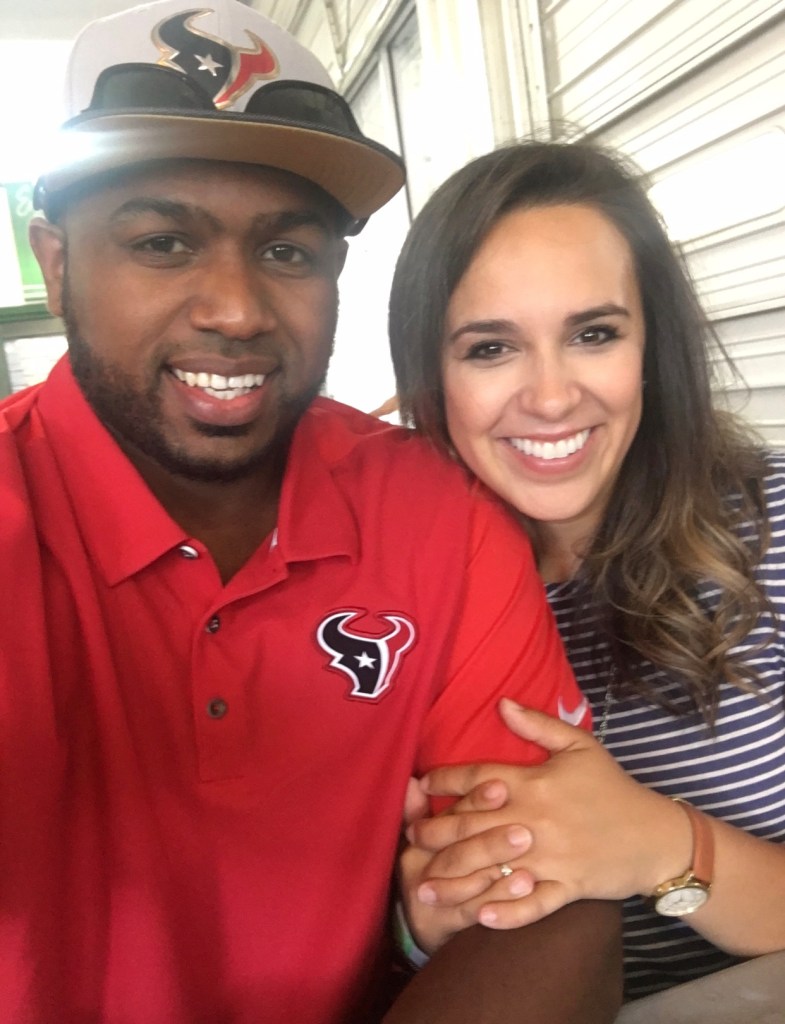
Photo taken after I told Bobby I had Crohn’s.
In that moment, Bobby made me feel comfortable and he didn’t seem phased by what I had shared. Not in a dismissive way, but in a way that made me feel like just with the distance, my disease wasn’t reason enough in his eyes to explore other options.
Advice for Navigating Online Dating with IBD
Don’t make your IBD the headline on your profile. While your IBD is a big part of who you are, it’s not your whole identity. It’s not necessary to include you have a chronic illness on your dating profile unless you feel so inclined. Personally, I wouldn’t give someone the privilege of knowing that side of you unless you feel they are worthy. At the same time, if you have an ostomy and you prefer to share photos of yourself like that on your profile—more power to you!
The cliff notes version of your health story will do. When you decide to share that you have IBD with your partner, don’t be doomsday. Don’t go on…and on…and on…about how debilitating and horrible it’s been and how miserable you are. Give a high-level elevator speech that “dumbs it down” a bit. You don’t need to downplay how hard it is but allow your partner to take some initiative and educate themselves and ask questions when they have them. How you share and present your illness to someone who may have never heard of IBD will have a lasting impact.
Don’t settle. Trust your gut. If a partner is making you feel uneasy or unhappy, don’t make excuses for them. Read between the lines on a person’s dating profile—see if you think their personality traits and interests will compliment you and your needs. Not everyone is nurturing and empathetic. If you see red flags that your partner lacks in those areas, think about whether it’s going to be a healthy relationship for you to be a part of.
No need to be shy! When we’re battling our health, often the thought of being vulnerable and open with a stranger can seem overwhelming. IBD is complicated and the stress of a new love interest can make us feel a bit out of control. But it can also be an exciting, sweet distraction from health challenges. Love gives a sense of normalcy. Just because you have IBD doesn’t make you unworthy of deserving love. Think about the type of partner you want holding your hand as you battle a flare from a hospital bed.
Love doesn’t need to stop because of the pandemic. I’m an old married woman now (ha), going on eight years since I was on eHarmony and matched with Bobby, but I wouldn’t have it any other way. There are so many sites and apps these days, I don’t even know all it entails. Gone are the days of only eHarmony, Match, and Plenty of Fish. 😊 If you’re feeling lonely and isolated like so many of us during this pandemic, and you’re single with IBD, don’t feel like you have to press pause on finding a connection or your person.
What IBD’ers Have to Say About Finding Their Match
Erica: “My husband and I met on Coffee Meets Bagel in 2017. We texted three weeks before meeting. I told him I had Crohn’s after texting a couple of weeks before we met. I had to reschedule our first date because of a health issue and didn’t want him to think it was because of him. I also felt like he should know what he was getting into.”
Michelle: “I met my husband in 2015 when Hinge came out! I was having a flare and threw up on our first date! I met him when I was going through getting diagnosed and he was so supportive through it all.”
Christine: “Disclose early on! I disclosed at about two months of dating with my fiancé and I felt like things could go further. I think it’s something the other person should be aware of. Not everyone is ready for that you need to know that you will be supported through that journey! We connected through Facebook! Sounds crazy, but here we are!”
Sarah: “Dating/meeting people is so hard nowadays and then throw in a chronic illness and it doesn’t make things easier! Personally, I prefer to be up front about my UC because if the person is going to like me or if this is going to work out, they are going to have to be on board with my UC, too! Whether I like it or not, it’s a part of who I am.”
Ryann: “I met my husband in 2017 and I told him on our second date. Our friend set us up and she had already shared that I had IBD with him. Previously, I had told other guys on our first or second date. One guy came back and apologized for being so weak and not contacting me again after that date. I didn’t reply, more because I didn’t blame him, but also because I found him to be incredibly dull! This was back in the beginning days of Tinder!”
Natasha: “I like to share early (in or around the first date) about my health so I don’t develop an attachment if they aren’t comfortable with chronic illness. Usually, it leads to a good conversation either way. Recently, I shared about my Crohn’s over text message and the guy was very inquisitive and only wanted to learn more, about me and about Crohn’s! I also have a pic of me with my ostomy in my dating app profile. It’s subtle, but if you know it’s there or know what an ostomy is, you’ll know immediately what I have.”
Payge: “My Tinder profile pictures had me with my bag and my current boyfriend googled what it was before he messaged me. He told me when he knew what it was, he instantly thought ‘I want to take care of this girl’…that’s how it went for me!”
Allison: “You don’t have to share any more than you’re comfortable with—if you want to disclose in your profile, great! If you wait until date number five, that’s okay, too! There are no hard fast rules for when or how you should share your story with someone. It’s YOUR story and every situation is different. Anyone who responds negatively or acts as if your illness will be a burden is NOT worth your time. The right person won’t care. Remember—nobody is perfect. Your vulnerability might allow the other person to share something they’re also trying to figure out the right time for. I’ve been online dating for five years now, met my current boyfriend on Hinge in September.”
Prior to receiving a chronic illness diagnosis, it’s incredibly challenging and nearly impossible to fathom ‘forever sickness’. In Tessa Miller’s book, “What Doesn’t Kill You: A Life with Chronic Illness–Lessons from a Body in Revolt”, she masterfully articulates the highs and lows of life with Inflammatory Bowel Disease (IBD). From navigating the diagnosis, flare ups, the healthcare system, relationships, and the mental health component, she’s created an invaluable resource that I wish every single person with chronic illness could be handed the moment they find out their life story has taken an unforeseen turn.
As someone who was diagnosed with Crohn’s in 2005, two months after college graduation, I wish my former self had these powerful words at my fingertips. The overwhelming nature of IBD can be nearly suffocating at times. As I read this page-turner of a book, I felt seen and understood. I found myself nodding my head, because I could relate to so much of her story and so much of her sage advice. I felt like a college student highlighting what felt like the whole page, because it was ALL so important.
Tessa and I are both journalists. We both have Crohn’s. We both randomly grew up in Illinois. I connected with her over social media after reading her New York Times article, “Five Things I Wish I had Known Before My Chronic Illness.” The article had an impact on me, so when I heard she landed a deal with a publisher, I anxiously awaited for this book to drop.
In the beginning of “What Doesn’t Kill You,” Tessa writes, “I became a professional patient, and a good one. I learned that bodies can be inexplicably resilient and curiously fragile. I would never get better, and that would change everything: the way I think about my body, my health, my relationships, my work, and my life. When things get rough, people like to say, “this too shall pass.” But what happens when “this” never goes away?”
Finding the Right Care Team
When you live with a disease like Crohn’s, it’s imperative you trust your gastroenterologist and care team and are confident in how they help you manage your illness. I always tell fellow patients to take a moment and think about who they will feel comfortable with at their bedside in a hospital room when they’re flaring or facing surgery. If it’s not your current doctor, it’s time to look elsewhere. Tessa breaks down the “qualifications” for getting a care team in place. From finding a doctor who explains why they’re doing what they’re doing and why to a doctor who looks at you as a human, not an opportunity.
“Good doctors see their loved ones in their patients; they make choices for their patients that they would make for their own family. Asking a doctor, “Why did you choose this line of medicine?” will reveal a lot about what drives them and how they view their patients.”
The Grieving Process of Chronic Illness
Receiving a chronic illness diagnosis forces us each to go through the grieving process. For many of us, we were naïve and felt invincible before our health wasn’t a given. We’re so used to feeling as though we’re in control of our destiny, that when we lose that control, we spiral, understandably. Tessa interviewed Paul Chafetz, PhD, a clinical psychologist based in Dallas. Dr. Chafetz is quoted in the book saying, “We go through life with an illusion of safety, guaranteed health, even immortality. Acquiring a chronic illness pierces that illusion, and this is a loss. Grieving this loss is an integral part of adjusting to the illness.”
Take a moment to stop and think how you coped those first few weeks and months after finding out you had a chronic illness. While acceptance takes time and comes in different stages, Tessa explains how flexibility and willingness to adapt to your new “normal” is even more important.
“Rather than searching for big, sweeping acceptance, then feeling like a failure when it doesn’t come, chronically ill folks can enact small, empowering steps, such as taking required medications, learning everything we can about how our diseases work, seeing doctors regularly and being prepared for appointments with a list of questions, advocating for our needs and wants, figuring out which foods makes us feel good, and going to therapy and/or connecting with a support group.”
In my own patient advocacy and experience living with Crohn’s I can attest to the fact that we all spend a lot of time wishing for our past and worry about what our futures will hold, rather than focusing on the right now. The majority of IBD patients are diagnosed prior to age 35. This leads most of us to experience the big milestones of adulthood (career, finding love, living on our own, family planning, etc.) with a disease in tow and wondering how that disease is going to complicate life or hold us back from accomplishing all we aspire to.
Bringing on the Biologics
Tessa calls herself an “infliximab veteran,” she spends a great deal of time talking with new patients and caretakers, mostly moms of young IBDers, about their fears. Most questions I receive through my blog and social media also revolve around biologics and the worries people have about side effects and whether the drug will fail them or be a success. I feel confident deeming myself an “adalimumab veteran”, as I’ve been giving myself Humira injections since 2008.
As patients we are faced with difficult decisions all the time and must look at the risk versus the benefit. Having health literacy and understanding your actual risk from a biologic is something that should be communicated with you from your physician. Tessa’s doctor explained to her that six in 10,000 people who take anti-TNF agents (Humira and Remicade) get lymphoma. But as patients, all we see on the internet and in the side effect notes are “lymphoma.” Force yourself to dig digger and remind yourself of your alternative—to not feel better.
The Truth Serum of Chronic Illness
One of the superpowers of chronic illness is that we get to see which family members and friends come to the forefront and which fade to the background. Not everyone is cut out to be a caregiver, but you’ll quickly see who has empathy and who genuinely cares. In my own personal experience, it’s helped me get out of relationships with guys who were no where to be seen while I lied in a hospital bed and allowed me to distance myself from friends who couldn’t find the time in their day to check in when they knew I was flaring.
Tessa says that chronic illness forced her to peel back the layers and the isolation wall she put up, too. Chronic illness has shown her that people do more than just hurt each other— “they nurture, they listen, they enrich one another’s lives.” Her IBD also empowered her to be brave enough to put an end to unhealthy relationships that weren’t benefiting her well-being, both with friends and love interests. Her Crohn’s has showed her that not every friendship is meant to support you in the same way.
This is a great piece of advice. As you live with a chronic illness, you’ll come to know which friends you can share your deep dark secrets and worries with, and which you give the high-level cliff notes version of your experience to. Your chronic illness will help you set those boundaries in a graceful way.
Her love story with her husband embodies what those of us with chronic illness deserve, a partner who sees us as more than our disease, but understands the severity and complexity at the same time.
Juggling a Career and Crohn’s
One of the biggest challenges of life with IBD is knowing how and when to disclose your health situation with your employer. You may wonder how the news will be received, if it will jeopardize your chance for promotion, if your coworkers will resent you…the list goes on and on. As someone who worked in the TV industry as a producer, news anchor and reporter for nearly a decade, and as a PR professional and corporate communications specialist, I’ve been lucky that all my bosses have been incredibly understanding of my struggles with Crohn’s, but never used them against me in any way. I’ve always waited until after I have received the job offer and then told my boss in a meeting the first week of work. This alleviated some of the stress on my shoulders and ensured my coworkers wouldn’t be blindsided when I had a flare that landed me in the hospital. By communicating openly, it also to set an expectation that I may not always feel up to par and that I may need more bathroom breaks or to work from home or come in late after doctor appointments.
Tessa so eloquently writes, “You want your boss to understand that while your disease affects your life, you’re still capable of doing your job. Deliver the necessary facts about your illness without bombarding your boss with information—keep it direct and simple. Be clear about how you manage the illness and that although you do your best to keep it under control, it can flare up. Tell your boss what you’ll do if and when that happens.”
Realizing the Power of Pain
One of my favorite analogies that Tessa shares in the book is that each of us carries an invisible bucket, some are heavier than others, and the weight of that said bucket is constantly in fluctuation. She says that as she started connecting with those in our community, she came to realize that her personal pain was no better or worse than anyone else’s. So often we weigh our struggles against those of others, and that’s not helpful to beneficial for anyone.
“Think about it: If a friend came to you in pain, would you tell them that other people have it worse and that their pain isn’t valid? If you did, you’d be a lousy friend—so why do you speak to yourself in such a way?”
Rather than thinking that ‘someone always has it worse’ ask for support when you need it. Don’t downplay your struggles out of guilt thinking you aren’t deserving of help. Give support when you can but don’t forget about the person you see looking back in the mirror, be loving, kind, and patient to them, too.
Leaving the Rest to Imagination
Some of my other favorite excerpts from the book are Tessa’s “Seven Secrets”. The secrets (both big and small) she keeps from loved ones and friends about her experience with IBD. The secrets are relatable. We don’t want to come off as a burden. We don’t want to scare those who mean something to us. We want to hold on tightly to the notion that our illness doesn’t define us, so we often don’t disclose the true reality of what encompasses our illness.
Another section I know you’ll love is “Thirty-Eight Experiences of Joy” where Tessa shares quotes from 38 different people with chronic illness and how they’ve discovered joy despite their illness. I’m honored to be featured in that section of the book.
She understands the power of community and how finding your tribe within your disease space and outside of it is an important aspect of disease management and life fulfillment.
“Connecting with other chronically ill people teaches you how to carry each other’s weight—when to lift when you have strength, and when to share the burden when you have no energy left,” writes Tessa. “I’ve found the chronic illness and disability community to be one of endless empathy and generosity.”
The Gratitude That Comes with Chronic Illness
I’ll leave you with one of my favorite quotes from the book and a perspective that I wholeheartedly share:
“At the beginning of my illness, I was so inwardly focused on what I’d lost that I couldn’t see the gifts illness had given me. Mom, a determined optimist, taught me to always look for the silver lining. Mine is this: Yeah, my body won’t allow for any bullshit—no jobs I hate, no relationships I’m not fulfilled by, no hours crying over wrinkles. Illness made me braver, kinder, and more empathetic, and that gives me way more radical power than the faux control I was clutching to for so long. In the most unexpected way, illness freed me. It compelled me to begin therapy, which kick-started the process of tending my wounds old and new. It made me focus on the present more than the anxiety of the future. And it made me be in my body in a way I never experienced before. Suddenly, I had to mindfully care for my body and brain as best I could and understand that beyond that, it’s out of my hands.”
Stay tuned to my Instagram (@natalieannhayden) for a special book giveaway kicking off today (February 8)! Five lucky followers in the United States will receive a FREE hardcover copy of Tessa’s book.
When you live with chronic illness, you experience a wide range of emotions and personal experiences that shape you. Life can feel like an uncertain rollercoaster ride, you never know when the next twist or turn is going to happen. This week on Lights, Camera, Crohn’s, 21-year-old Parsa Iranmahboub, candidly shares the mental health burden that IBD brings upon a patient. Diagnosed with Crohn’s when he was only eight years old, Parsa shares the perspective of what it’s like to be a pediatric patient who has grown into adulthood. He’s currently a student at UCLA and the Education Chair for the Crohn’s and Colitis Foundation’s National Council of College Students.
Parsa explains the psychosocial component of life with Crohn’s disease and ulcerative colitis by breaking it down to anxiety, embarrassment, guilt, and loneliness. He recently spoke about this at the Crohn’s and Colitis Congress as well as on IBD Patient Insider and his powerful words resonated with me and I know they will with you, too. Here’s Parsa’s breakdown of the IBD patient experience:
Anxiety: Being a bathroom disease, there is often the anxiety of whether a patient has easy accessibility to a restroom when they are out. But there can also be anxiety related to a patient’s diet. When I was younger, I was placed on a low sodium diet due to one of my medications. If I wanted to eat out with family or friends, there would be this anxiety of whether I could even eat anything from the restaurant. There’s also the anxiety that stems from extra-intestinal manifestations. I have a history of developing fistulas. And during my sophomore year of college, my labs were not looking too good, I was flaring a little bit, and I began to worry if this meant I would develop another fistula. I began to wonder how I would deal with a fistula as a college student. How would another flare up affect my grades and my ability to get my work done? I lived in a communal style dorm, so how would a sitz bath even work? Essentially, with anxiety there can be this fear of the disease taking over my life and how can I constantly accommodate it.
Embarrassment: Embarrassment can arise in numerous forms. For one, there’s the poo taboo. But there can also be embarrassment from when you are flaring. From when you are losing weight, when you no longer look healthy, when you now look “sick.” There are the side effects from medications. From when you begin to gain weight, develop acne, and now have that dreaded moon face. Let’s not forget the impact of extra-intestinal manifestations. In 6th grade, I had surgery for a perianal fistula. After the surgery, I had to wear tighty whities with a maxi pad to help absorb the pus. It would be an understatement to describe how much I began to despise physical education. Not because I had to exercise and run around. No, I was always too active of a kid to hate PE. But because we had to change into our uniforms during the beginning of class. And I was embarrassed to be in the locker room. I was embarrassed that everyone else would look cool with their boxers, but here I was with my tighty whities and a maxi pad. And it might sound ridiculous, almost like a scene taken from the “Diary of the Wimpy Kid”, but to my sixth-grade self, looking cool and being like everyone else mattered.
Guilt: There is often the guilt of feeling like a burden for others. That others have to not only be flexible with you but that they need to make accommodations because of you. “Oh, you all want to go hiking, well I can’t because there’s no accessible bathroom.” “Oh, you all want to eat at this place, actually can we go somewhere else where I can better tolerate the food?” There can even be instances where you feel guilt for believing that you no longer are a good friend. That since you have to refuse to hang out with friends because of fatigue or pain, your friends probably think you simply don’t enjoy hanging out with them. But there can also be guilt from a non-compliant label. When I was younger, I would receive weekly injections. Soon, I began to throw up after every injection. My doctor switched me to the pill version, but it would still make me feel incredibly nauseous. So much so, that I would refuse to touch the pills. Instead, I would take the pill container, open the lid, slowly pour the pills into the lid, pour too many, attempt to pour the extra pills from the lid back to the container, and once again pour too many pills back. It was a whole process. But I simply refused to touch the pills.
Well, it shouldn’t be a surprise that eventually I became non-compliant. Consequently, I switched medications and soon developed acute pancreatitis. At the onset of my symptoms, I was out of the house and had to call my dad to pick me up because I was continuing to throw up blood. And in the car, I told him “Dad, I think I’m going to die.” Thankfully, it was an over exaggeration. But at that moment, it wasn’t.
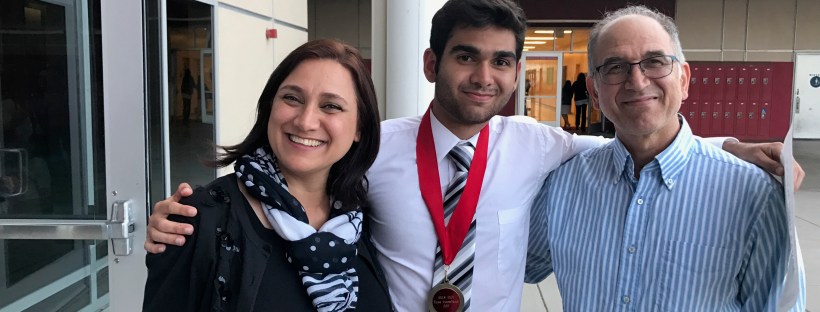
Parsa with his parents.
Now that I reflect on the moment, not only do I feel guilty for putting myself through that situation, but for also putting my family through that. I can’t imagine being a father and hearing your son tell you those words. And all of this happened because I couldn’t get myself to take those stupid pills. So, not only was I labeled as a non-compliant patient, a patient who was too immature to take his medications, but I was now also a patient who had “hurt” his family.
Loneliness: IBD is an invisible disease. You might look at a person and not realize they are living with a chronic illness. The invisibility is both the disease’s blessing and curse. There have been so many instances where I’ve been happy to have the ability to put on a mask and pretend that everything is okay. That my friends and peers do not have to associate me with a “disease,” a connotation that I despise so much that I often introduce my chronic illness as Crohn’s and not Crohn’s disease. However, because of the invisibility, the disease can feel extremely isolating. You might not know anyone else who can relate to your experiences/feelings. In fact, despite being diagnosed at a young age, for almost a decade I refused to share my story with friends and those close to me. It wasn’t until I met an IBD patient for the first time who was my age that I began to realize the importance of a shared community.
Dr. Tiffany Taft , PsyD, MIS, a Research Assistant Professor at Northwestern University Feinberg School of Medicine, spoke alongside Parsa during that Crohn’s and Colitis panel about Mental Health as it relates to IBD. As a Crohn’s patient of 19 years herself, she offers a unique perspective for her patients. I asked her when an IBD patient expresses these feelings of anxiety, embarrassment, guilt, and loneliness how she helps people deal with the struggles.
“The first thing I do is simply listen and reflect to the person my understanding without advice or judgement. It’s important to let someone tell their story before interjecting with any sort of interpretation or the like. Then, I start with some education about how our thoughts affect how we feel and how we behave. And that these thoughts are often on autopilot or may feel like they’re on an infinite loop and impossible to turn off,” explained Dr. Taft. “My goal is to help the patient understand their thinking and learn to slow it down and take a step back from their thoughts to be able to evaluate them, and maybe either change them or not let them have as much power.”
She went on to say that from there her and her patients tie their thoughts into other symptoms like anxiety, shame, or guilt, to see patterns and opportunities for change.
“It’s not an easy process, but most people can succeed. Loneliness has been harder during the pandemic. Social distancing has created a lot of isolation without an easy solution. I encourage staying connected via video chat, texting, and social media (so long as it’s not stressful!) People say that online interactions aren’t as fulfilling, and that’s probably true. But if I shift my thoughts from this negative lens to a more positive perspective, then it can help offset some of that loneliness until we can all be together again.”
The Decision to Open Up
It takes time and patience for many of us to come to terms with our diagnosis and decide how we want to present our experience to the world. For both Parsa and me, it took us a decade to take off our proverbial masks and share our reality with those around us. Parsa says he decided to share his patient journey at the end of freshman year of college after he joined a research lab at the UCLA Center for Inflammatory Bowel Diseases. He met someone for the first time who was his age and had IBD.
“When I was talking with her, this sort of light bulb just sparked. I realized I could connect with this person in a way I couldn’t have connected with anyone else before. She truly understood the challenges I was facing or had faced. Not from a scientific or “oh, I see” perspective, but from a “oh, I know cause you’re not alone” perspective. This connection was essentially my first exposure to the IBD community, and slowly, I began to become more involved in the community.”
The Power of Connecting with the IBD Community
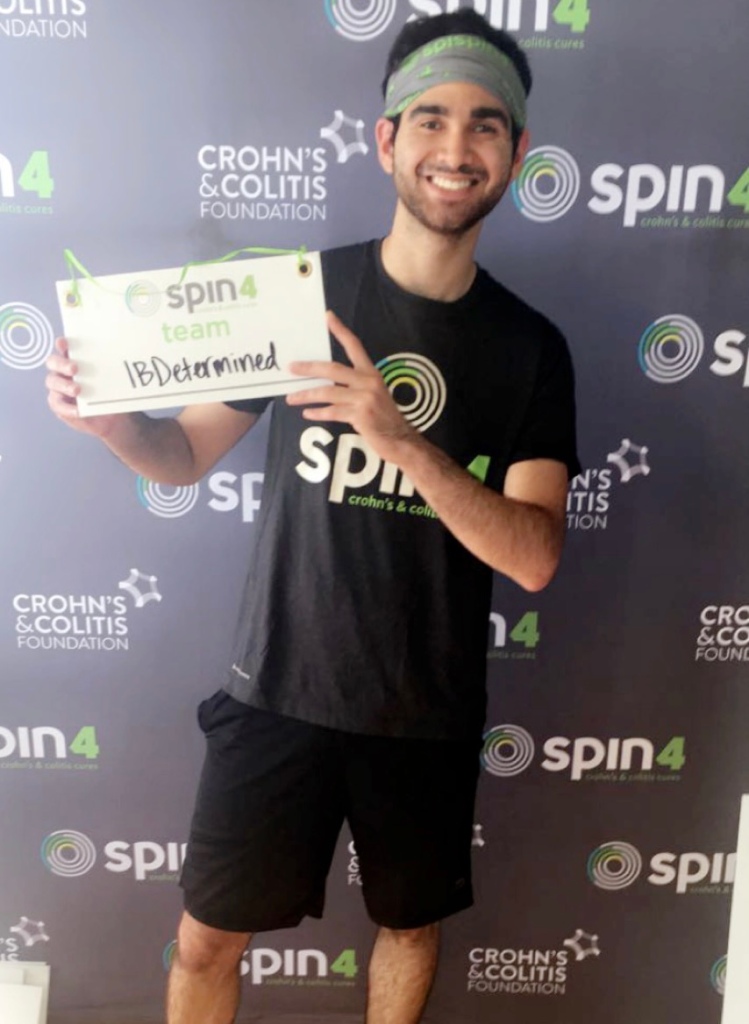
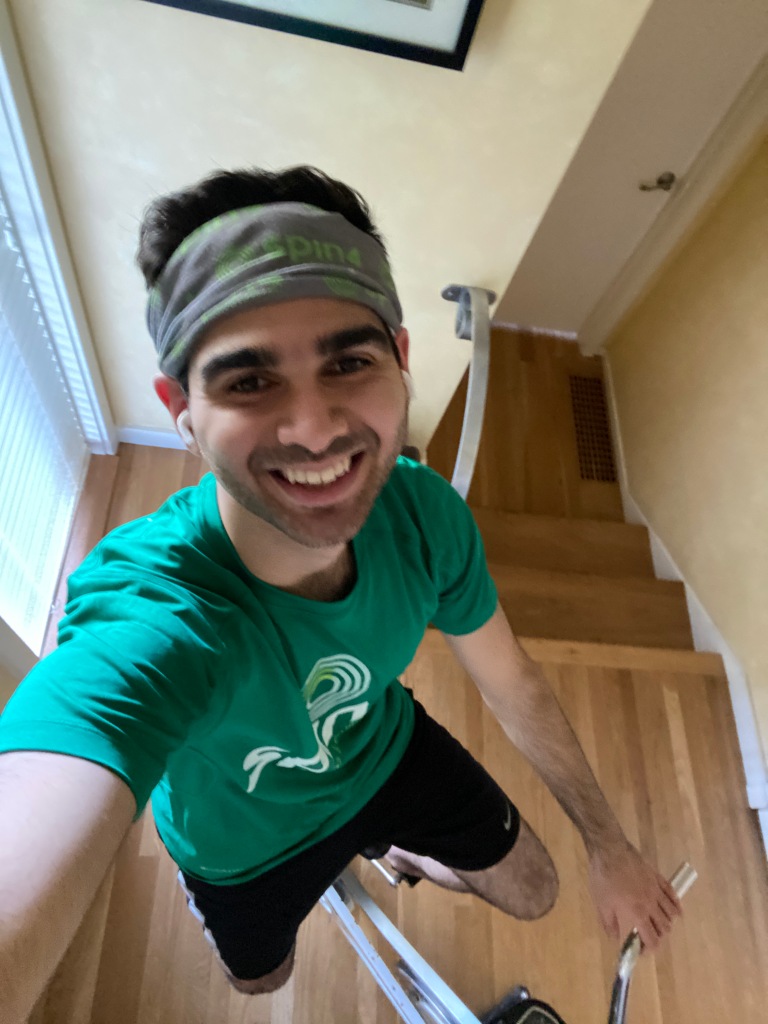
Parsa went from forming his first spin4 team to joining the National Council of College Leaders to becoming more involved with his local chapter in California. He then started a local support network for college students on the UCLA campus. His advice for patients and caregivers—find a support network within the IBD community.
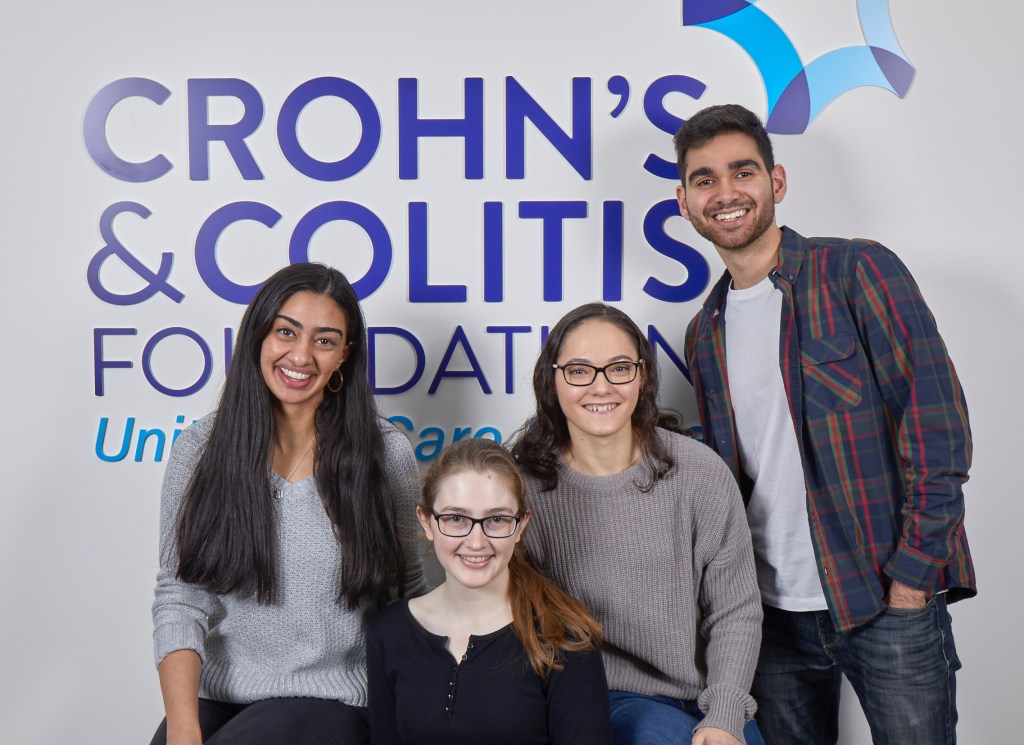
Foundation of National Council of College Leaders (NCCL)—this group of college students from across the United States volunteers with the Foundation to provide a distinct voice for young adults with IBD. Members also connect on how IBD affects them as students, athletes, and partners in a relationship, the intersectionality that stems from a patient’s identity, and tips for having an ostomy bag, reducing stress through coping mechanisms, and applying for accommodations at school.
Parsa also co-founded IBDetermined at UCLA, a student organization geared towards providing a support network and advocacy-centered space for UCLA students with IBD.
“Even though there are some amazing national and local support groups, we noticed that there was a gap for local resources that focused specifically on the intersection between being a college student and an IBD patient. Hence, we wanted to create that more local space, where individuals could address their specific questions/concerns/thoughts relating to being an IBD college student at UCLA. It’s a space where our members can learn about accommodations that are available through our university’s Center for Accessible Education, can exchange tips and advice for navigating schoolwork and college life with IBD, can express their frustrations about the disease or the lack of university resources, and can share where the best and cleanest bathrooms are located on campus.”
Parsa says growing up with Crohn’s made him responsible at a young age. He learned about resilience. He learned to embrace the obstacles he has hurdled and to keep on pushing through even when he couldn’t immediately see the light at the end of the tunnel. Parsa says he learned to appreciate the time he felt healthy enough to live life not controlled by a chronic illness. Through the years he’s realized you can still be fortunate through a misfortune. This belief has given him a strong appreciation to make the most of the opportunities that come his way and refuse to take the easy way out.
He’s not your typical IBD advocate. He doesn’t have Crohn’s or ulcerative colitis himself, but he’s extremely passionate about supporting the patient community, spreading awareness, and making a difference. John Peters’ wife, Katherine, was diagnosed with Crohn’s when she was 12. John met her when she was 21. They dated 4 years and just got married in April. As they dated and got to know one another, he had a front row seat to the challenges IBD brings about in a person’s life. Ironically, John’s brother, Bobby, was diagnosed with ulcerative colitis this past year.
John and his brother, Bobby
Connecting with the Crohn’s & Colitis Foundation
When John met Katherine, he remembers how she was a volunteer at Camp Oasis.
“I remember her coming back from camp and telling me what a rewarding and inspirational experience it was. I signed up the next year because I wanted to learn more about Katherine’s illness, while contributing to a good cause. As I reflect on my experience at Camp Oasis now, I feel like it enabled me to develop a deeper appreciation for the courage those with IBD bestow.”
John sees volunteering as a win-win, not only does it give him an inside look at IBD, but also allows him and his wife to spend quality time together. Out of all the volunteering he’s participated in, Camp Oasis takes the cake.
“The campers love sharing stores about IBD, and every camper feels connected to everyone around them. They don’t need to feel embarrassed because everyone at Camp understands first-hand (or through loved ones) the challenges that having IBD brings. It’s a pretty amazing atmosphere to be a part of and the experience has given me a different level of empathy for those who live with Crohn’s and ulcerative colitis.”
From Camp Oasis to Day on the Hill
Day on the Hill is the Crohn’s & Colitis Foundation’s annual two-day event, where volunteers from across the nation meet in Washington, DC to talk with their legislators about policies that directly impact the IBD community.
Because of COVID-19, last year, the Foundation took Day on the Hill virtual, hosting virtual advocacy trainings and organizing conference calls with Members of Congress, their staff, and Foundation volunteers. Plans for 2021 have not been announced yet.
“Day on the Hill has been my most educational experience with Crohn’s and Colitis Foundation so far. I was unaware of what legislative action could do or how much it can affect an IBD patient. My mission is to inform as many people as possible about what legislation can help IBD patients and how to advocate for it. The more people who advocate, the greater the chance for change,” says John.
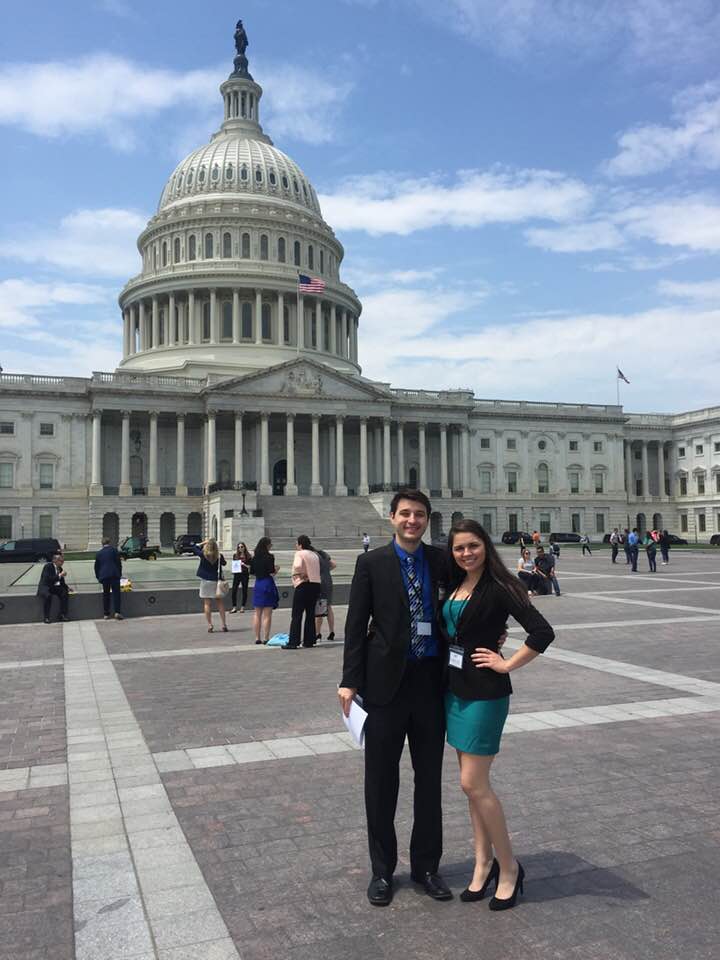
John with his wife, Katherine, at the Capitol for Day on the Hill
There are two main bills volunteers have been focusing on:
Safe Step Act—This bill would reform the practice of step therapy, which requires patients to try “insurer-preferred” medications before a more ideal medication recommended by the physician. The hope is to create a more transparent and expeditious appeals process.
Medical Nutrition Equity Act—Insurance companies and other healthcare programs would be required to cover necessary foods prescribed by the physician.
John says Day on the Hill is truly a one-of-a-kind experience. He recommends anyone who may be interested to take the leap and apply to participate.
“Our day was mostly speaking with Congress members’ staff and explaining what we are petitioning for (see the bills above). I was on a team of five volunteers and each one had a chance to share how the proposed legislation affects their daily lives. It was incredible to see how just one bill in Congress can have resonating effects on so many people.”
John’s advice—to contact your local congressional representatives and discuss these bills. Click here to find out who your local representatives are. Every single person who advocates for these bills gets us one step closer to getting them passed in Congress.
Taking Public Policy Advocacy a step further
As John juggles being a full-time medical student, a newlywed, and navigating the pandemic, he’s decided to create Facebook and Instagram groups solely dedicated to educating our community about IBD legislation.
He recently launched the following social media pages:
Facebook: Crohn’s and Colitis Legislative Advocacy
Instagram: @ccla_ig
Give the pages a follow and stay up to date on all the latest IBD political news. It’s important to note John created these social media pages on his own and they are not affiliated with the Crohn’s & Colitis Foundation.
Advocacy doesn’t happen only during Day on the Hill, it’s important to join the Foundation’s Advocacy Network to receive alerts around times of action. You can do so by visiting here.




















 lights camera crohn's