
This week–a guest post from an IBD advocate who continually inspires me. Meet Sonya Goins.  She is a news reporter for a community television station in the Minneapolis/St.Paul area. Sonya is also a Crohn’s patient, diagnosed with the digestive disease in 1985 while she was in college. I’ll let her take it from here:
While fighting the physical pain of Crohn’s is tough, the mental aspect is even harder.
On January 3rd, 2018 my doctor put me on TPN (Total Parenteral Nutrition), which means I was fed through my veins. All of the nutrients I needed to survive were in an IV bag and pumped through my veins throughout the day. My doctor wanted to give my colon a rest so ulcers could heal. I endured this treatment for eight and half months. It was one of the most trying times of my life. No food, just water, broth and on occasion, coffee.
Despite my circumstances, I named my IV catheter “hopeful.”  However, it took me a minute to adapt a positive inner attitude. You see, in public I put on a good, cheerful attitude. There were times when I wanted to crawl up into a big ball and shut out the world. The first few weeks of constantly wearing a backpack full of IV fluids were very hard. I did not like what I saw in the mirror. I was angry at my situation. It wasn’t until I visited a pediatric Crohn’s and Colitis Foundation support group that I changed my way of thinking. Seeing young people living with the digestive diseases, and going about their lives despite their circumstances, motivated me to do better.
I had to live my new normal to the best of my ability.
The mental game of TPN
Mentally, not eating real food was very, very challenging. Although I could not eat, I still cooked for my youngest child. The smells of the food made my mouth water, tempting me to taste what I know would make me sick. There were a few times I lived on the edge and took a sample. I paid for my mistakes—painful cramps and bloody diarrhea were my punishment.
After the first month on TPN, I knew I needed professional help if I were to survive. So, I sought the help of a therapist. I also prayed and meditated—a lot. 
First, I needed a distraction for when I was tempted to eat. A friend taught me how to crochet. She even purchased the yarn, hooks and beginner books to get me going. I still cannot do a granny square, but I learned a new skill.
When times were bad and I wanted to give up, I would mentally go to my happy place—Turks and Caicos. Several years ago, I visited the Caribbean Islands. I imagined myself sitting on the pristine beaches, watching the waves crash.
The social impact
The loss of social invitations also did a number on me. Some of my friends did not want to hurt my feelings by eating in front of me, so they stopped including me. However, I did have one friend who went out of her way and found a restaurant that served the best broth in town. We sipped on broth and caught up with each other’s lives. This was one of the highlights.
I was determined not to let this situation get the best of me. Instead of going out to eat with friends, I invited friends to go for a walk. I walked with former coworkers, acquaintances and family members. The fresh air and good conversations did me a lot of good.
Taking steps to heal mentally and physically
Walking became my foundation. I was motivated to walk for another reason. Before I got sick, I signed up for several half marathons to raise money for the Crohn’s and Colitis Foundation. I finished the New Orleans half marathon in March, just three months into my treatment. I have never been so proud. I had to walk the race, but I finished. Several months later, I also completed the Twin Cities 10 mile race, and the Savannah half marathon.


My unexpected journey made me stronger mentally and physically. I am more outgoing and more self-assured than ever before. After all, you cannot be shy walking around with an IV bag strapped to your body.
I share my story to give others hope.
Sonya Goins is also a Crohn’s and Colitis Foundation Board Member/MN Dakota Chapter. You can find her blog at SonyaStrong.com. She also has a podcast on iTunes and GooglePlay entitled “Conversations about Crohn’s and Colitis.”


 Anthony has seen me fight for so long. It makes me feel like I’m not going through this alone,” said Alexandra.


 Try having a flare during the worst natural disaster in the history of your country. It happened to me. I survived.
 One morning I decided to stop in my GI’s office. He had lost the A/C unit and the office was flooded during the storm. He ordered some labs, an emergency colonoscopy and a few days of rest. I was anxious, exhausted, scared. After the colonoscopy, I was prescribed prednisone for a month and then started Humira.
 I hope my experience sheds light on what it’s like for those in the chronic illness community as they endure the repercussions of natural disasters. It’s a critical conversation that needs to happen—preparedness for the IBD community in the face of weather disasters. How can employers, government and society step up to the plate?
 Sickness and health truly take on a whole different meaning when you live with a chronic illness. Katy witnessed her husband Vince’s compassion and character while they were dating.
 “Operation: Good Health.” She made it a priority to get a minimum of eight hours of sleep a night, as lack of rest tends to be a trigger for her. She was on a mission to hydrate, hydrate and hydrate some more. To set herself up for success and limit any surprise flares, she planned out her meals the entire wedding weekend. For example, she does well with bland foods, like noodles, rice, chicken and (big one) avoiding alcohol. And finally, she delegated responsibilities (aka stress) to friends and family. Katy admits she’s pretty Type A and would much rather do things herself than hand them off. However, she wanted to enjoy her wedding and because of her proactive planning, she was able to do just that!
 Reagan, Grayson and Carter may not understand why their mommy is in bed or why she needs to pull over on the side of the road when she gets sick, but Katy’s Crohn’s has taught her children a great deal of empathy at a young age. A few weeks ago, she was in debilitating pain and her nine-year-old offered to make dinner for her brothers. She poured them each a bowl of cereal and that was everything.

 Currently, many patients and caregivers struggle to inject medications correctly, which means patients don’t always receive their full dose of medication. This can lead to symptoms worsening and a greater threat of a flare up.
 There’s also an online study—available to anyone in the United States—going on right now for those living with an immune system or digestive system condition. You can earn $15 for a 15-minute, online survey.
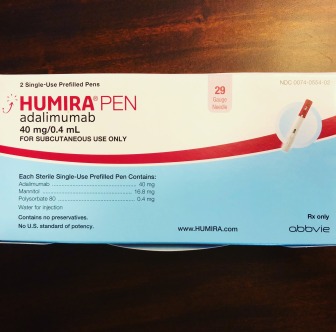 It changed in a way that I never knew was possible. I have so many flashbacks of my journey with Humira. The tears as I felt sickly in my 20s sitting alone in my apartment and wondering why me. The dread, anxiety and anticipation every other Monday and the strength I had to muster up within myself to once again receive my medication. Holding the injection in my hand, getting in the zone and focusing my thoughts on brave family members and friends as I held down the plum colored button and felt the burn. The sad look on my son’s face as he looked in my eyes and witnessed his mama hurting.
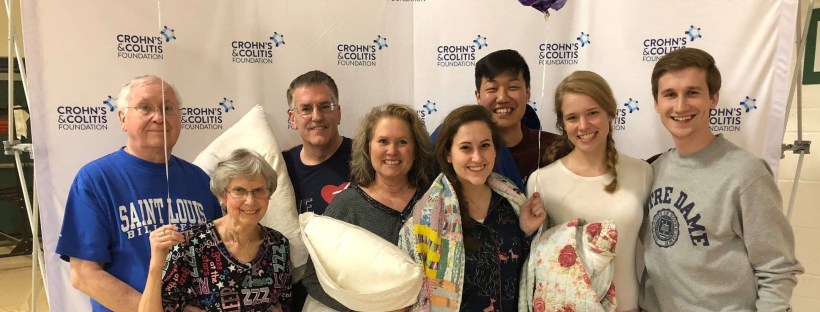
 Linde graduated from my high school and later moved to St. Louis. She currently resides in Atlanta, where she works for the CDC and does Policy work for the division of lab sciences.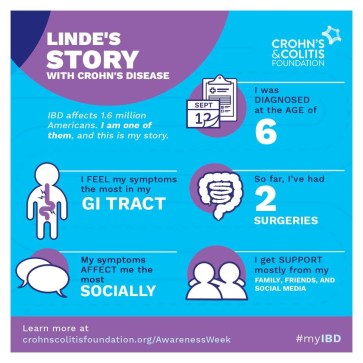
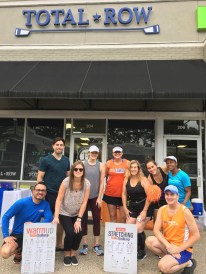 I’m training for a half marathon and taking on the biggest fitness and
 When I was diagnosed with Crohn’s disease at age 21, a month before my 22nd birthday—life had so many unknowns. I bottled up a lot of fears about how my life story would unfold and if I would be able to accomplish the hopes and dreams I had thought were a given.
 It’s a path that will bring you heartache. Significant others will let you down—you’ll be disheartened when they fail to show up when you need them most…but, then it will happen. You will meet the person who was meant to fight this fight beside you. You’ll know. You’ll see how that person loves you unconditionally and even more so, because of your illness. They will see you as so much more—see yourself the way they see you. Not some sick person. A person who has a sickness that is part of them, but far from all of them.
 Don’t allow this illness to make you think you aren’t capable—because you are. You will surprise yourself, if you continue to be positive and find alternative ways to make your dreams become your reality. I know you’re sitting there with your huge spreadsheet of 200 U.S. cities, wondering which TV station you’ll be able to work at…and if your journalism career will ever happen. Looking back—I’m so proud of you for continuing that job search amidst your very first flare. Looking for jobs across the country, as you swallowed 22 pills a day, grappled with a chronic illness diagnosis and dealt with all the side effects and pain that is Crohn’s. Work ethic and attitude will take you far with this disease.
  You will shine under those bright studio lights.
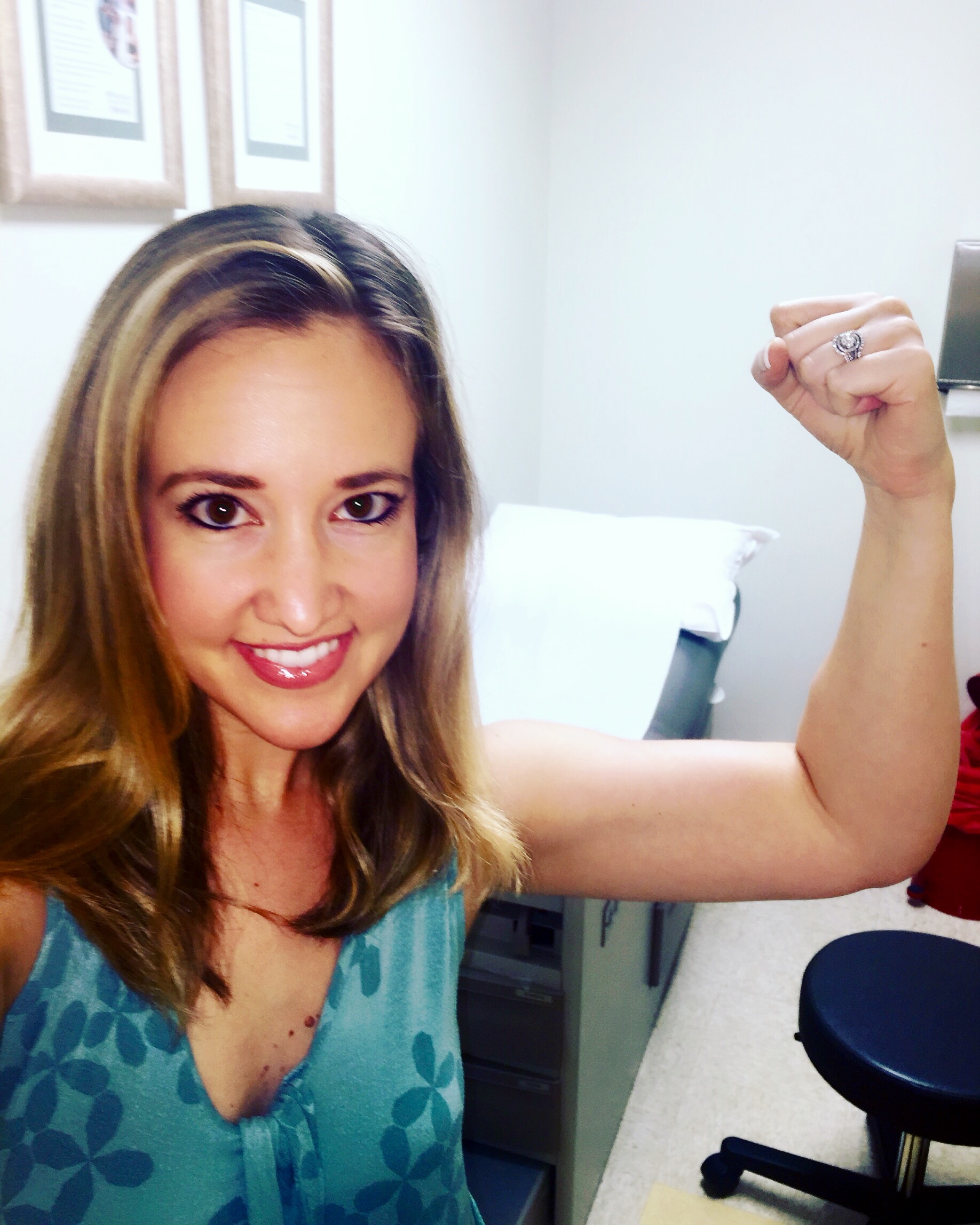 That first CT scan, that first colonoscopy, that first surgery, that first injection…it’s a lot to deal with. You’ll shake like a leaf and then as time goes on—you won’t bat an eye. You will find a strength within yourself that you never knew was there. You’ll be a seasoned warrior in no time.
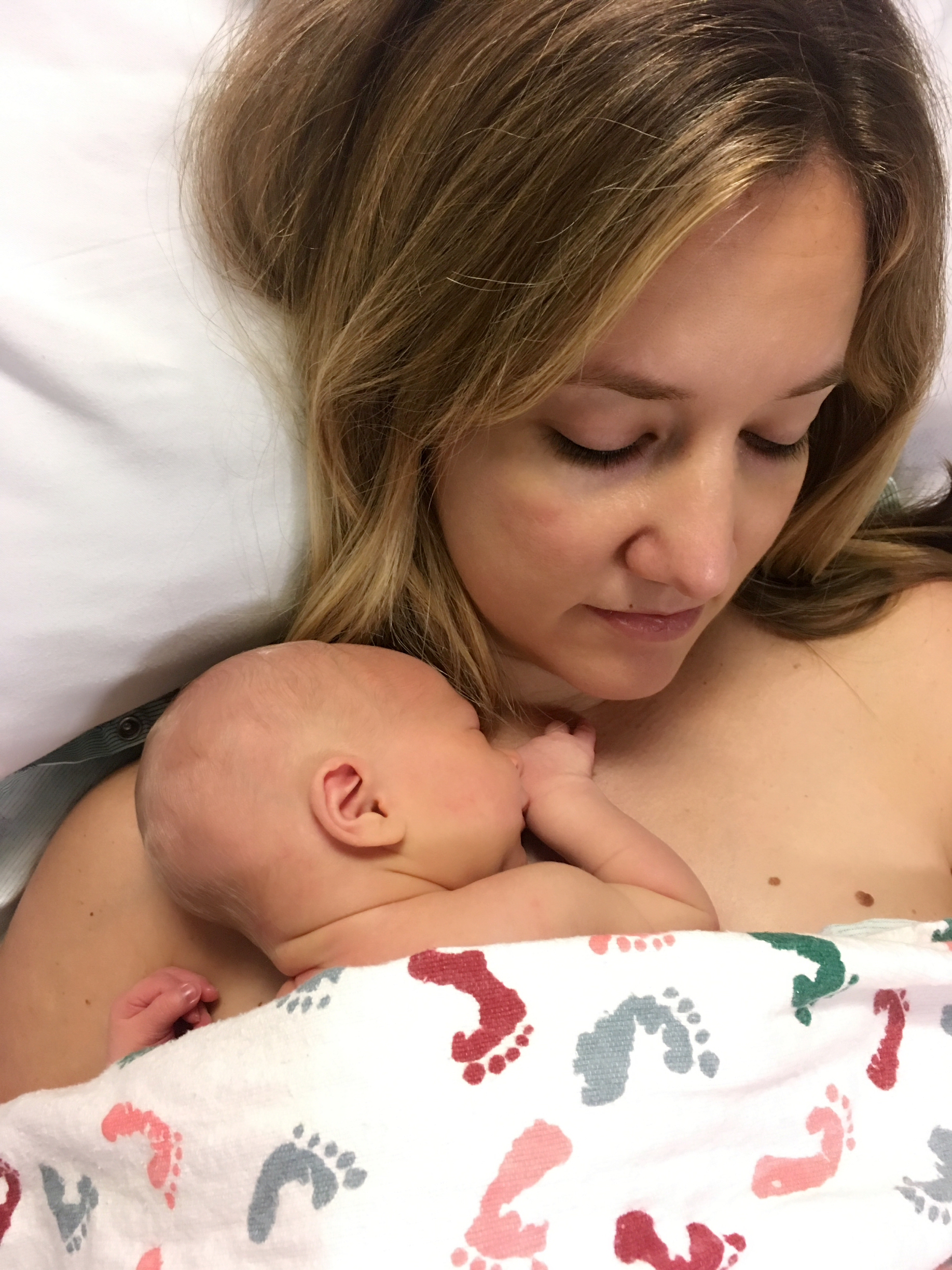 You’ll do all these things. All with your sidekick—your enemy, but also your ally, Crohn’s. The one thing that really sets you apart. In the future you won’t keep your disease a secret, rather it will come up in conversations almost immediately, with a sense of confidence. A badge of honor. Yes, I have Crohn’s. Yes, it’s not ideal. But, yes…it’s made me sort of a bad ass. I’ve been through a lot. I haven’t backed down. And there’s so much life left to live.

 There aren’t a whole lot of “safe spaces” for those of us to feel understood and connected with.
 As someone who’s battled Crohn’s disease for over 13 years, I constantly find myself needing to take a step back and remember that the only person who’s lived my journey is me. It’s up for me to tell my story. It’s up for me to share it. It’s up to me to communicate to those when my feelings are hurt or I’m disappointed. But before I jump to conclusions, I need to assume the other person is trying to help me or learn more about my experience—rather than ruin my day or hurt my feelings. API all day, baby. Try it. Trust it. Live it.
 lights camera crohn's