Roadmap to a Cure for Crohn’s Driven to Change IBD Landscape as We Know It

They call themselves “Propellers.” They’re a team of volunteers, made up of IBD patients and caregivers who created a non-profit called Propel a Cure for Crohn’s in 2016. They are laser focused on preventing and curing Crohn’s disease and, on the heels of their first research project funded at Stanford University in the world-renowned lab of Professor Mark Davis, they’re now determined to make a meaningful difference through their Roadmap to a Cure for Crohn’s effort. During this month (September 2022), they’re aiming to raise $50,000 to help get their latest project off the ground and to provide a solid foundation to bring their global team together.

This is a grassroots effort fueled by patient and parent volunteers. Patients and caregivers have an opportunity right now to directly influence a brighter future without Crohn’s! This is a peer-to-peer fundraiser—it’s not just about the monetary donations, but also sharing the message with others far and wide. Not only are international researchers involved, there are people all over the globe participating. In addition to the English-language campaign, there are also Swedish and Portuguese online campaigns running as well.

The Patient/Caregiver Perspective

Ildiko Mehes recalls what it was like when her 9-year-old daughter received her lifechanging Crohn’s disease diagnosis in 2017.

“As a parent, a serious diagnosis like Crohn’s is a huge shock, and it’s absolutely devastating and heartbreaking. Even during periods of remission, we are always on high alert and waiting for the other shoe to drop. At diagnosis, my whole world stopped, literally and figuratively. As irrational as it sounds, as a parent, you wish the rest of the world stopped with you to help you address the crisis. You wish that all of modern medicine rolled up their sleeves and urgently worked together to precisely diagnose the problem and bring her back to long-term health.”

As a caregiver, Ildiko has a unique sense of urgency and determination. She feels we need and can do better for IBD patients.

“When an otherwise healthy child, with no prior medical history, suddenly presents with IBD symptoms during a routine winter virus, you ask yourself “what caused this switch to be flipped?” Not having any answers to the underlying mechanism of disease onset or perpetuation, having a trial-and-error approach to disease management, and being forced to consider serious immunosuppressive medications with modest clinical trial benefits feels unacceptable as a parent. This is what drives me.”

As a pharmaceutical executive with more than 20 years of experience, Ildiko uses that unique skill set to go after complex and difficult goals with Propel a Cure and feels a deep sense of obligation to help our community.

“While there is excellent research ongoing in IBD, it happens in silos. It lacks global coordination and a plan. We don’t yet understand many basic things about Crohn’s. We are all just hoping for a “eureka moment” that hasn’t come over the last 100 years. We are continuously enticed with headlines of a “promising” new pathway or new drug candidate, usually in mice. And then that great idea sits there, with no progress made, a decade or more later. I know we can do better,” she said.

Natalie Muccioli Emery was diagnosed with Crohn’s disease in 2011 and she’s also a Propel a Cure Board member. She started dealing with abdominal issues 26 years ago. Being a veteran patient has provided her with perspective about how far treating and managing IBD has come and how far we still have to go.

“Propel a Cure was the first organization whose mission resonated with me. I appreciate their mission to cure Crohn’s Disease, but I even more appreciate the fact that they have laid out a plan as to what the areas of knowns and remaining unknowns are in their Roadmap to a Cure for Crohn’s project. Complex issues like Crohn’s Disease will take a collaborative and systematic approach to address, and this cause has captured that,” said Natalie.

Not only is Natalie an IBD mom, she’s also an IBD aunt!

“I believe that as an adult with IBD, the way I embody the role of a “Crohn’s Warrior” is not for myself it is for the next generation. I have “been there and done all that” with Crohn’s. But just because I did it with Crohn’s doesn’t mean the next generation should have to. I grow increasingly concerned when I see the rising rates of IBDs like Crohn’s in younger people. I believe the rising rates of Crohn’s should create a sense of urgency and a desire for a better future.”

Putting the puzzle pieces together

The Roadmap to a Cure is an ambitious project but one that is needed to drive real progress toward cures and prevention of IBDs, not just talk about “cures” in some very distant future. Ildiko says the brilliant clinicians and scientists she has gotten to know all tell her that getting to a cure will take a grassroots effort, global collaboration, and involvement of patients and caregivers.

“We at Propel a Cure are deeply committed to doing exactly that. The first step in our project is to systematize what we already know about Crohn’s today. We know a great deal, thanks to research. But when we are talking about complex fields like genetics, epigenetics, immunology, microbiology, epidemiology, multi-omics platforms and artificial intelligence, etc. there is no way any one person or group can know everything. We need a large global group of dedicated and brilliant experts to put all the puzzle pieces we already have on one table so we can begin to then put the pieces together,” she explained.

Grabbing the attention of medical professionals and researchers

Propel a Cure grabbed the attention of Dr. Bram Verstockt, MD, PhD, Department of Gastroenterology and Hepatology, University Hospitals Leuven, on social media.

“I truly like the concept of joined forces across various stakeholders, including patients and caregivers. As clinicians and scientists, we can have ideas about how to move forward based on experiences and interactions with patients on a daily basis. However, the next step really is to involve patients actively in many of these projects, as is currently the case with Propel a Cure,” said Dr. Verstockt.

The “Roadmap to a Cure” aims to bring together expertise across many different fields and niches in IBD.

“Over the past decades, a lot of scientific evidence has been generated in multiple domains of Crohn’s disease, so now it’s time to bring all that evidence together and truly connect the dots. Only by doing so, one might unravel knowns and unknowns and highlight where the remaining key gaps are, and we can define the priorities and strategies of how to fill these gaps to significantly advance the field, to improve the lives of patients with Crohn’s disease,” said Dr. Verstockt.

Where the roadmap can take us

After the initial step of putting together the state of the art, the next step is identifying gaps in our knowledge: what puzzle pieces do we still need? The third step is to develop the plan, or the Research Roadmap, to get from what we know today to developing cures and prevention strategies.

“We truly believe in a future where we can prevent and cure Crohn’s and eliminate so much patient and family suffering,” said Ildiko.
The reason this requires a grassroots effort and all of us patients and caregivers to fund it, is that otherwise the current system largely doesn’t provide incentives for new ideas or cures or global collaborative efforts of this magnitude. A recent paper discusses how the same ideas have been funded for decades, with limited progress and that we urgently need new directions.

Ildiko believes the current research incentive model is broken. “If we want true progress and cures for Crohn’s and other IBDs, we need a new collaborative model among IBD foundations/nonprofits, patients, caregivers, researchers, clinicians, and others. I believe this can become a model for other chronic and immune-mediated diseases.”

Click here to watch a video where Ildiko explains the Roadmap to a Cure project further.

Hopes for the future

I would really like to see more key opinion leaders be brave about acknowledging the risks and limitations of current therapies, avoid putting lipstick on a pig when discussing some newer drug candidates in trials with lackluster results and the same mechanisms, dispense with biased headlines like “safe and effective” when the data is much more nuanced or unclear, and openness to “outside-the-box” ideas, like microbiome manipulation, including via diet, infectious triggers like Epstein-Barr virus in Multiple Sclerosis, vagus nerve stimulation, Fecal Microbiota Transplant (FMT), hyperbaric oxygen, etc. and also adopt routine monitoring via intestinal ultrasound for many patients,” said Ildiko.

As of now (September 12, 2022)—more than $26,609 has been raised!

“I have been overwhelmed by the response so far, as has the entire Propel team. People are really connecting with our mission. We are getting donations from so many states and countries! We have received more messages of profound thanks and hope than I can recount. This fuels us so much,” said Ildiko.
Natalie feels a wide range of emotions each time she sees a donation come in or the campaign shared across social media.

“I go from feeling hopeful, to introspective, to sad. I truly wish we did not have to do this campaign and that in 2022 we knew what the underlying cause(s) of Crohn’s are, and that safe, effective, reliable treatments were available for all Crohn’s patients. But here we are. Crohn’s is still very much part of the lives of patients and caregivers, and we need to take action to change that. I am so grateful for the outpouring of support we have received so far, but there is more work to be done!”

Propel a Cure has virtually no overhead fees or salaries, so every single dollar donated to Roadmap for a Cure goes to research.

We are all volunteers who work out of our homes. The donations will be put towards collaborative research teams worldwide. Each team will lead a contributing area to the development of Crohn’s Disease (environment, microbiome, immune system etc.) and highlight where the gaps in knowledge remain,” said Natalie.

“The ultimate dream obviously would be to cure and if not, to significantly improve the quality of life for millions of patients worldwide,” said Dr. Verstockt.

Click here to donate to this incredible cause or to join their team.

What four educators have learned about life in the classroom with IBD

Life with IBD impacts our careers in many ways. Our disease can often dictate what path our future takes. As students, teachers, and families gear up for another school year, I thought it would be interesting to hear from educators who have IBD about what it’s like to lead a classroom while living with an unpredictable chronic illness. This week on Lights, Camera, Crohn’s hear the inspiring stories and perspectives of four unsung heroes who don’t allow their IBD to rob them of their career aspirations.

Sarah Rife has been a teacher for seven years, she’s also an IBD mom and an ostomate. She’s currently teaching eighth grade math in the Chicagoland area, but previously taught high school Geometry and Algebra.

“I have taught through many highs and lows Crohn’s wise. For the first 5 years, there wasn’t a single year that I didn’t use every single sick day I had (and then some unpaid days). I believe four out of five of those first years, I had at least one hospitalization where I missed consecutive days, as well. In this time, I was on four different medications and tried a clinical trial.”

While this was going on Sarah says she rarely ate at school and if she did, she stuck to 3-4 “safe foods” to help get through the day.

“I constantly taught with an escape plan in the back of my mind. You can’t just leave a room full of 28-32 kids sitting unsupervised, so I constantly had to think about things like ‘Who will I have cover my class?’ ‘What if I am gone more than 5-10 minutes?’ ‘What can they work on that they will know how to do if I have to step out in the middle of teaching them something new?”

Sarah is open about her IBD with students and their families and says having IBD has made her a more compassionate educator since she understands when students need to miss school.

“When I was younger, I was the student missing multiple days of school. I remember the things that some of my favorite teachers did that helped me to not stress when I felt like I had mountains of missing work. Whenever I have a student gone for health reasons, physical or mental, my standard answer when they come back is “Worry about everything else first, and then I’ll talk to you about what we can do to bring you up to speed in math class. Don’t stress, I will work with you on it.”

One year while being evaluated by her principal during a drop-in visit. He walked into her room, sat down, and started typing. He was aware of her Crohn’s, but Sarah panicked when she knew she needed to make a mad dash to the bathroom while he was in her classroom observing her.

“I ended up going over to him and asking “I really need to step out and use the bathroom. Do you want me to grab someone like I usually do, or do you just want to watch them since you are here” He agreed to watch them, and I ran out to go to the bathroom. Whenever I had to step out, I was also conscious of what time it was. This time, there were about 30 minutes of class left. In my head, I needed to get back ASAP because THE PRINCIPAL was in there and he was supposed to be observing me. When I heard the bell ring and I was still on the toilet, I panicked – I’m talking instant tears. I was able to finish and tried to hurry back to my room. My path crossed his on the way back and I started to say, “I’m sorry, I didn’t know I would be that long.”

Sarah says her mind was racing with crazy thoughts about her abilities as a teacher and what she was capable of. The principal could see she had been crying and more tears were starting to fall, and he interrupted her and said, “Sarah, I am not worried about it. This is your third year here and we know this happens. I am worried about what I see when you are able to be in the classroom and what I saw meets and exceeds our expectations. Please don’t worry about it.” – This reassured her so much more than even he will ever know, but the story replays in her head every time an administrator pops in her room for an unannounced observation – even 4 years later.

When Sarah taught high school, she was nowhere near remission, forcing her to be extremely transparent with her students.

“I told them that I had a disease called Crohn’s and that in a nutshell, my immune system was attacking itself, specifically my intestines. They knew that me having to step out of class and disappear to the bathroom was a possibility and witnessed it multiple times a week, sometimes in the same class period. They were also aware that often these bathroom breaks would result in pain, nausea, and exhaustion.”

Whenever Sarah would have an episode, she says the students went above and beyond to be empathetic and understanding.

“I had students volunteer to work out examples on the board so I could sit down, and they were extremely good at switching gears and changing the plan if I needed to do something with less walking around, standing, or talking – for example work on a worksheet instead of doing notes or bringing questions to me at my desk over me walking around offering help. I really do think high school students are more resilient and compassionate than people give them credit for.”

Since her ostomy surgery, Sarah’s life in the classroom has changed for the better.

“I feel like a completely different teacher. My energy isn’t nearly as much of an issue, I can teach without constantly having an escape plan or worrying how long I’ll be stuck in the bathroom, I can eat lunch at school like a normal person, without worry or only packing the same 3 things, and for the first time in my teaching career, I had paid sick days left at the end of the year. I had a chance to worry about the content I was teaching first and my health second, which I had never been able to do in the past.”

Sadly, this past week, Sara’s ostomy leaked while she was in the middle of teaching 30 thirteen-year-old students. Luckily, she works less than one mile from home so she yanked her shirt down as far as it could go and told the admin she’d be back in 15 minutes.

Sara Margolin of New York has been a professor of psychology for 15 years, with a focus on neuropsychology, cognition, and aging. She says her experience with ulcerative colitis and two other autoimmune conditions has made her more understanding toward her students.
Sara says, “Robin Roberts said it best, “everybody has something.” And she’s right. I’m not the only person with a chronic illness. Many of my students struggle or someone they love struggles. Understanding that they deserve the compassion that I wish to have has only made me a better professor.”

Sara has had to leave the classroom on multiple occasions to urgently use the bathroom.

“I will either quickly show a film if I have one at hand or pretend to get a call from my children’s school and “need to leave to take it.” But in my smaller classes, where the discussion leads us there — in the discussion of medical trials, medications for chronic illness, or psychological issues stemming from chronic illness, I’ve discussed my condition. And there have been a handful of students over the years who have been diagnosed while in my class, and I share with them that I understand what they are going through. We bond over that.”

Now that classes are back to in person this fall, she has some concerns knowing she is not fully in remission and not able to teach remotely anymore.

“When I was teaching at home, I had a time or two where I turned my camera off and taught from the bathroom…. EEK! … and knowing that I may be in the position to need to do that but not be able to is nerve wracking. But I know that my colleagues will fill in for me if I do need them to.”

Madison Laspisa of New York has taught fourth grade for four years. She was diagnosed with Crohn’s disease in June 2020, during her first year of having her own classroom. Not only were schools shutting down when her severe symptoms began, but she was dealing with school closures and remote teaching, on top of being diagnosed with a chronic illness.

“My life was flipped completely upside-down to say the least. I was truly devastated at everything that was happening around me and to me. My first year in my own classroom should have been the most memorable part of my career (in a good way), but I sadly cannot say that. My life changed before I had a minute to truly process what was happening. However, since we were forced to stay home because of the Covid-19 pandemic I had the availability to see doctors and get procedures done as needed. Had it been a normal school year I would have had to take a leave of absence during my very first year of teaching.”

Since then, Madison says her IBD has impacted her experience as an educator in more ways than she’d like to admit.

“Aside from needing to take days off to receive my infusion, there have been days where I needed to take a last-minute half day because I desperately needed to see my doctor. At times, this can leave the main office scrambling to find a substitute for my class with an already existing shortage. Not to mention the schedule change my students have to now adjust to with their teacher leaving mid-day.”

Madison says the toughest challenge for her is the amount of time she needs to take off to receive her medication and meet with her care team. She does her best to schedule doctor appointments after school hours, but sometimes it’s not realistic. Right now, she receives her biologic every four weeks, which was changed from every eight weeks.

This required change in my treatment plan will now require me to miss time in my classroom with my students twice as often. It’s not as simple as “taking a day off” as it is very time consuming to create thorough substitute plans on the days, I am absent. It makes me feel like I’m a “bad teacher” because I have to take time away from my students and classroom. I feel guilty when I’m making substitute plans because I know I am going to be absent the next day and my students have no idea.”

Madison says the weight of the unpredictability of her Crohn’s makes her anxious. She worries about waking up one morning and not being physically able to go into work and do her job.

 “I love what I do with a passion and anything that can hinder my ability to do my job to the fullest breaks me. Having the summer months off allows me to slow down and take a break from my rigorous work schedule. In a sense, it provides me with some relief because I know being home, I don’t have to worry about missing work because of my IBD.”

Madison hopes that if someone reading this article aspires to work in education, that they don’t allow their IBD to deter them from taking the leap.

Teaching and being with my students is my escape from my reality with IBD sometimes. IBD has robbed me of so much and I refuse to let it rob me of my dream job. Do not let IBD dictate what you can and cannot do. Being a teacher and having IBD are both full-time jobs and can be extremely overwhelming at times but loving what you do makes all the difference.”

Krista Deveau has been a teacher in Canada for seven years, she recently became a mom and is an ostomate. She currently teaches kindergarten but has also taught third grade and worked as an intervention specialist helping students with literacy and numeracy. She started her teaching career three months after having a bowel resection surgery. She ended up landing back in the hospital three months later, weighing under 100 pounds, in one of the worst flares of her life.

My GI team told me that I had to work part time if I was able to or else my chances of being back in a hospital bed were quite high. Working part time has really given me a work- life balance where I can take care of my health and myself and also focus on my career.”

Prior to receiving her ostomy, Krista tells me it was difficult to teach, as she was having accidents almost daily and was vomiting in a garbage can outside of her classroom. During her first year of teaching, she had a meeting with an administrator after school and happened to have an accident. Krista had forgotten to bring a change of clothes.

“I was so embarrassed that I stayed behind my desk all afternoon so students couldn’t smell me. I cleaned up at recess as best as I could. After school I went to meet with admin and told them I had to leave because I had had an accident and didn’t have a change of clothes. I had already told them about my situation and how I was experiencing incontinence, so it wasn’t a big deal, but I was humiliated.”

Krista says teaching is a stressful and demanding job—and that it’s important to be honest with your admin team so there are no surprises along the way.

“Make sure to take care of yourself. Don’t stay late every day. Work smarter, not harder. Collaborate and share plans with other teachers so you aren’t reinventing the wheel. Lean on your coworkers. Find one good coworker friend that will have your back. Don’t work on weekends. Don’t take on too much of the extras, it’s okay to say no. Try to have a healthy work life balance. And find a school/school board that’s a good fit for you and where you feel supported.”

Helpful Tips for Educators with IBD

  • Be flexible and rework plans, not just in terms of being absent, but also what you can do instead if your energy level is too low to actively teach on your feet or if you need to talk for an hour straight multiple times a day.
    • For example: Create PowerPoint slides where every single step of a math problem animates itself with the click of a button so you can be sitting instead of standing up, exerting energy.
  • Teaching is a pleasant distraction. Teaching enables you to get your mind off your IBD and do what you love. Regardless of what you do professionally, your IBD is going to be a part of you, why let it take more from you than it already has? Enjoy the thing you can enjoy.
  • Make the appropriate accommodations for yourself. Once you are hired or work in a school district, provide school administrators with medical documentation as to why you are unable to work on a certain date. At the start of the school year, it can be helpful to turn in a letter stating your treatment plan along with a request to use the bathroom when needed stating your medical condition. Typically, teachers use the bathroom on their scheduled breaks, but this accommodation allows that in the event you need emergency use of a bathroom, someone will need to cover your class at any given time. This type of documentation for my district must be renewed every school year.
    • For example, if a typical teacher instructs five classes with an hour to plan and a 25-minute lunch, split with a 25-minute study hall, inquire about keeping your schedule consistent year after year and teaching two classes, then having a plan period, teaching two more classes, and then a ‘duty-free lunch’—meaning you get the entire 56 minutes for lunch, instead of having a study hall to give you a buffer for a bathroom trip along with minimal interruption to other classes.
    • Request a classroom close to a bathroom and department office so that there are people nearby in case you need someone to cover your class on a moment’s notice.
  • Try not to fear the worst. Being hospitalized is beyond your control and whether you have a chronic illness like IBD or not, life happens, and co-workers will need help from time to time. Rather than stress about who gave up what time to help you, focus on how to pay it forward and help other teachers when you feel well and when someone else is in need.
  • Teaching takes a village. Everyone is more than willing to help you out if you let them. Besides, it all becomes so much easier when you don’t feel like you must hide such a huge part of who you are. The sooner you realize people are willing to help you and you don’t have to try and keep it hidden, the easier teaching with IBD becomes.

How an innovative prescription app looks to change the game for IBS and IBD patients

This blog was sponsored by Mahana Therapeutics. All thoughts and opinions shared are my own.

Did you know that two thirds of people with inflammatory bowel disease (IBD) also meet the criteria for a functional GI disorder? Dr. Aline Charabaty, Dr. John Damianos, and Dr. Katie Dunleavy recently presented a paper at the 2022 Guild Conference addressing the substantial overlap between Crohn’s and ulcerative colitis and the gut-brain interaction. You may wonder what constitutes a functional GI disorder, irritable bowel syndrome (IBS) is the most common.

“What we know is that up to 30-40% of patients with IBD in remission (absence of gut inflammation) continue to have GI symptoms such as abdominal pain, bloating, diarrhea, constipation, and fecal urgency, due to disorders of gut-brain interaction (DGBIs, also known as functional gastrointestinal disorders),” explained Dr. Aline Charabaty, director of the IBD Center at Sibley Memorial Hospital.

As someone who was diagnosed with Crohn’s disease more than 17 years ago, I’ve been told by multiple gastroenterologists that I have IBS as well. At one point I was told, “you have a touch of IBS” …whatever that’s supposed to mean. I know I am not alone in believing I have both IBD and IBS, especially since having 18 inches of my small intestine removed for bowel resection surgery in 2015.

Dr. Charabaty says this is the case for many patients because of the following:

  • Structural damage to the gut caused by IBD. Crohn’s disease can lead to small bowel stricture, which can cause cramps and constipation (by blocking or slowing down the stool flow); Long standing UC can create a “lead pipe colon” (where the colon loses its normal twists and turns that typically slow the stool flow down and become like a straight tube which makes the stool “fall” straight down), which can cause diarrhea and urgency. Resection of part of the small bowel and colon decreases the surface of the bowel that can absorb the water and solidify stools, which leads to loose stool. Finally change in bowel anatomy from stricture or resection, abdominal adhesions from prior inflammation, abscess, or surgery, can lead to small bowel bacterial overgrowth (SIBO) which can cause bloating, pain, diarrhea, or constipation.
  • People living with IBD can become intolerant to certain foods or modify their diet. This can lead to change in gut flora that affect gut functioning and lead to GI symptoms.
  • Recurrent flares or previous severe inflammation can lead to change in the gut sensation. Visceral hypersensitivity, gut motility, gut microbiome, intestinal permeability, and how someone perceives and tolerates all the sensations (pain, discomfort) that come from the gut. 
  • IBD affects people’s emotional and mental health and is associated with a higher incidence of depression and anxiety. We know that depression and anxiety can affect the gut functioning and lead to IBS symptoms.

“All these changes are similar to what we see in people living with IBS and can cause IBS and IBS symptoms in people living with IBD. Sometimes the way I explain it to patients with IBD, is that IBS is like the PTSD of the gut. The gut has been inflamed, traumatized, manipulated, changed from prior flare and now it can’t go back to functioning properly, even if it’s healed and it looks normal,” said Dr. Charabaty.

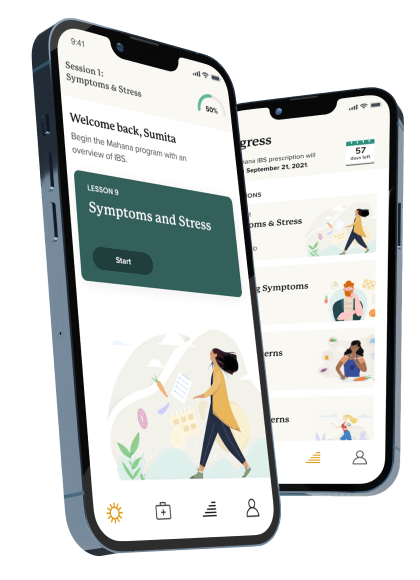
This is where Mahana IBS comes in. The main mission? To empower people with chronic conditions to lead fuller lives through digital therapeutics. That’s why they debuted their new prescription digital therapeutic app, Mahana IBS, in the fall of 2021. Their wish is to destigmatize IBS and bring hope and meaningful solutions to patients like you and me.

Steven Basta is the CEO of Mahana Therapeutics. He says the app is safe, FDA-cleared, and has been clinically proven in the world’s largest trial of its kind to reduce IBS symptom severity.

“Cognitive Behavioral Therapy (CBT) has long been recommended in clinical guidelines as a safe and effective treatment for IBS. Access to traditional CBT with a therapist has been a huge challenge due to the limited number of IBS-trained therapists (less than 300 in the US). Now patients can access CBT and learn the skills it provides to help a patient manage their disease by using Mahana IBS on their smartphone, with great results: 3 out of 4 patients find relief and results for most patients are lasting. Mahana users can complete the program in 90 days or less at their own pace with daily lessons on their phone to create a healthy brain-gut connection and live life more fully.”

Both IBD and IBS negatively impact our quality of life. Our mental health, our psychosocial health, and our financial health (increased health care utilization, missing days of work, medications to treat symptoms).

“Beyond treating the inflammation of IBD, and preventing IBD-associated complications, it is important to recognize and treat IBS when it is present, so people can recover and optimize their quality of life. CBT is an effective therapy for IBS and reduces or eliminates symptoms of abdominal pain, diarrhea, constipation, and bloating,” said Dr. Charabaty.

Unfortunately, access to a therapist who can provide gut-directed CBT can be limited: lack of therapists trained in CBT in someone’s geographical area, limited time availability (many therapists are not taking new patients, or have long waits to see someone; or from an IBD patients’ standpoint—lack of “extra” health care time available, when we often juggle many health appointments), deal with lack of insurance coverage, additional costs related to taking time off work and the expenses related to travel and participate in CBT sessions. Which makes the app even more useful and beneficial for the patient community.

Bringing up digital therapy to your GI provider

Digital therapy is new, and Mahana Therapeutics is working hard to spread awareness in the clinical and patient community to ensure everyone who could benefit, has access, and knows about Mahana IBS. 

“It’s important for patients living with IBD to ask their doctor whether Mahana IBS is suitable for them and discuss how it can work with their treatment plan,” said Steve.

As a gastroenterologist who specializes in IBD, Dr. Charabaty says, “Having an FDA-cleared prescription app that provides CBT right at the patient’s fingertips is pure gold! Easy and effective access to CBT at a time that is convenient for the patient, in the privacy of their home, without the added extra time and cost burden of a visit to a clinician. I believe that with this technology/app, which removes many barriers to accessing therapy for IBS, that many more people living with IBS (whether they have IBD or not) will benefit from what CBT has to offer and will be able to improve their symptoms and regain their quality of life.”

Patients who are in IBD remission experiencing IBS Symptoms may want to ask:

“If my IBD is in remission and my symptoms are IBS related, could a digital therapy treatment such as Mahana IBS gut-directed CBT be suitable for me?”

GIs who want to understand more about the clinical evidence and indications for use for Mahana IBS can head this website to check out the medical provider welcome pack which contains all the clinical information they need to get started and to prescribe Mahana IBS.

While the app is a prescription, patients can also download the app on their own and show their gastroenterologist in clinic. But to gain access to the full program, patients need to get a prescription to unlock the benefits.

How the app is tailored to each patient

People experience IBS differently which is why Mahana IBS provides a personalized approach, regardless of type of IBS. In the early sessions of the app, patients create an IBS symptoms profile, take an IBS Symptom Severity Score assessment, and create their personalized model. 

“This means people get to identify and capture their own symptoms and associated thoughts, behaviors and actions that arise as a result of these. As patients progress through the app and unlock tools and content, exercises are provided that are tailored to people’s individual IBS symptoms. Progress is recorded through the IBS Symptoms Severity Score at the beginning, the middle, and at the end of the program to measure results,” explained Steven.

Reframing thought process to reduce IBS symptoms

We can all relate to how feeling anxious can leave our ‘stomach in knots’ but in IBS there is a disorder of the brain-gut communication which causes and perpetuates symptoms. For example, our guts can release hormones that change our mood, and the brain in turn sends a signal to our guts to change our bowel functions which then sends more signals to the brain.

“Patients may develop habits or use ‘coping’ techniques that perpetuate the vicious cycle of brain-gut miscommunication without knowing it. The Mahana IBS app uses a gut-directed CBT program that was researched and developed over several decades. It is designed so you can understand your personalized patterns and then learn skills to help support a healthier brain-gut interaction. The program delivers a combination of education and exercises so that patients identify and reframe thoughts, feelings, and actions related to IBS. Through the Mahana IBS program, patients can gain tools and habits for managing symptoms long-term,” said Steven.

Along with learning to reframe our thoughts, the app also features visceral relaxation exercises like diaphragmatic breathing or belly breathing, which can reduce visceral pain and improve GI function. Mahana IBS has easy to follow animations to help patients learn and practice these techniques.

While Mahana IBS is a treatment program designed to be completed in 90 days or less with lasting results, Steve tells me some patients may experience relief from their functional GI disorder within a matter of weeks.

“Patients go at their own pace, so they may complete the program more quickly. Once the 90 days have elapsed, patients can still access their personal data (for example goal setting, IBS-SSS score or their personal IBS Model). Patients can return to the app at any time to find support in any of the lessons, tools, and exercises they have completed.”

Accessing Mahana IBS 

Mahana is committed to affordable access. Some patients may be reimbursed by insurance. For those patients who are not covered by insurance, there is a subsidized program to ensure patients will pay no more than $90 out of pocket for prescription cost. That’s less than a single session with a therapist ($120/session) for the complete 10-session program.

Steven says it’s incredibly rewarding and a huge privilege to lead the Mahana team transforming access to treatments like this through digital therapy.

“As CEO of Mahana Therapeutics I am inspired by so many amazing patients with IBS.  One patient who had struggled for years with IBS symptoms that made her feel truly hopeless expressed that Mahana IBS changed her life.  With the lessons and skills she learned, she no longer avoids the food she loves, and the way she thinks about IBS has altered so completely, it no longer limits her life.  Our team’s mission is to make this story a reality for millions of IBS patients.”

Mahana IBS is available for download directly from the Apple App store and Google Play store—and the first session is free to try! To unlock all the specific features and benefits, you’ll want to get a prescription from your GI. Once you’ve been prescribed the app by your doctor, you will get a message from Blink Pharmacy with instructions to get started. 

Turning Over a New Leaf: The Lifestyle Changes This Single IBD Mom Made to Manage her Crohn’s

**Disclaimer: This article is in no way meant to offer medical advice or guidance. Medication to treat and manage IBD is NOT a failure. Please understand this is one person’s experience and journey. Prior to going off medication, consult with your gastroenterologist and care team.**

She was diagnosed with Crohn’s disease in 1991 at 19 years old. As a veteran patient and IBD mom of two teenagers, Kelli Young says the COVID-19 pandemic, along with turning 50, inspired her to dig deeper into her health journey and look beyond the “cookie cutter” approach to treating IBD. After multiple surgeries and decades of biologics and other medications, she was determined to try a different approach.

Much like many of us in the IBD community, we often choose to hide our disease from others. Kelli says 15 years of that strategy often left her feeling misunderstood. Once she started sharing and opening herself up to support, her world changed for the better. Anytime someone is sympathetic and says, “you poor thing,” Kelli reminds them that Crohn’s disease molded her in the person she is today and that everyone has problems, hers just happens to be IBD.

“Having lived more than half my life as an IBD patient, I knew I didn’t want to live the second half of my life the way I did the first half.”

Taking a closer look into food sensitivities

It’s no surprise the importance of diet has become a larger part of treating IBD in recent years, but there’s still a lot of gray area.

“Diet is often the one thing that the medical profession overlooks or provides the same generic diet to everyone, assuming everyone is the same. Diet is the #1 factor that affects your health in every way imaginable. Your energy, sleep, weight, sex drive, bowel movements, heart rate, and mood, just to name a few.”

Prior to changing her diet, Kelli connected with her longtime friend of more than 20 years, Dr. Sean Branham, a chiropractor who specializes in functional medicine. Dr. Branham ordered the Oxford Food Sensitivity Test. The test measures inflammation in the body on a cellular level. Food sensitivities are unique to each person, so it’s impossible to determine what your sensitivities are without getting tested. Reactions can also be delayed or be dose dependent.

Kelli says, “The Oxford Food Sensitivity Test looks at all types of white blood cells (Neutrophils, Lymphocytes, Monocytes and Eosinophils) and measures release of all pro-inflammatory chemicals like Cytokines, Histamines, Prostaglandins and Leukotrienes. Certain groups of foods are pro-inflammatory to humans because we may not contain all the enzymes to thoroughly break them down (like dairy). Other foods are pro-inflammatory because of their processing, like many different forms of sugar. Some are inflammatory due to genetic modification like gluten. Some healthy foods can create inflammation once digestive damage has been done and these partially digested foods leak across the digestive barrier and trigger an immune response.”

Customizing diet with Food Sensitivity results

Kelli’s tests results showed mushrooms, cashews, trout, mangos, green peas, coconut, among other foods, triggered an immune reaction. Once Kelli had her Food Sensitivity results in hand, her and Dr. Branham started to customize her diet.

“We first started by removing the bigger classes of pro-inflammatory foods like; dairy, sugar, gluten and soy and then assessed specific foods that were causing a problem for me individually.”

Along with removing these food groups from her diet, Kelli did a whole-body digestive cleanse that involved a specific diet with supplements, a shake, and a cream to rid the body the body of toxins, decrease inflammation, and cleanse the liver and digestive tract.

“Testing revealed that there were more than just digestive issues going on. I also had a blood sugar regulation problem, Estrogen dominance, nutrient deficiencies, a need for: digestive enzymes, immune support, and microbiome support. Once I completed the cleanse, we customized a supplement regimen specific to me based on my test results. We started with what Dr. Branham considered the most important things first and then as we corrected those issues, we moved on and tackled the next issue and so on.”

Celebrating a “new way of life”

As a single mom of a 19-year-old and a 16-year-old who have supported her through her IBD journey every step of the way, Kelli calls these lifestyle changes her “new way of life”.

When my son was between the ages of 8-12 years old, he was showing IBD symptoms, but he didn’t have IBD, he was experiencing empathic pains. He watched me, a single mother, battle with the daily struggles. I tried to hide it, but he saw right through me. Today he is 16, growing, thriving, and enjoying his healthy mother. My daughter, 19, the age at which I was diagnosed, is thriving as well. I am now able to truly be present in both of their lives.”

When Kelli and her husband divorced, her children were only 8 and 5 years old. As an IBD mom it made an already challenging time that much more complicated. She never dreamed she’d be at this place in her life health-wise.

“Back then I wondered how I was going to give myself my own shots, how I was going to care for two small children 50% of the time when I was always sick. Being a single mother with IBD forced me to take a good hard look at my life, not only for me, but for the sake of my children. My motto used to be “expect the unexpected” and “no expectations.” Today, I no longer worry about the future bad days or wonder if I’m going to be around to be a grandmother someday. Yes, it’s difficult at times to follow such a structured lifestyle, but it’s even more difficult living a life being chronically ill.”

Going off all meds

Kelli has been off all IBD medication since May 2021. She says her GI of 30 years is reluctantly supporting her decision to go this route on her patient journey. Kelli had a colonoscopy in June 2022, and after the scope in recovery he said, “Well Kelli, your new way of life is working. I’ve never seen your scope results look this good.”

While this lifestyle may seem “extreme” to some or difficult to follow, Kelli says she was sick and tired of being sick and tired.

“The definition of “remission” varies depending on who you ask. I am celebrating three years of a “disease free” diagnosis. The Crohn’s will ALWAYS be very much part of my life, but now, the only time I have a “bad day” is when I cheat on my new way of life, eating something I shouldn’t be eating, not getting enough sleep, not exercising, and not managing my stress.”   

A Special Report: Changes to Lights, Camera, Crohn’s

It’s been 6,207 days since my life changed forever. On July 23rd, 2005, I was diagnosed with Crohn’s disease at age 21. Since that time, I’ve evolved and changed in ways I may not have if it weren’t for my IBD. After living in silence with my condition while working in television news for a decade, I decided to use my love for storytelling and speaking to be the voice I needed to hear upon diagnosis as I navigated the many crossroads of young adulthood (finding love, a fulfilling career, and having a family).

July 23rd also marks the day I launched my blog, Lights, Camera, Crohn’s. Since 2016, I have shared fresh content, every single Monday (sometimes even twice a week!). 336 articles on my site alone. More than a quarter-million visitors and more than 387,000 views.

It’s been a labor of love and a mission project that continues to fill my cup and implore me to constantly want to learn more and shed light on topics that are often not talked about. Every day of every week since my blog began, I’m constantly thinking about story ideas, topics of interest, people to interview, ways to word content, images that are needed…the list goes on.

This photo was taken at a wedding July 23, 2016, right after I pressed “Publish” on the first Lights, Camera, Crohn’s article. I found out I was pregnant two days later.

The weekend I started my blog in 2016, I was one month into married life and found out days later I was pregnant with my first child. Since then, I am now a stay-at-home mom of three children (ages 5, 3, and 1). Life has gotten way more hectic and busier with each year that passes, but I’ve held tightly onto fulfilling my promise to the patient community, and to myself, to deliver new content each and every week. I’ve been organized through the years—often having an article written days before my Monday deadline, but this past year, with another baby added to the mix, it’s been more of a stress on me. I’ve spent many Sunday nights finishing my articles. At times it’s felt like a lot to juggle. I haven’t wanted to let anybody down, including myself. And I haven’t wanted my content to start lacking in any way.

Don’t worry, Lights, Camera, Crohn’s is not going anywhere

My blog has grown into more than I ever thought possible. It’s so rewarding to know my words have helped comfort and guide so many in the IBD community. I need to cut myself some slack and give you a heads up that moving forward there may not always be an article on Mondays. It pains me to say that, but at this point in my life, in this season of IBD motherhood, I need to start taking time to rest and relax. Since having my third baby last summer, I get my kids down for the night and START to work around 830 pm. It’s just constant. I truly rarely get a break. I’ve been in remission since August 2015, and I don’t want the stress to get the best of me.

You may not be aware—but my blog is only one aspect of my advocacy work. I also spend a great deal of time working with digital healthcare companies, patient-centered non-profit organizations, sitting on advisory boards and patient engagement teams, communicating with patients in need online and over the phone, and do freelancing work on the side, all without childcare.

I laugh as I write this because I already have three articles lined up for August…so there will be months where there IS an article every Monday. Just not always. My commitment and desire to serve as a patient leader is not waning in any way—I just want to be honest with you, my loyal readers, that this mama needs to lighten the load and take a little self-imposed stress off my shoulders.

I started contemplating this a few months ago, and almost changed my mind this week about sharing, but it’s time. We had an AMAZING 6-year streak of constant new content. I’m excited to see what this coming year brings in the way of patient stories, research, and perspectives. Having extra time to work on articles will really allow me to do more special reports and expand my “IBD Motherhood Unplugged” and “Patient Experience” series.

Thank you for giving me so much to talk and write about, always. There are endless topics that need to be brought to the forefront and I love providing a platform for others to share their journeys and experiences with the community. As always, please reach out if you have a story idea you want me to cover. Lights, Camera, Crohn’s has truly evolved from being a blog about my IBD experience to an award-winning and well-respected site that has highlighted hundreds of different patient stories and physician perspectives—and I love that. There’s no greater compliment then when I hear a gastroenterologist uses my blog to educate their patients.

Excited to see what 2022-2023 brings! Thanks for the love, support, and understanding and for making the first six years of Lights, Camera, Crohn’s what it was.

-Natalie

Recognizing the touchpoints of independence along your IBD patient journey

Take yourself back to the very first time you needed medical attention for your IBD (but didn’t know it yet). Close your eyes for a moment. Who was that person? Do you know them anymore? How have you changed and transformed since that life changing day?

I was diagnosed with Crohn’s disease July 23, 2005, at age 21. I was blindsided by a chronic illness after growing up as a literal picture of health. A three-sport, in shape athlete, who had never even had an ear infection or been to an emergency room. As a recent college graduate, my world flipped upside down as I struggled to find my way in the real world.

Now, 17 years later, I can tell you firsthand what I, you, and so many others have endured on our patient journeys and how each experience (even the mundane) serves as monumental touchpoints for gaining independence and confidence in making you a more empowered and direct patient. 

Let me paint the picture clearly for you

The first time you bravely laid in an emergency room bed and every time there after—not knowing the tests, pokes and probs, and physical scrutiny you were about to go through. 

How it feels to be wheeled by a stranger through stark hallways to CT scans, MREs, and scopes, wondering what the results will be on the other side and the repercussions for more medications, a longer hospital stay, or surgery.

The difference a couple months makes–pre-diagnosis in May 2005 and 2 months after 60 mg of prednisone a day and 22 pills a day.

What it’s like when you say goodbye to loved ones and they roll you into the OR and you’re shaking like a leaf, all alone and feeling frail and broken, alone with your thoughts and prayers.

The number of moments you’ve watched nurses and even rapid response nurses fumble with IV’s try after IV try and when it’s been more than five, you find your voice from that point forward and start only giving medical professionals two tries before it’s on to the next.

How it feels at the butt crack of dawn when the world is sleeping and the hospital is bustling, waking you abruptly to get more vitals and more labs and you lay alone, haggard, frustrated, and delirious. 

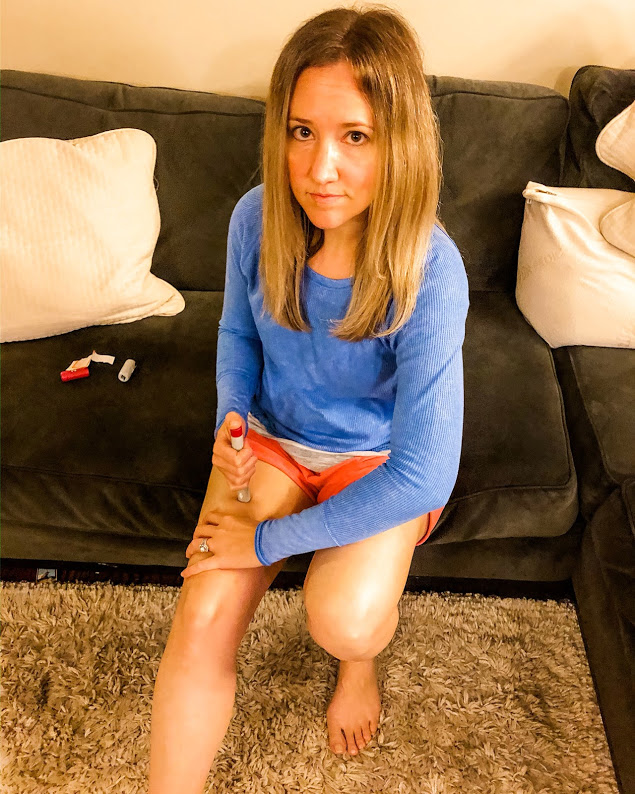
The moment when your GI has a heart to heart with you about starting a biologic and having to determine for yourself what route is your preference—infusion or self-injection. Would you rather sit for hours hooked up to an IV drip or sit on your couch with your kids looking on as you inflict pain on yourself. 

The times you’ve sat up in the middle of the night wide awake thanks to the prednisone kicking in while the rest of your world is asleep wondering if you’ll ever regain some semblance of control of life.

What it’s like trying to eat meals inconspicuously with your family while they not so subtly watch each bite and every trip to the bathroom with sadness and worry in their eyes.

How it felt driving to a first date or a job interview and feeling like your IBD is a dark secret looming over the conversation and not knowing when to take down your walls and share. 

Listening to your friends make comments about health and energy without considering what your experience with a chronic, debilitating illness may be like since you look well on the outside. 

What it feels like to look at your reflection in the hospital bathroom. Battered arms, sunken in eyes, a shell of who you used to be. But as soon as you walk out of the door, putting a soft smile on to protect your visitors from worry. 

What it’s like to sit on an airplane or be on a road trip with others and silently worrying about whether you’ll be able to make it and what your game plan will be. 

When you’re up in the middle of the night doing the second half of colonoscopy prep and wondering ‘why me’ in your 20s and 30s, feeling isolated in the physical, mental, and emotional anguish the process puts you through year after year. 

What you’ve internalized each time someone dumbs down your IBD, offers up ridiculous remedies or goes into a discourse about their aunt’s brother’s cousin who “healed” their Crohn’s this way. 

When you’ve waved the white flag and alerted family and friends that you needed help or to be seen in the hospital after doing as much fighting as you could against your own body.

The first time you bravely looked down at your incision and saw your body forever changed and came to see your scars as battle wounds. 

Waking up each day not knowing what the next 10 minutes will feel like for you and getting after it anyway. 

Not knowing if you’ll find your person, but meeting people and having the courage to share about your health issues, even if there are heartbreaks and disappointments along the way.

Deciding to have a baby and discussing family planning, despite all the what ifs and becoming a parent because that’s what you hoped for prior to your IBD. 

Landing that dream job with your IBD in your back pocket, not letting the detours stop you from finding the path you were meant to go on. 

Celebrate the independence you’ve discovered

The list goes on and on! No matter how old you are when diagnosed with IBD, in that moment we are robbed of our naivety and thoughts of invincibility, and we’re forced to go on a lifelong war and conquest. Our bodies no longer feel like ours. Our dreams feel in disarray. Our people may change and not be who you thought they were. Our hearts may break, but like a phoenix this disease can build you up just as much as it breaks you down. 

The reprieve of remission, while not perfect or without symptoms has enabled me to breathe and regain my grounding. In 2015, after three back-to-back bowel obstructions and 18 inches of my small intestine, Meckel’s diverticulum, and appendix removed, there was only one way to go and that was up. 

Give yourself grace. Celebrate the independence you’ve discovered that you may not be able to have realized until you’re years out like it took me. And when you’re in the hospital, in for a routine clinic visit or for labs, taking your meds and balancing every daily decision against how it will make your IBD feel, you’ll come to realize what you take on and all you accomplish every day just to survive and thrive, makes you something special. While you may feel dependent on others—and the support of caretakers and a support system can’t be understated, neither can the endless strength that lies within you.

How to be an investigative journalist specializing in chronic illness

Chronic illness forces you to wear many hats and approach life in ways you never thought possible. One of those hats is being an investigative journalist or sleuth. Each time something starts going awry with our health we immediately start the mental gymnastics about what could be going on and if the symptoms are linked to our IBD.

I find that even though my Crohn’s has been in remission since August 2015, that the next flare always looms in a cloud of worry when I’m not feeling my best. 

This past week I experienced this firsthand when my eyes both started twitching nonstop, along with headaches. I started thinking about what I could have done to trigger this bodily response. Was it Crohn’s related? Hormonal from breastfeeding weening? A mineral deficiency? A problem with my eyes or vision? Sleep deprivation or stress? The laundry list of possibilities and worries weighed heavily on me. After consulting with my GI, OB, and having an appointment with my eye doctor, I learned the eye twitching was a result of allergies. I now do eye drops once a day to help. It was such a relief to get an answer and physically be able to do something to make myself feel better.

When you notice an uptick in IBD symptoms or health issues in general how do you get to the bottom of what’s going on?

Here are my top tips for getting answers:

Be proactive. Don’t let things fester and let your anxiety get the best of you.

•Take physical notes, not just mental ones. As the hours turn to days it can be difficult to remember when symptoms began and if they progressed. Keep a simple log of what is happening, how often, the severity, etc. 

•Reach out to care providers early and often. Send a quick message on the patient portal informing your GI about what is going on. With IBD, I find it helpful to always loop my gastroenterologist in since so many issues are often related to Crohn’s. 

•Be seen. If symptoms don’t resolve in 3-5 days, it’s a good idea to be seen in person or at least a telehealth appointment. You can always get on the books and cancel an appointment if you start to feel better. 

Try not to Google too much. While this is always tempting and can feel like a quick way of gaining understanding, it also can lead to going down a dangerous rabbit hole of what ifs that possibly aren’t even relevant. 

Listen to your gut. You know when something feels off. Don’t drown out how your body is speaking to you through symptoms. 

Practice mindfulness and calming exercises. It’s not unusual to feel up against a wall or like you’re taking two steps forward and one step back with chronic illness. Remember to breathe. Take a walk outside to clear your head. Do all you can to rest your mind from stresses that can trigger your IBD.

I get how exhausting it is to constantly feel at odds with your body and worry about what could be going on. Suffering in silence and not communicating health challenges only sets you back from feeling your best. Be mindful of how you feel each day and feel empowered by collaborating with your care team and giving them all the necessary intel to have the full picture when figuring out your health story past and present. 

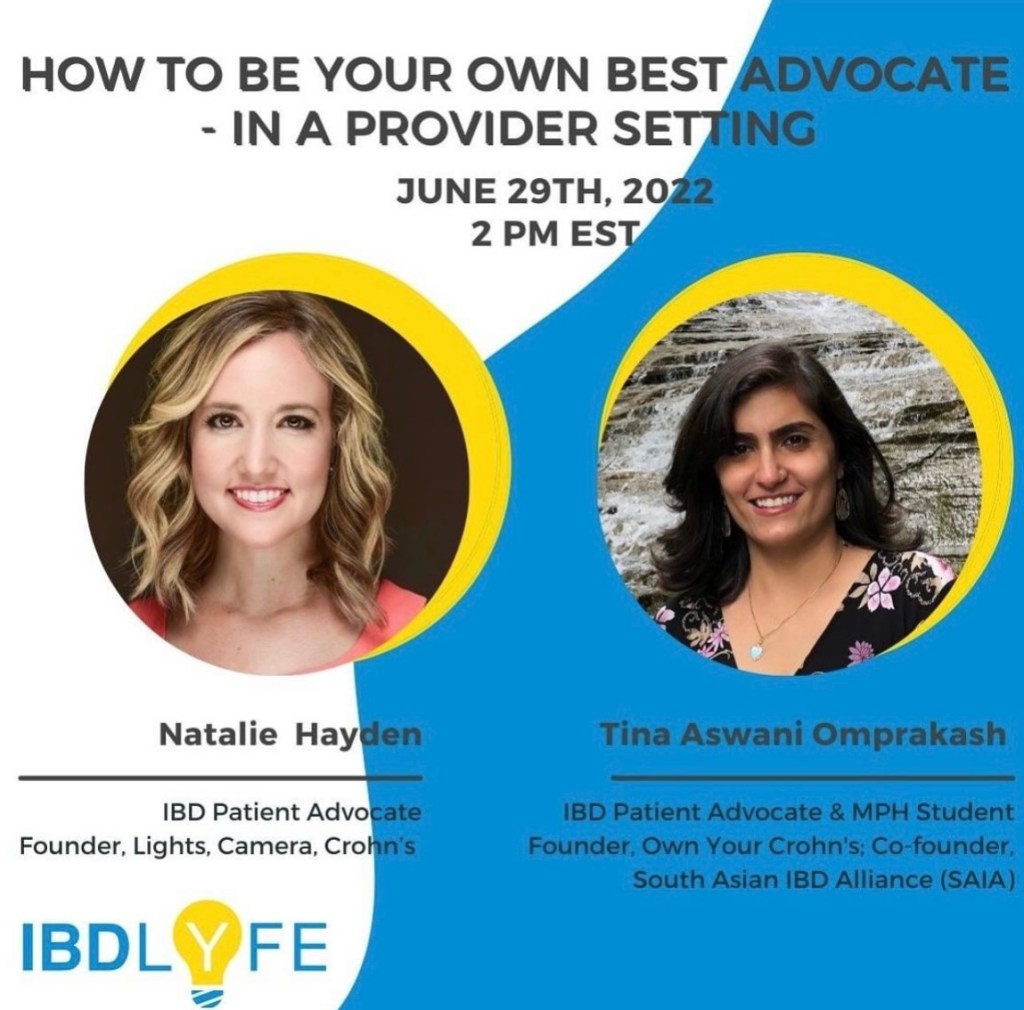
Stay tuned for a special discussion on IBDLyfe, Wednesday June 29, 2022, at 1 pm CT about “How to Be Your Own Best Advocate in a Provider Setting.” I’ll be speaking alongside fellow patient advocate, Tina Aswani Omprakash. Register here.

IBD Dads: What these patient heroes have to say about fatherhood

Fatherhood looks differently when you have a chronic illness. Finding a partner, family planning, decision making, and parenting are all impacted when you have IBD. This week on Lights, Camera, Crohn’s we hear from several men around the world. Whether they are preparing to start a family or have adult children, you’ll hear firsthand accounts about how their Crohn’s disease and ulcerative colitis has shaped who they are as men and as dads.

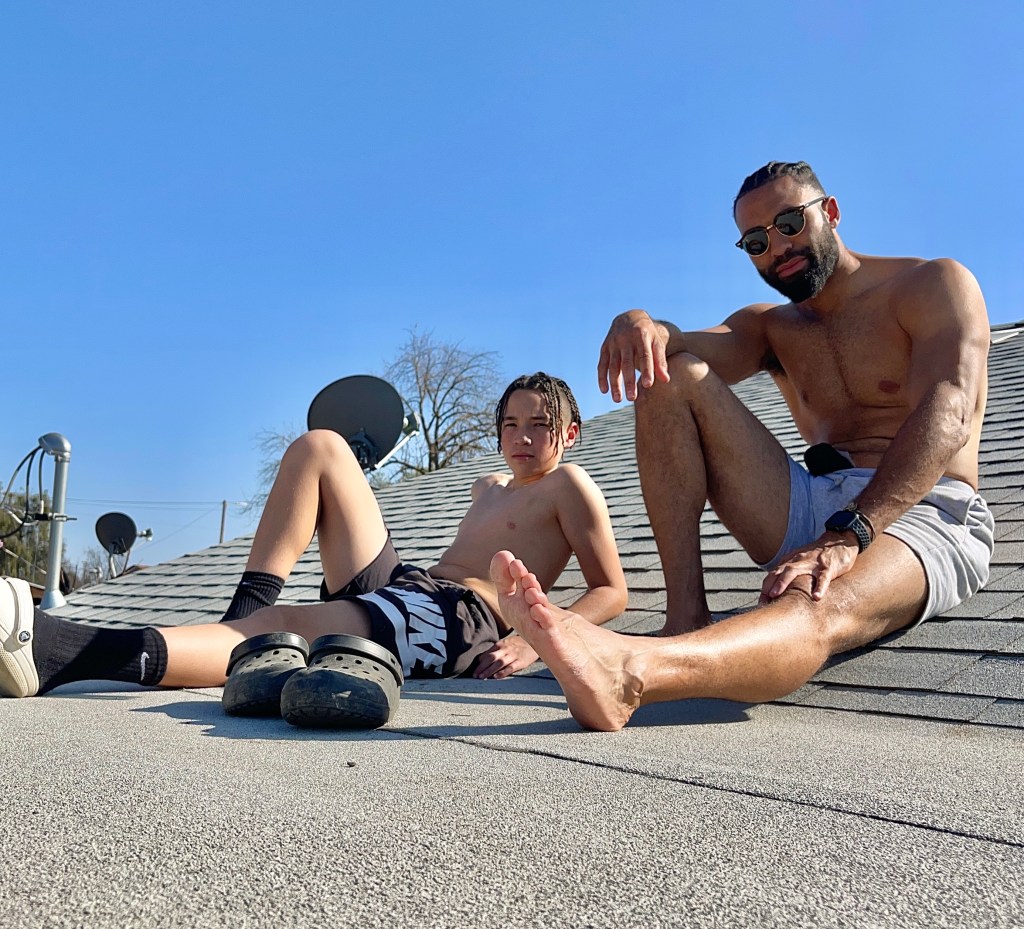
London Harrah, a 31-year-old dad in California, was diagnosed with ulcerative colitis in April 2016. He says IBD has impacted fatherhood in different ways and presented unique challenges. He’s grateful for the endless support his family has given him, making him feel comfortable to openly share about the struggles.

“Prior to my surgery and ostomy, my ulcerative colitis heavily impacted my parenting role. I had to shape my entire day around my ability to have close access to a restroom. Now after surgery, I have had a lot more freedom and a heightened quality of life. I am now able to partake in a lot more activities without my condition hindering me. I also feel like being an IBD dad makes me stronger because I look at parenting as an opportunity to set an example for my son on how to deal with adversity,” said London.

He says IBD has instilled a profound sense of empathy in his 13-year-old son because he has not only witnessed his dad go through the ups and downs of chronic illness, but London has also shared other peoples’ stories from the patient community with him as well.

“Some people ask me for advice on how I navigate different topics in life, and I share many of those stories with my son so he can understand different things that are actually happening in the real world and paint a picture of what some people have to deal with, that may not be visible on the surface.”

London says his son has been through this journey with him since day one. He can still remember when he first started experiencing symptoms and he knew something was wrong and trying to explain that to his child.

“He watched me spend hours in the restroom and was there for me as much as he could. I have always felt open and able to talk to him about this topic, more than anyone else.”

London sees his ostomy as a great learning opportunity for his son.

“As a dad, having an ostomy is kind of a great experience to have because of all the life lessons and teaching opportunities that it creates when raising children. You learn a lot about yourself during this journey and it allows for a lot of realization about the important things in life, which are all transferable when raising our children.”

Brandon Gorge of Michigan has five-year-old and two-year-old sons. Diagnosed with ulcerative colitis freshman year of college in 2003, he’s grateful his IBD was under control for 11 years while on Remicade/Inflectra infusions and now Stelara for the last year and a half.

“My sons wake up early and I love to wake up with them, have breakfast and play before getting the day started. With their ages, my biggest challenge is having to run to the bathroom while my wife is still sleeping. I used to have to wake her up to cover for me, but now they’ll play while I’m in the bathroom or come in with me. I tend to schedule doctor appointments and lab work early in the morning. Making sure my wife knows my morning plan is important so she can schedule accordingly, and we can make sure the boys are set for the morning/day.”

Brandon credits his wife for being a great listener and support.

“She comes with me to colonoscopies and to Crohn’s and Colitis Foundation events. My parents are still a huge support as they helped me find the right doctor when I was diagnosed with UC a week before moving out of state for freshman year of college and continue to be a sounding board for my UC. They’re also involved with the CCF because of me.”

His older son broke his arm when he was four and has been extremely interested in how the human body works and heals. Brandon and his wife found a YouTube video series called “Operation Ouch” by two British doctors. One video they stumbled on is about a girl with IBD.

“He said it wasn’t interesting because he couldn’t see her booboo. I explained to him that some people have booboos that you can’t see, and I have the same one as the girl in the video. He knows I go to the “tush” doctor regularly; they take pictures inside my body – and I’ve showed him the pictures, I give myself shots, and getting a shot is no big deal. Talking about the bathroom is very normal in our family!”

Brian Greenberg of New York was diagnosed with IBD when he was 11 years old, he’s now 39. He says juggling and finding a balance for all things in life is difficult. Between being a husband, a father, and then having a career, and managing chronic illness on top of general health, it’s a lot.

“My family is amazing. My wife knows there are nights where I have to tap out, and she understands when this happens. My family and her family have also been supportive that it took me a little longer to settle into being a dad and learning how to add everything it comes with to my 24/7 job of being a Spoonie. But their patience has paid off and I feel like after a few months of being a father, I found my stride.”

As an ostomate with a 17-month-old daughter, Brian says while she still has no idea what she’s seeing, him and his wife have started the education process with the books “Awesome Ollie” and “Ollie the Bear.”

“It’s teaching her that after some challenges and the fact I’m a little different now, I’m still capable of so much, which I hope to show her one day.”

Trying for a family as a man with IBD

Brad Watson-Davelaar of Canada got married earlier this year and now him and his wife are hopeful to start their family. Brad was diagnosed with Crohn’s disease in 2001 at age 17. Since then, he’s never been in remission.

“I used to be worried about having kids since my IBD has never been stable. Since meeting my wife five years ago, I’ve learned that she and I together are a wonderful team. I’m very much all in for kids. Being an uncle really solidified my desire to be a dad. We’ve been trying for two months and we’re hoping my wife is pregnant by the end of the year, which is a big ask as I’m preparing to go in for a laparoscopic right hemicolectomy with abdominal-perianal resection transanal total mesorectal excision with permanent colotomy later this year. I don’t know how my mental and physical state will be afterward.”

Brad and his wife have talked about the possibility of their children having IBD, but both agreed that if that is the case, they will 150% be there as a support and advocate for our children, something he lacked in his own health journey.

“We’ve also talked about how I will be a stay-at-home dad, as I’ve been on disability for a large majority of my adult life. I know there will be rough points where I will feel like utter garbage and just not feel like being there. But I know even if I let myself get to that point, my wife will be there to help. We’re making sure to move ourselves to where we will have a good support system if anything happens. Having a strong partner makes it easier to be ready and excited for what the future holds.”

With everything going on in the world, Brad says it’s a bit daunting to become a dad.

“I’ve been doing my research. I really want to make sure to do the right things. I treat the prospect of fatherhood much like I manage my IBD. Lots of research and staying open to change. I am so excited to be a father though. I feel like it’s what I need in my life.”

Reflecting on how IBD changes through each parenting season

Alistar Kennedy of the UK was diagnosed with ulcerative colitis in 2000. Now as a 49-year-old married father of two he’s able to reflect on how his IBD journey has impacted fatherhood and family.

“When you have a chronic illness your energy and time are limited. Having children can be exhausting and all-consuming even without health issues. The biggest challenge I found when my children were very young was coping with their boundless energy, their desire to be active, and trying to enjoy outdoor play. Active IBD can be a big issue in those circumstances, fatigue was a real struggle, but also the need to keep near to facilities in case you need them. This meant solo parenting was hard, but good planning and an understanding partner made the normal things achievable. Also, as the kids grew, they became more aware of what was needed from them. Empathy and adjustment to surroundings.”

Speaking of empathy, Alistar says his kids are both very aware of his IBD and how it’s impacted their family.

“My kids have grown up knowing I might have a day when I’m unable to do things due to fatigue or have to make a dash to facilities. Being open and honest with them from an early age has given them a broader understanding of the struggles a lot of families have. They are both very caring individuals. As a family, we are flexible and everyone understands that, sometimes plans must change. We make the most of the good days.”

Since being diagnosed, Alistar sees great promise for the future of IBD treatment and care in the years ahead.

“Medication, treatment plans, the role of diet, and the importance of mental wellbeing has advanced dramatically in the last 20-plus years. I see far more hope from the future about what this disease will mean for all of us and how it will or won’t dictate our lives. If you want to start a family and enjoy everything that can bring, you can. It won’t change the fact teenagers can’t load a dishwasher properly! I’m very proud of the fact that I did the school pick up and drop off for 10 years solid without either child getting a single late mark!”

Dan Bradley of the UK recalls how differently IBD impacted his role as a dad when his children were younger.

“My youngest child is 17, so I don’t feel like my IBD affects my children in a big way. When I was diagnosed 8 years ago it created a huge challenge with being a dad and dealing with the lethargy and fatigue. It was a struggle to be able to do my day-to-day activities and be there for the wants and needs of my children since they were too young to understand my illness and what I was going through as a parent during that time.”

He feels his disease helped shape who his children grew up to be as they enter adulthood.

“I like to think my children were brought up to offer empathy to others, but my IBD has certainly given them a deeper understanding about stomas and the complications that can arise with chronic illness. There’s nothing like telling your 16-year-old daughter she needs to get out of the bathroom quickly when she is trying to get ready for a night out!

Thomas Fowler of New York was first diagnosed with ulcerative colitis in 2004 when he was 30 years old, then three years later he found out he had Crohn’s. Since he was first diagnosed, he’s undergone more than 25 surgeries and currently deals with anal fistulas. He says life as an IBD dad is about finding your “new normal” and that it helped him to have a decade of life with IBD prior to taking the plunge into parenting.

“We talk about Crohn’s all the time, so my kids accept me as I am because they don’t know Daddy without Crohn’s. I sense that they know when I’m having a bad day or flare. I tend to shutdown socially and don’t talk as much. Fatigue is my number one battle in life. I don’t mind the bathroom trips as much or the daily pain, it’s the fatigue. It’s the one symptom that I can’t fight.”

Recently, Thomas says his latest challenge with IBD and fatherhood is juggling his Crohn’s with his son’s baseball season.

“I am not able to eat dinner before baseball practice/games. My son 100% understands why. And sometimes my son will ask to go and get ice cream after a game, and I say I can’t because Daddy has to get home and eat real food first. Sometimes that means eating at almost 9 pm. Which presents another issue in and of itself, because if I eat that late, I automatically know I’m going to be up several times during that night to use the bathroom.”

Why men with IBD tend to stay silent

As an IBD mom of three myself, I’m aware in my extensive advocacy work how our patient community is predominately made of female voices and experiences. For many years, the male experience has been lacking and is often difficult to find.

“Men are conditioned not to share their detailed emotions. Often told to ’suck it up’ and just get on with it. Sharing can make you feel vulnerable and fragile to our peers, so we avoid it. It shouldn’t because it’s incredibly empowering and rewarding. I was diagnosed pre-social media and at the time, advice, and information available online was vague, confusing, and often misleading. It felt very lonely to have IBD back then. Being part of an online community has been game changing. Men struggle to engage and verbalize in this space though, but they are there. Personally, I’m very facts and evidence driven, so the advocacy space must reflect that,” said Alistar.

“We’re taught at an early age that we’re supposed to be tough. That we shouldn’t be sick or show any weakness. That stereotype is slowly being broken as men are learning that even our health can change in a moment, and it’s okay to be vulnerable,” Brian explained.

“I co-chair the Crohn’s & Colitis Foundation’s Detroit Young Professional Group. One of my co-chairs is also a dad. Our group is evenly split between men and women. Before I became involved with the group, I never participated in any type of group for support or advocacy. I think a lot of men (and people with IBD) need to learn how to advocate for themselves with insurance and their medical team before they advocate and help others,” said Brandon.

Dan said, “I think it’s a typical man thing. IBD is not talked about. Some of the symptoms that come with IBD, in particular going to the bathroom, can be seen as a taboo subject. I do feel this is changing and more awareness is getting out there. In the UK, we have recently had a couple of “famous” people raise awareness which has been fantastic.”

“I think in the society we live in today makes it harder for men to be vulnerable with their feelings. In my situation, even I still struggle sometimes talking about certain topics with new people. I do however acknowledge the difficulty and try to work through it,” said London.

Advice for future IBD dads-to-be

Whether you’re in the throes of trying for a baby or if you’re a parent and your child has IBD, and you worry about his future and what it will hold in regards to fatherhood—here’s some amazing advice to guide you and show you all that’s possible.

“There are always more good days than bad. Having children is a wonderful, if very tiring, gift. They change you for the better and help you to grow as a person. Getting my IBD under control has been incredibly challenging, but we’ve done all the things normal families do. Be open and honest with your partner about your fears, priorities self-care and mental wellbeing. Talk and share your feelings to your family and friends. Don’t be hard on yourself. Take naps! The best advice as an active parent is always that good up-front planning and working as a team is essential,” said Alistar.

“Talk to your gastroenterologist to ease any fears about the effects of medicines or worsening IBD, develop a treatment plan, and revisit that plan before a flare gets out of control and affects you being able to be there for your kids,” said Brandon.

“I would tell fellow men not to let IBD stop them from becoming a dad! They are very well capable of having a healthy child, but it starts with them taking initiative and becoming healthy (mentally/physically) themselves before-hand,” said London.

Brian said, “Becoming a father with a chronic illness like IBD is scary. I wasn’t sure how it was going to work, how I’d be able to adjust to everything I was about to add onto life, or where would I find the energy. But you find answers to all those things because the love your heart is filled with carries you through so much, and it’s more important than anything else in life to find a way.”

“Don’t hesitate to start a family.  There will never be a “perfect” time to have a kid with this disease. Don’t set goals like, I’ll start a family when I’m 2 years symptom free, or when I don’t have a surgery for 3 consecutive years. You will always have issues for the rest of your life. The only hard part I had was when my kids were newborn through toddler age and I had them by myself away from the house. You get very creative with bathroomn visits.  I would use the diaper changing tables and strap my kids in and let them use my phone for distractions so I could use the bathroom. You become a logistical genius when leaving your house. Being a dad is the BEST thing that has ever happened to me.  And a hug from your kid is better than any medicine money can buy when you are having Crohn’s related issues,” said Thomas.

“There is no reason on earth to allow your IBD to stop you from becoming a dad if that’s what you want to be. Go for it. Be open so everyone knows where you stand. With the right medication and treatment plan in place, there really isn’t anything you will be stopped from doing. I enjoy long bike rides, long walks with the dog, and a pub lunch after reffing my kids football games. I have flown with an ostomy without issue. If you think you may have IBD, don’t ignore your symptoms. See a doctor and get yourself on the path to treatment so you can live life as fully as possible,” said Dan

14 years of injections: What I’ve learned as a mom with Crohn’s

This blog article is sponsored by Portal Instruments. All opinions and experiences shared are my own.

I’ll always remember how I felt the moment I was told I needed to go on a biologic drug to try and manage and control my Crohn’s disease. It was Fourth of July weekend 2008. My gastroenterologist walked into my hospital room and told me it was time to “break out the big guns,” meaning starting to get medication through an infusion or through a self-injection. I was a morning news anchor at the time in Wisconsin, three years into my patient journey. I knew without a doubt, for privacy reasons, and keeping my chronic health issue under the radar, that doing an injection in the comfort of my apartment was the best choice. As I watched the fireworks reflect off the hospital room window with my mom, tears flowed down my face. I didn’t know how on God’s green Earth I was ever going to be able to give myself an injection for the rest of my life.

I was never a huge fan of needles prior to my diagnosis. Once you have Inflammatory Bowel Disease, needles unfortunately are all part of it. While we may get desensitized, patients would give anything to be able to treat their disease without needles. When I started on my biologic, my mom and I went to my gastroenterologist office and a nurse told me I needed to do four, painful injections in my thighs because at the time I didn’t have enough fat on my stomach. I was shaking like a leaf. I had no idea what to expect, I was about to inflict pain on myself, the injector felt so foreign in my sweaty palms, and I was scared about not only how much it was going to hurt, but also the long-term side effects the medication could cause to my body. 

I did the first injection and it felt like liquid fire burning through my skin. I couldn’t believe I had to sit there and do three more, back…to back…to back. The experience was traumatizing. When I finally did all four, my mom and I walked into the hallway and I embraced her, crying because of my reality, and knowing that in two weeks I would need to inject two more needles into my thighs for the final loading dose. Since July 2008, I’ve done a self-injection every other Monday and for a short time weekly, while I was flaring. That’s more than 2,600 shots. 

Dreading “shot day”

The first few years I would absolutely dread my “shot day” and deal with the looming dread each week. Early on I would get emotional during the process and feel bad for myself. I was only 25 years old. It made me feel like I was a sickly person. My peers couldn’t relate. It was isolating and overwhelming. Every time I open my fridge, the box of injections is staring back at me as a constant reminder of what’s to come. 

Doing my injections as an IBD mom

Fast forward to present day, I’m now a 38-year-old mom of three. Luckily, the formula for the medication was changed in 2018, making the drug virtually “pain-free”, but there are times I still feel the needle. Even though I have my medication process down to a science, I still wish I didn’t have to do it and I usually wait until Monday nights to do it. The timing is moreso out of habit, because when I was a morning news anchor there was no way I was going to deal with an injection at 2 a.m. I started a tradition of doing my injection while watching the Bachelor/Bachelorette, and that’s carried over now that I have three young children, often waiting until after their bedtimes. Each time after I’m done with my shot, I text my mom to let her know how it went. She’s a nurse and has been my greatest support with my IBD since the day I was diagnosed.

Sometimes my 5-year-old and 3-year-old watch me do my injection and each time they are intrigued. I’m sure my 11-month-old will be the same once he starts to gain an understanding of what I’m doing. It makes me sad that they often witness me doing my injection, but they are also my greatest motivation to be strong and smile through it. Watching me doing injections has made my kids incredibly brave at the pediatrician when it’s time for them to get their immunizations. Because I have little ones, I have to be mindful of disposing of my medication properly and keeping the Sharps disposal container out of harm’s way. We keep Sharps Containers up high in a cubby hole in our laundry room and I dispose of the injector pen immediately. 

As an IBD mom, my greatest fear is passing along my Crohn’s to my children. While the risk is low, it’s there. I hope and pray my children won’t ever need to receive a biologic medication whether it’s through self-injection or infusion. For me, there’s no end in sight, I’m expected to be on my medication (if it remains therapeutic) for the rest of my life. Thinking of my babies having to deal with needles and being forced to inflict pain on them would be difficult for me and only add to the guilt.

The future holds so much promise when it comes to drug delivery without a needle. My hope is that in the years to come, other people won’t have to succumb to the same anxiety, pain, and worry I’ve had to deal with for more than a decade.

Love & IBD: An eye-opening look at what it takes to find the right person

Saturday my husband and I celebrated our sixth wedding anniversary. Special milestones like this tend to make us all reminisce about the past, present, and the future. When you live with IBD many of those memories and the current reality are from flare ups, hospitalizations, procedures, recoveries, and simply navigating the day to day. While Bobby has been a part of my life for nine years (next month!), I spent the first eight years living with Crohn’s disease, without him—in my 20s.

During those eight years I experienced many heartbreaks and disappointments when it came to trying to find my person. To give you the cliff notes version—my boyfriend who I was dating when I was diagnosed never visited me during a week-long hospital stay and broke up with me while I was in a wheelchair over the phone after getting discharged and going into my parent’s car. Then, I dated a guy who refused to drive 3 hours when I was hospitalized for an abscess the size of a tennis ball in my small intestine, because “gas prices were too expensive” (can you imagine how he’s handling the prices now, HA!) and he wanted to go fishing. Another moment that makes me shake my head to this day is when I had to cancel a first date because I was doubled over in pain on the bathroom floor and was heading to the ER and he texted me that it was a poor excuse and laughed at me.

While I could have seen my Crohn’s disease as a scarlet letter and settled with a person who clearly didn’t have a genuine heart, I used my IBD to guide my decision making and it brought me to the relationship and the person I was meant to be with.

So, while I was out to dinner over the weekend looking across the table at my husband and the man I have three kids with—a man who has taken my disease journey and everything that’s come along with it in stride, I not only felt an immense sense of gratitude but also want you to know that your disease can give you superhuman clarity when it comes to helping you weed through the people who aren’t your person. This week on Lights, Camera, Crohn’s a close look at love and relationships and the tremendous support our romantic partners are, while also speaking to those who are single and struggling to see themselves as anything but a burden. I hope this article shows you the incredible relationships so many of us in the IBD community have been able to have, despite our disease—and remind you that you are worthy of all that love has to offer. Your disease does not make you less than. You deserve the same respect, consideration, compassion, and unconditional love as everyone else.

How does your partner go above and beyond?

I tapped into our community on Instagram and asked: “How does your partner support you?” By reading the countless messages it just goes to show, it is possible to find a partner who sees you for more than your IBD. Someone who loves you for all of you:

“Taking care of the house, speaking up for me at appointments, fighting insurance when I can’t anymore, and listening to me.”

“Knows what I can and cannot eat and makes sure there’s food available that I can tolerate.”

“I’ve got a winner, there’s too many things to type in this small box! Will make a late-night food run because of my limited options with a flare or let me pick a meal. Shows support by driving me to colonoscopies, even if it means missing work.”

“They listen when I “complain” and offer solutions when I don’t feel well.”

“Attends most of my doctor appointments with me.”

“When I’m ill he takes over with our son and cleaning, orders takeout, and rubs my back.”

“Encouraging me to rest, especially to flare and then taking care of the house and baby.”

“Dealing with insurance and appointment scheduling so I can focus on other stuff.”

“I could go on forever but knowing my needs even when I don’t want to ask for help.”

“Helps me believe good days are coming. Asked, “where are we going on our next adventure?” while walking me around the hospital unit. Listens. Is present. Helps without being asked. Considerate. Kind. Empathetic.”

“He takes on more responsibility around the house when I’m not feeling well and comforts me!”

“By listening, learning, laughing, and trusting me.”

“Ricky is my rock. He is steadfast and always levelheaded.”

“He takes care of the kids and keeps the household running when I’m out of commission.”

“Understands the importance of rest, diet, low stress, and medications.”

“He got a Crohn’s and Colitis shirt and wears it on my bad days or procedure days to show support.”

“My husband doesn’t “do sick” well. He has never been sick since I met him 10 years ago. So, it was very hard for me during my first flare up as his wife. He did not tolerate me being sick at all. He kept telling me not to “identify” with the illness and manifest good health. At the time it was torture. I felt so alone and didn’t feel any compassion from him. He is a “mind over matter” person and has been helping me manifest a strong, healthy body. He supports us by living a very healthy lifestyle. He gets me up every morning to work out with him, no holistic treatment is too expensive. He is giving. Sacrifices everything for his family. Even though he is different from me, I’m forever grateful for his approach because I have never been healthier!”

“When I’m in a flare he takes care of the kids and cleaning so I can rest and not stress while I’m sick. Helps me feel comfortable and confident managing my Crohn’s.”

“In ever way. He never asks more of me than I can give at that moment.”

“Being by my side before I even have to ask.”

“He’s my cheerleader on injection days!”

“He understands if I need to stop driving often.”

“Does more than his share of chores. Eats safe food dinners with me. Hugs me when I cry and so much more!!!”

“My husband is truly a miracle. Diagnosed as newlyweds, never in remission. His thoughtful intentionality and his presence make me so proud and lucky. I couldn’t do this without him.”

Fears about finding your person

Now on the contrary, those who are single and struggling to find their match may hesitate to put themselves out there for many reasons. Chronic illness and love can be overwhelming. I asked the following question on Instagram: What worries you about love and IBD?”:

“They will not accept my permanent ostomy and think it’s gross.”

“Thinking I’m less fun because I don’t want to go out as much and need to rest more.”

“Feeling less than. Who wants to deal with going IBD/fibromyalgia? ☹”

“Honestly, everything…like how and will they truly be there at my worst.”

“Being considered too much baggage!”

“Why would someone choose to love someone who’s sick all the time?”

“That my husband would get tired of my lifestyle and not feeling well all the time and leave.”

“That they won’t accept my ostomy—how long do I wait to tell them? It’s hard.”

“How to tell someone when you first start dating. Men not wanting to deal with it.”

“Fearful I won’t have the energy to keep up with activities, dates, etc.”

“My wedding day—how I will feel! I’m far from that stage of life, but I worry about this often.”

“It’s hard enough to find a man, let alone one that can handle IBD life.”

“That I won’t be accepted. I’ve had to get dentures because of Crohn’s.”

“They won’t accept me for my disease, and I will be a burden to them because I’m sick.”

“That someone will get tired of dealing with my health issues. That I will burden them too much.”

“I worry about rejection and being a burden to a potential partner.”

“I’m not single, but my biggest fear is one day my spouse will wake up and realize this isn’t the life he wants and that taking care of me is too big of a sacrifice. That he’s run out of energy to give and needs to take care of himself (do what makes him happy). I don’t know what I’d do without him.”

Woah. How heartbreaking and relatable are those comments?! First, I want you to read an article I wrote awhile back that addresses the term “burden” as it relates to love and IBD. While it can be incredibly intimidating to share the fact you have IBD and everything that comes along with your personal case (scars, ostomy, flaring, need for hardcore medications, etc.), it’s all a part of you and if someone you are dating is going to pass judgement or be “turned off” by that, I’m telling you now RUN FOR THE FREAKIN’ HILLS. As you date, don’t settle for anyone who makes you feel guilty for something that’s completely out of your control. Let your IBD shine a bright light on someone’s true colors. Same goes for friendships. In the moment it can be shocking to see who is there and who is not, many people will surprise you—and not in a good way, but take that intel and keep your inner circle made up of people who you can trust implicitly and be yourself completely with.

When it comes to disclosing—you’ll know when the moment is right. For me, I told my husband on our third date while we were out to lunch. You don’t have to get into the nitty gritty, just put it out there—a high level explanation—and let them ask questions. In that moment you will be able to gauge their interest. Bobby didn’t bat an eye. To this day he reminds me I’m a healthy person, aside from my intestines. Don’t wait too long to share about your IBD so you don’t invest time and energy if they aren’t going to be worth it. If you’re lying in a hospital bed and feeling neglected or alone as you face serious health complications, it’s time to take a serious look at what you want and what you need in a relationship. I promise you will not regret breaking up with someone who makes your life and emotions complicated.

I can still remember crying in my parent’s bedroom after being diagnosed with Crohn’s and dealing with a breakup during the same week. I was 21. It felt like my world was crashing and burning. I wish I could hug that girl and tell her not to worry and that she’d be a happily married mom of three kids who rose above and didn’t settle. Love and IBD doesn’t have to be scary, it’s something really special.