
This blog post is sponsored. All thoughts and opinions are my own.
Coping with chronic illness is complicated. When it comes to IBD, no two people have the same experience, but there are often many parallels and overlaps. Crowdsourcing is now being used to understand how to best treat chronic conditions, such as Crohn’s disease and ulcerative colitis. By empowering patients from all around the world to share information on a large scale and leveraging the power of advanced artificial intelligence to analyze and organize that data, StuffThatWorks is revolutionizing how medical research is done.
Chances are you’ve heard of the popular app, Waze, which allows people to build maps and share data with other drivers to bypass traffic. It’s an app my husband and I use all the time! One of the members of the Waze founding team, Yael Elish, started thinking about how crowdsourcing could be used to understand how to best treat chronic conditions. Yael’s daughter started to struggle with a chronic health condition and wasn’t responding well to treatment. Her illness was taking a heavy toll on the entire family. 
“It seems like almost everyone dealing with an ongoing medical condition dedicates endless hours researching, speaking with others, and scanning groups in search of something that can help us feel, and live better. We want to know if there are treatments that will work better, if our side effects are unusual, or if diet or lifestyle changes could make a difference. We look for people like ourselves and seek to learn what works (and doesn’t) for them,” said Elish, Founder, CEO, StuffThatWorks.
When it comes to managing chronic illness, it’s much like trying to find the needle in the haystack—the one treatment that will work best for us. The power lies with patients. We are the people who have tried various treatments and know what’s worked best. Crowdsourcing puts patients in the driver seat. Large amounts of information can be gathered from millions of people worldwide.
“I want people to feel empowered – and validated. To realize that their point of view and experience is not only legitimate but is extremely valuable to helping the world understand illness and treatment effectiveness,” said Elish. “I want StuffThatWorks to be a place where patients can share their collective voice and be heard by the medical community. Where patients themselves are able to impact and drive the research that is being done about their condition and play an active role in finding solutions that will help everyone with their condition feel better.”
StuffThatWorks Currently Serves 85 Condition Communities
As of now, more than 125,000 people are contributing members within 85 condition communities. Over 6.5 million points of data have been shared! One of the biggest communities (fibromyalgia) has over 15,000 members. PCOS has 12,000.
StuffThatWorks is looking to grow the IBD community.
Right now, there are three communities, IBD in general, ulcerative colitis, and Crohn’s. Of these three, Crohn’s is the biggest with 729 members who have reported their experience with 270 treatments. The ulcerative colitis community has 409 members and 155 treatments in the database.
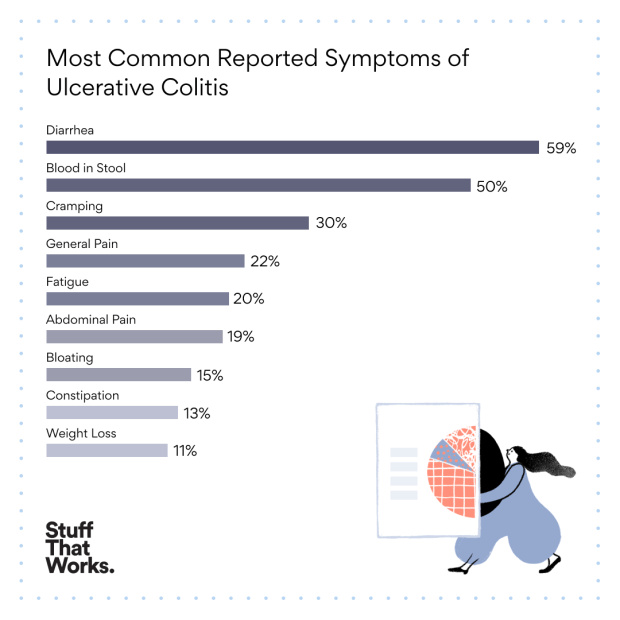
Take the UC survey: https://stuff.co/s/5sSltbnK
On average, Crohn’s community members report they have tried 6.2 different treatments, and 37% describe their Crohn’s as “severe.” By sharing treatment experiences, our community members can use data to help one another figure out which treatments are best for different subgroups of people.
“The power of this database is that it can reduce the years of searching for the right treatment or combination of treatments. Our platform lets people explore how different treatments work effectively together, and we’re able to analyze everything from surgery and medications to alternative treatments, changes in diet, stress reduction and more,” said Elish.
COVID-19 response
StuffThatWorks is in a unique and powerful place to help advance the research on COVID and understand how it impacts people with different chronic conditions. Who is more at risk? Does the virus present differently in people with certain conditions? Do certain treatments work better/worse for them?
“We are currently prioritizing COVID-19 research by inviting everyone with a chronic condition to contribute to the research by answering questions about their experiences related to the coronavirus pandemic, even if they do not have the virus. We are also inviting all current StuffThatWorks members to fill out the coronavirus questionnaire and contribute to this new research,” said Elish. “We’ve also set up a dedicated coronavirus discussion forum, where doctors are answering questions and providing important information about the latest research.”
In a time when many people are feeling anxious and alone—discussion boards are helping to bridge the communication gap and allow for people to connect with one another. StuffThatWorks community members are seeking support about decisions: Should I cancel my doctor’s appointment? How much am I at risk if I am taking immunosuppressants? How can I help my partner understand my anxiety about coronavirus?
The world is suddenly realizing that crowdsourcing is the holy grail of how to gather health care data on a large scale. The real-time nature of it is particularly important, and the ability to get data from such a vast number of diverse sources.
Crowdsourcing research is limitless: The hope for the IBD community
You’ve heard the adage “strength in numbers”. Once large numbers of people with IBD sign up and become members on this free platform, everyone from the newly diagnosed to veteran patients can find something new and continue to evolve and learn about their patient journey.

Take the Crohn’s survey: https://stuff.co/s/bzqQR5xP
“I want people with IBD to feel empowered – that this community is THEIRS, not OURS – and that they can determine what it’s used for and how it can be most helpful. They can add new research questions, post personal discussions or experiences and ask others specifically what works and doesn’t for them,” said Elish.
As members of the IBD family, by joining this platform we immediately become part of a supportive community where we can talk with others just like us, either collectively, or one on one, about how we manage and handle the day-to-day with our IBD.
Driving Research through Patient Reported Outcomes
Patients like you and me have power to influence the research direction of the medical world. We are all a piece of the puzzle and play a critical role in helping with the future development of medications and treatments, and hopefully one day a cure.
So much medical research is done using small groups and funding for large-scale research is extremely hard to come by. The opportunities are endless with crowdsourcing, in terms of the research that can be collected and the solutions we as patients can only provide. 
Whether it’s shortening the amount of time it takes to get an IBD diagnosis or helping people find optimal treatments quicker, by sharing our experiences we gain invaluable insight into improving our quality of life and managing our chronic illness. It’s truly a win-win for everyone involved.
Check out StuffThatWorks and sign up for free as a member. Take part in building a knowledge base aimed at figuring out which treatments work best. Your story. Your experience. It’s powerful and it all matters.

 Jadyn woke up with a fever and a slight cough. Given the craziness of the times we live in right now, they immediately called the COVID-19 hotline. Once the person on the other line heard about Jadyn’s health history and the fact she is immunocompromised, they agreed, Jadyn needed to be seen. In urgent care, Jadyn was tested for the flu, strep throat, and COVID-19. The Richt’s were told they would have a test result in five days, it’s been more than a week now, and still no result.
 I’ll allow Anna to take you back to the beginning, so you can have a better grasp of their ongoing journey and how it’s brought them to where they are today.
 The first couple years were nothing short of a dog fight. I remember sitting in my sister’s living room after an appointment when all of the sudden the doctor’s number popped up on my phone. She was calling to say that Jadyn’s lab results didn’t look good and we needed to head to the hospital right away.


 lights camera crohn's