
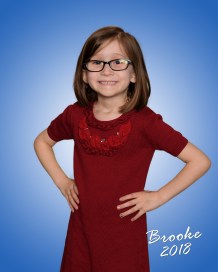
 She’s a ball of energy and a sweet little chatter box, wise beyond her years. Seven-year-old Brooke, of Missouri, was diagnosed seven months ago with Crohn’s disease. She spiked a fever on New Year’s Eve 2017 that lasted for eight days, and from that point forward, life was never the same.
I had a chance to get dinner with Brooke and her mom, Tara, this past week. I couldn’t help but look at this little girl in awe. Despite already being hospitalized three times since March and starting on a biologic drug in August, it was as if she has dealt with the disease her entire life. She talked candidly about all the pokes of the needles and how she tells all the nurses they are her friend. She raved about the tater tots and pancakes at St. Louis Children’s Hospital. And laughed about how annoying it is when the lights go on in your hospital room in the middle of the night. She was more like a teenager, than a little girl.
Here’s how her Crohn’s diagnosis came about. After ruling out the flu, mono, strep and a UTI, doctors discovered she was anemic. The pattern of fevers continued for two months. Still no answers. As time passed, Brooke’s pediatrician started considering a GI issue. After an endoscopy and colonoscopy,  Brooke and her family were told she had Crohn’s disease on March 2, 2018. In a matter of months, she went from being an outgoing, energetic kid to a hospital patient on a laundry list of medications. She developed her first fistula while on methotrexate and was on prednisone for more than three months.
Dealing with the diagnosis
Fast forward to this past summer and this sweet little girl received her first Remicade infusion four days before she started first grade. Brooke is the first person in her family to receive an IBD diagnosis. Her mom, Tara, says these past months have been the hardest she’s ever endured. Her mind races with the what ifs, as she navigates her family’s new normal.
“Were there signs we should’ve seen sooner? Di d we do something to cause this? Were we making the right decisions for her treatment and care? Brooke has a HUGE personality. When she was first sick, and before her diagnosis, she just stopped talking. She would lie on the couch for hours and hours every day. This was not my Brooke. She normally can’t sit still for more than a few minutes! I was SO scared because I knew something wasn’t right. Watching her in pain and miserable for two months while we waited on this diagnosis was miserable. You just feel helpless…all we could do was love her and pray,” said Tara.
Juggling life and family from the hospital
Tara and her family have encountered many challenges along the way. Between the costs of the medications, the hospital stays, all the tests and trying to juggle work. To say it’s been a lot, is an understatement. Tara’s husband, Josh, works from home which helps, but Tara is a preschool special-education teacher. She was out of paid sick days by the end of January of this year. Although both employers have been understanding of Brooke’s health situation, the family has taken a big hit financially.
“ When you’re going through this, you are spread so thin and it’s difficult to ask for help. We have another daughter, Haley, who is 10. Of course, when Brooke was in the hospital, either Josh or I were with her every minute. We live over an hour from Children’s Hospital in St. Louis, so it wasn’t possible to pop up for a quick visit. It was also hard for us to ask for support. We needed help mentally, financially, and logistically with many things. We have an AMAZING support system of family and friends who have helped us throughout this process.”
An advocate from the start
Brooke has been a true IBD warrior every step of the way. She doesn’t even cry anymore when she gets her IV. Brooke openly communicates about her diagnosis and is able to tell you which foods trigger symptoms, and which are safe for her to eat. She explained to me how she’ll have one strawberry at lunch at school, if it doesn’t “hurt her tummy” she has two strawberries the next day, and three the day after that. This little girl just gets it. Tara says in just a few short months, Brooke has already become a very good advocate for herself.
“Watching my baby go through this has changed me forever.  Although I know she doesn’t know yet, what it really means to have Crohn’s, I am always so amazed by her strength. She talks about it very ‘matter-of-factly’. It doesn’t define her. I hope and pray constantly that anything that I encounter, I can deal with, the way she has dealt with this. It’s made our family stronger by seeing that we can face this together.”
A GoFundMe page has been created for Brooke and her family. Click here to submit a donation, every dollar helps!

 has worked in the life insurance special risk marketplace for more than 30 years. He specializes in helping those with pre-existing conditions, such as Crohn’s disease and ulcerative colitis. While he’s not able to represent everyone, he works closely with companies who underwrite conditions such as IBD the most favorably.
 Insurance can be confusing—no matter what type you’re dealing with. Some of the most common misconceptions with life insurance protection are that it’s too expensive, too complicated and that conditions such as IBD are not insurable. This is simply not the case.
 The profession entails a great deal of stress, both physically and mentally. Not only are the hours long, but you are exposed to a ton of people who are sick, while you are immunocompromised.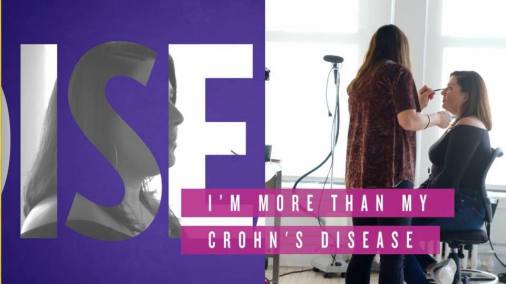


 “The Pain Companion: Everyday Wisdom for Living With and Moving Beyond Chronic Pain.” The author, Sarah Anne Shockley, lives with chronic pain herself and offers sage advice about how to find compassion within yourself and adjust your mindset. To Sarah, “pain is a necessity, but suffering is an option.” I’ve found personally after living with Crohn’s for more than 13 years, that the way I look at, deal with and handle pain has evolved greatly in that time. It’s not something that happens overnight, but you’ll notice a transformation within yourself as time goes by. You come to find a kind of patience and strength within yourself that you never knew existed.
 This excerpt really spoke to me, since no two IBD patients have the same exact journey or disease process or pattern. We’re all unique in how we experience the disease but can find great comfort from leaning on those who “get” the pain on a different level than the average person.
 The same goes for chronic pain. We all know with IBD that symptoms of a flare start to fester. We know it deep down and may try and keep the worry and stress to ourselves. Until the pain is too much to take on alone. Think of pain as your body communicating with you and giving you a target for healing.
 Linde graduated from my high school and later moved to St. Louis. She currently resides in Atlanta, where she works for the CDC and does Policy work for the division of lab sciences.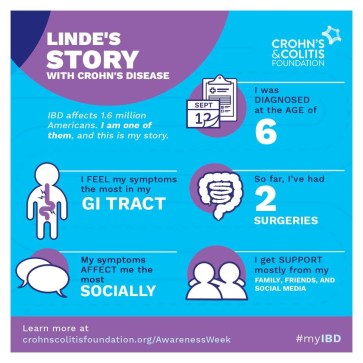
 I’m training for a half marathon and taking on the biggest fitness and
 There aren’t a whole lot of “safe spaces” for those of us to feel understood and connected with.
 As someone who’s battled Crohn’s disease for over 13 years, I constantly find myself needing to take a step back and remember that the only person who’s lived my journey is me. It’s up for me to tell my story. It’s up for me to share it. It’s up to me to communicate to those when my feelings are hurt or I’m disappointed. But before I jump to conclusions, I need to assume the other person is trying to help me or learn more about my experience—rather than ruin my day or hurt my feelings. API all day, baby. Try it. Trust it. Live it.
 This week, a look into her life and how she took on the disease as a preteen, went to college out of state and landed her dream job in California with Walt Disney, after growing up in Wisconsin. My hope is that Emily’s story of perseverance, brings comfort to parents and fellow children and teens experiencing IBD as their life story unfolds.
 While I know that my parents were scared, confused and upset that I was going through this, they never let that show to me. They were and always have been the ones that lift me up when I am down, and never fail to stay by my side through all I have endured.
 And there were times when I wished I would have decided to go to school closer to home, because that would have been easier. The biggest roadblock was the physical distance, because it meant a lot of back and forth travel. Especially, during flare ups. I found myself needing to make the 4-hour drive home more often than I wanted to, which resulted in the need to miss more classes. Additionally, learning to manage my symptoms completely on my own and having to adequately communicate with my medical team from so far away, was challenging at first.
 My health took a drastic turn and it became clear that I would need an ostomy sooner rather than later. I initially was very scared and upset that this was happening. I didn’t know what an ostomy was or anyone that had one, so I had little idea of what to expect going into it. By the time I was a couple weeks away from surgery, I was honestly ready to have it done. I had been experiencing more symptoms and was ready to have the surgery behind me and be feeling better. I was doing my best to go into things with a positive outlook and think about it as a fresh start, but this was no easy task for me. It was an overwhelming and emotional couple of weeks following the surgery getting used to having and caring for an ostomy. I am not afraid to admit that I was scared to look at it and care for it myself after my surgery. But then I realized, this isn’t going to go away anytime soon, so I had to start doing things myself. The more familiar I became with everything, the more comfortable I was and began to realize that I was actually feeling better than before the surgery. This was hard for me to admit to myself, because I didn’t want to be put in the situation of having an ostomy or needing one for the rest of my life. While I am now on the road to needing a permanent ostomy, it still has not sunk in that it will actually happen yet. And I don’t think it is going to fully sink in until that surgery happens.
 This is something that I never thought I would get to experience, and I think having Crohn’s has made me appreciate this opportunity more than I could ever imagine. The last year has been a wild roller coaster ride. I am just thankful to be here, because there were many times where I didn’t think I would even be able to graduate last year. My family and friends have been very supportive because they know how much this opportunity means for me personally and professionally. It is hard to be this far away from my main support system, but they are always just a text or phone call away. Additionally, my providers were very encouraging to me, pushing me to continue to live my life to the fullest and not let my disease slow me down. Hearing them say that to me, was really the last push that I needed to make this a reality. Knowing that my medical team wanted what was best for me, and was willing to work with me to get me where I am today, helped give me the confidence that I could do this.
 It is important to trust their advice and recommendations, as scary as they can be sometimes. Additionally, try your best to not dwell on the negative things that are currently happening and think about what your future can hold. Always do your best to roll with the punches and keep moving forward, your best is all you can do.
 You have your husband and children, but other than that…all your family and friends are thousands of miles overseas. That was the case for my college friend, Brittany Cable. Brittany was diagnosed with Crohn’s in 2007, about a year after she had her oldest son.
 Despite the hardships and heartbreak through her life, she’s never allowed the difficult moments to dull her spirit. She tells it like it is and isn’t ever shy when it comes to sharing her story. I’ve always admired that about her.

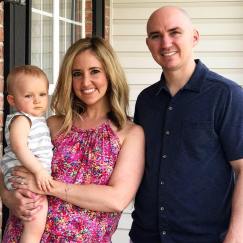
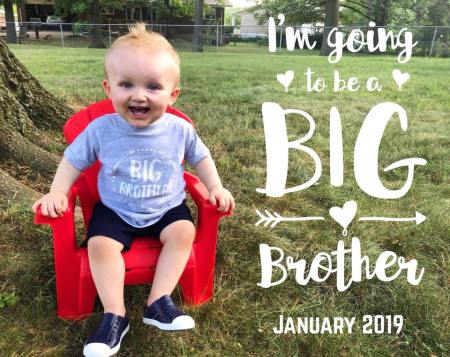
 Everyone works together to watch me, the baby and the pregnancy every step of the way. We get an ultrasound once a month! I see that as a perk!
 lights camera crohn's