
Twenty years ago, Katy Love, was diagnosed with Crohn’s Disease. She was a sophomore in college. She could barely make it out of bed some days, due to the enormous amount of pain and overwhelming fatigue. After her diagnosis and subsequent surgeries, she wondered if she’d ever be able to have a “real job” – like many of us in the chronic illness community, she worried about how she would be able to work and manage her illness. Katy didn’t allow her diagnosis to prevent her from following her personal or professional dreams. Now as an IBD mom, running her own PR business from home, in the middle of a pandemic, she has some advice to share about being successful in the face of adversity. 
After graduating from college, I took a job at an interactive advertising agency. My dream job. Then, reality set in. I needed to ask for accommodations for my Crohn’s disease– I had to ask for a flexible schedule – one where I could work from home when needed.
I was elated when the agency agreed. Since then, I’ve been blessed to work with several teams (for other companies) that understood my illness and trusted me to work remotely when needed. As someone who has worked from home quite often during my career, due to a chronic illness, I’ve learned a few helpful best practices that have helped save me time… and my sanity.
Create a realistic routine and office hours. If you know you can’t start working until 9 a.m., due to family obligations, don’t start your work time until 9 a.m. Then, plan accordingly for your end time each day. Be sure to share your office hours with your family and colleagues. It’s important for everyone to know when you’re working. Also be patient with your new schedule. As with all new things, it will take some time to become a true routine. This is all new territory – working from home is a normal occurrence for me, however, having all my children and my spouse at home, while trying to work from home, is a new challenge.
Get Dressed. Every single day. I know this may sound silly, as you haven’t left the house in weeks. But I find this extremely important. It sets the tone for the day. When you look the part, you’re much more likely to feel the part. Plus, with all the Zoom calls, you want to look like you aren’t wearing yesterday’s PJs for the weekly team meeting.
Establish a defined workspace. You need an area where you know – this is my desk, my work zone. Your family members know that when you are there, you are working. Working from bed sounds delightful…I love my bed. However, it’s easy to be distracted if you’re not in a specific workspace.  Also, surround your workspace with all that you may need during the day. Computer, chargers, phone, etc. I like to also put candles or fresh flowers near my workspace – they smell great and elevate my mood. With spring finally here, go outside and pick a few flowers and put them in a mason jar. Anything that makes you smile and motivates you.
Communication is KEY. I learned this early on in my career. Just because you’re not in physical sight of your team, and your employer, you want them to know you’re ON and working. The worst thing you can do is go dark. If they don’t see you, hear from you, it’s easy to assume you aren’t taking working from home seriously. So, over-communicate with your team during this time.
Take breaks throughout the day. When you’re setting up your new routine/office hours, schedule breaks into the day. Personally, I like to work out in the mornings. So, finding 30 minutes to hop on my bike sets my day up for success. In the afternoon, take a walk outside, or bake with your kids.  It’s extremely important to incorporate self-care into your routine right now. There’s so much uncertainty and doom/gloom in the news. Make sure you are taking time to appreciate yourself, your team, and your family, while keeping your health as a top a priority.

 She’s a 30-year-old mom and wife from Utah, who works full-time outside the home. She’s battled Crohn’s disease since December 2011.
  My mom did an amazing job making sure our lives did not revolve around her disease. She did her best to stay healthy and support us. I want my daughter to have the same experience as I had growing up. I don’t want her to ever feel the burden of my disease. I want her to know that no matter how difficult life gets, there is always hope. My mom is the one person I can call who fully understands my struggles. To have another family member that has and is dealing with the same chronic health issues is a huge support. I am very grateful for her.
 I remember explaining to him at one point that this disease would be something I will deal with my whole life and it was okay for him to leave me. It’s really hard to put my relationship with my husband into words. When it comes to Crohn’s, the thought of all he does to support me, makes me tear up. He knew that after our wedding day he would take my mom’s place at all my appointments and be my sole caregiver. Nate never shied away from the challenge and it makes me love him more and more everyday. He is my number one and having support from him means the world to me.


 It feels like a fiery pain inside my rib cage that travels all the way down my stomach. The gnawing makes me feel raw internally and externally. I put my glasses on and as I’m standing up and rocking my daughter in her nursery, I try to think of her warm little body as a heating pad.
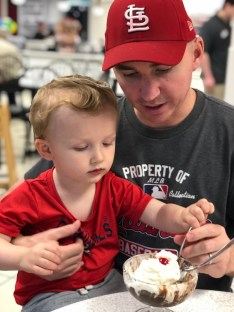 The fact that so many people without IBD are under the assumption that our pain and symptoms are self- imposed upsets me. We already beat ourselves up mentally as it is. My husband and I took our son for ice cream last night, so immediately I wonder if all of my pain is a result of the choice to have ice cream with my 2-year-old.


 One of the most helpful pieces of the toolkit is the


 This Friday, I’ll be 27 weeks complete with my baby girl. My January due date is quickly approaching. Time is going both fast and slow. For the most part, my Crohn’s has behaved itself. But, there have been multiple times where I can’t seem to decipher if what I’m feeling is related to pregnancy aches and pains or my IBD. The burning and gnawing feeling in my abdomen often feels so reminiscent of the beginning of a bowel obstruction that I can’t help but fear the worst.
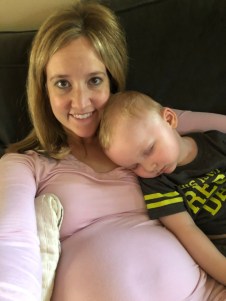 It’s difficult because every single pregnancy is different and so is every single person’s IBD. My OB tells me that with a contraction the pain will come and go, and I’ll be able to see a pattern and time it, whereas Crohn’s pain will be constant.
 My advice to myself and to all of you who may be dealing with these same fears and thoughts is to listen to your body. Be mindful of when you hurt, why you may be in pain and how often it’s taking place. Don’t turn a blind eye to your aches and don’t feel like a bother to your GI or OB. Reach out to your healthcare team and alert them when you have a concern, so they are aware of what’s going on. This is not a time to internalize your pain. This is a time to be vocal, be your own best advocate and start being the strong IBD mama that you are for your unborn child.
 lights camera crohn's