
What do you get when you mix chronic illness, dark humor, artistic storytelling, and a deeply broken healthcare system?
You get The Out-of-Network Network — a sharp, satirical, and heart-achingly relatable newsletter born from the experiences of patients who’ve seen (and survived) the absurdities of the American healthcare system firsthand.
Founded by Ian Goldstein, a Crohn’s disease patient and comedy writer, and Amanda Lehr, a writer navigating ankylosing spondylitis (AS) and mast cell activation syndrome (MCAS), OONN is more than a newsletter. It’s a lifeline. A laugh. A community. And most importantly — it’s a call to action, cloaked in clever cartoons and short, punchy stories that make you feel less alone in the madness of it all.
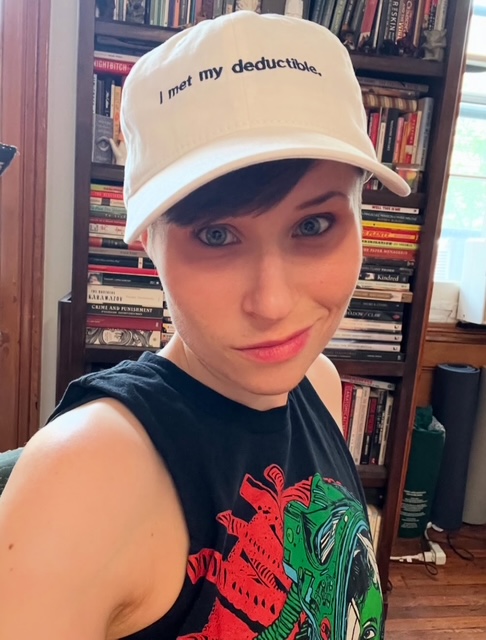

Meet the Founders
Amanda Lehr may not have Crohn’s, but as she puts it:
“I’m a fellow member of the ‘My Body is an Autoimmune Fight Club’ community.”

She’s lived with ankylosing spondylitis since her teens and recently received a diagnosis for MCAS — a condition that turns everyday encounters into allergic warzones.
“Being in my body is like trying to live in the booby-trapped Home Alone house: if there’s not a real intruder around, I’m the one getting hit by swinging paint cans and having my head set on fire.”
For Ian Goldstein, Crohn’s has been a two-decade battle, from bowel resections and obstructions to navigating biologics like Humira, Skyrizi, and Rinvoq. His life revolves around the proximity to hospitals, navigating insurance loopholes, and, like many chronic illness patients, learning to laugh at the chaos.
“I find so much humor in the world of healthcare. Not in the pain we patients deal with. But in the absurdity of interactions and situations that doctors, insurance companies, and people ignorant to our plights bring.”

How Out-of-Network Network Was Born
It all started with what Amanda and Ian lovingly refer to as “The Luigi Incident.”
A moment of internet virality around a meme, combined with a groundswell of people sharing stories about healthcare trauma… it lit a spark. They saw an opportunity to make something lasting.
“Knowing how fast the news cycle moves, we didn’t want this conversation to get lost in the shuffle,” Amanda shared.
So, they built OONN: A weekly Substack newsletter that pairs short healthcare horror stories with custom illustrations — funny, heart-wrenching, eye-opening, and artfully absurd.
“The situations we face aren’t inherently funny,” Ian says. “But how incompetence plays out — lazy doctors, power-hungry insurers, $70,000 hospital bills for inedible food — that’s darkly hilarious.”

Community Through Cartoons
Some of Ian’s favorite entries include:
- “Paying $70,000 for the shittiest food I’ve ever eaten” by Katy Maiolatesi (Illustrated by Kirun Kunju)
- “COBRA for Valentine’s Day” by Nathan Place
- “Ladies and Gentlemen, Here Are My Organs” by Amanda Lehr (Illustrated by Sólveig Eva Magnúsdóttir)
Amanda, meanwhile, loves the diversity in voice and style across their contributors.
“As a writer, I enjoy collaborating with such distinct voices and artistic styles. As a human, I’m moved by how we all come together around this common belief: healthcare should not be a luxury product.”
The Common Denominator
So, what’s the throughline in the stories they receive?
“It’s a combination of incoherence, incompetence, and institutional hostility,” Amanda explains. “Sick and disabled people end up spending hours fixing mistakes that could bankrupt them.”
“People are crushed by sky-high bills and red tape,” Ian adds. “And those burdens pile onto lives already made difficult by chronic illness.”

More Than Just a Newsletter
For both Ian and Amanda, OONN is as therapeutic as it is informative.
“The first word that comes to mind is catharsis,” Ian says. “Reading someone else’s story — and laughing through it — tells me I’m not alone, and I’ll get through it.”
Amanda agrees, “It’s not better medicine than my biologics, but it’s still pretty damn good.”
Want to Share Your Story?
The Out-of-Network Network is always looking for contributors — writers and illustrators alike. If you’ve got a healthcare horror story, a cartoon-worthy insurance mishap, or just want to laugh (and cry) with the community, you can email Ian: ianscottgoldstein@gmail.com or Amanda: amanda.lehr@yahoo.com.
Final Advice from the Frontlines
Ian shares one last nugget of wisdom — a survival tip for navigating healthcare:
“Record everything. Record your doctor when they give you results. Record your call with your health insurance. Just make sure you’re legally allowed to. It helps you remember things, and it protects you if you need proof later.”
You’re Not Alone
Whether you’re battling Crohn’s, AS, MCAS, or just trying to make sense of a $3,000 copay for a basic test, Out-of-Network Network reminds us that laughter really is the best medicine (after your biologic infusion, of course). And that in this broken, bureaucratic mess of a system, solidarity and storytelling might just help us all stay sane, one cartoon at a time.

You can also subscribe to their weekly newsletter on Substack and follow them on Instagram: @out_of_network_network, @iangoldsteinyes, and @amandamlehr.

 Your disease is making the simple task of sitting in class alongside your peers an ordeal. While you may feel alone in this moment, thousands of college students around the world living with IBD can relate to this overwhelming stress and strain.
 Balance is key. Health comes first,” said Aaron Blocker, a Crohn’s patient and IBD advocate. “It sucks to have to pause college because of your health, but school will always be there, and your health is important for long-term success.”
 As a straight A student, now struggling to pass classes due to an awful flare, I was devastated that I needed to ask for help. I was appreciative of my professors’ extreme kindness and that I was granted accommodations (deadline extensions, attending a different lecture on bad days, rescheduling exams, etc). This was a profound moment that taught me it was okay to ask for help,” said ulcerative colitis patient and IBD advocate, Jenna Ziegler.
 Ask for extra time, ask for a note taker. Get in touch with your school’s office for those with disabilities. Access the support you need to be on equal ground.”
 I also can use the bathroom frequently without question, eat in class without any questions and I’m allowed more than the usual 2 absences allowed in most classes,” said Tina Aswani Omprakash, Crohn’s patient and IBD advocate. “If there are group projects and I can’t partake; I ask the professor if I can do something on my own.”
 Family planning is exciting, nerve-wracking, and daunting. Couple those emotions with battling inflammatory bowel disease (IBD) and the experience can be downright overwhelming. The tide is changing though when it comes to pregnancy and IBD, thanks to the
  With two sons, ages six and three, she felt even more in the dark during her preconception discussions and pregnancies.
 “The IBD Parenthood Project is a huge win for the IBD community. This resource is paving the way for how we work together with our clinical team. This is a proud moment for the IBD family. We’re showing the health community how to work collaboratively with patients,” explained Jessica. “I never want women to feel alone in the process. This initiative empowers IBD women and their support systems, and makes the experience of bringing a life into this world a whole lot more enjoyable and a lot less worrisome.”
 Upon delivering both of my babies, I felt symptoms start to creep back into my life less than a week after they were born. I too would include an MFM specialist in the future, if I were to have another child.
 lights camera crohn's