
For women living with Crohn’s disease or ulcerative colitis, the question of whether to have children can carry a weight that goes far beyond the usual conversations about fertility and family planning.
Will my disease be controlled enough to have a healthy pregnancy? What happens if I flare while I’m pregnant? Will my medication affect my baby? What if I’m too sick to care for a child? What if breastfeeding means making another difficult medication decision? And the question that can be hardest to articulate: Will I be able to experience motherhood without IBD taking over the entire experience?
For Grace Hubbel, those questions aren’t simply academic. They are personal.

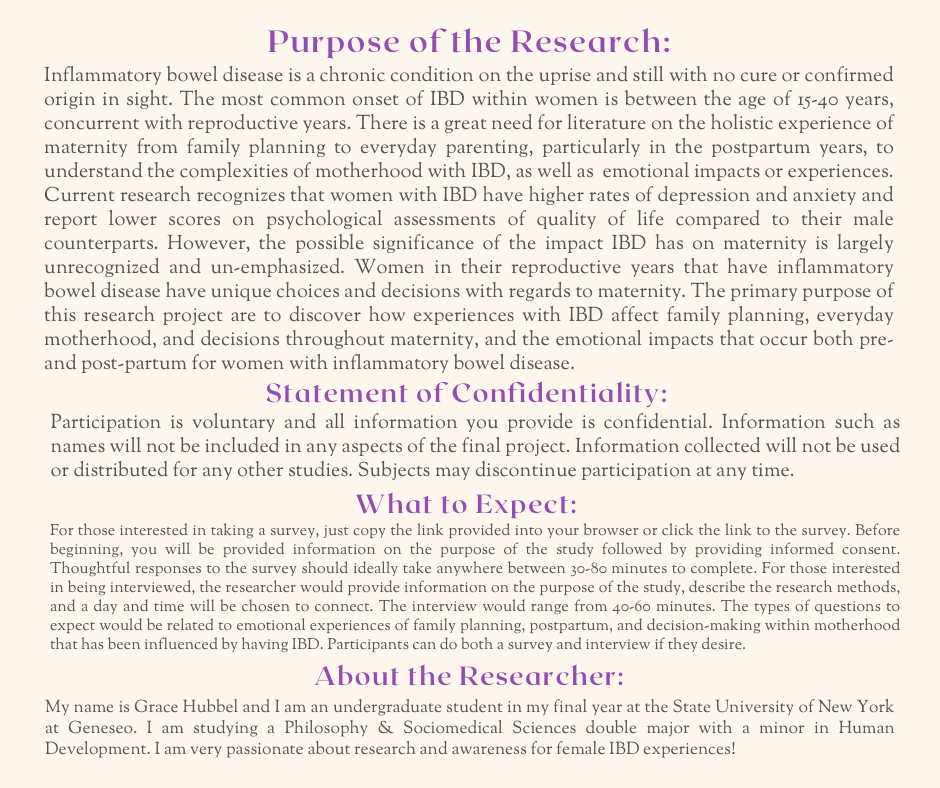
Diagnosed with Crohn’s disease at 14, Grace is now 22 and studying sociomedical sciences at the State University of New York at Geneseo. Her own experience with IBD and the stories she has heard from other women, led her to pursue an IRB-approved research study examining “The Impact of IBD on Decisions in Maternity and Emotional Wellbeing in Women.”
This week on Lights, Camera, Crohn’s a look at how her personal experience as a young woman with IBD inspired this incredible research and how you can get involved as a citizen scientist. Grace’s goal through her study, “The Impact of IBD on Decisions in Maternity and Emotional Wellbeing in Women” is to explore an area of IBD research that she believes has been overlooked: not simply what happens to a woman’s body during pregnancy, but what it feels like to make decisions about motherhood while living with an unpredictable chronic illness.
A Crohn’s diagnosis at 14
Grace grew up watching her older brother struggle with Crohn’s disease. He was diagnosed when he was starting college and nearly lost his life before his first surgery. When Grace began experiencing symptoms of her own at 14, she wasn’t completely surprised.
Her disease quickly became severe. She lost weight rapidly, her menstrual cycle stopped, and painful sores and ulcers made it difficult to swallow. She remembers feeling exhausted and unlike herself.
“I crawled into my mother’s bed once and told her it felt like I was disappearing with how I was losing pounds by the week,” Grace recalls.
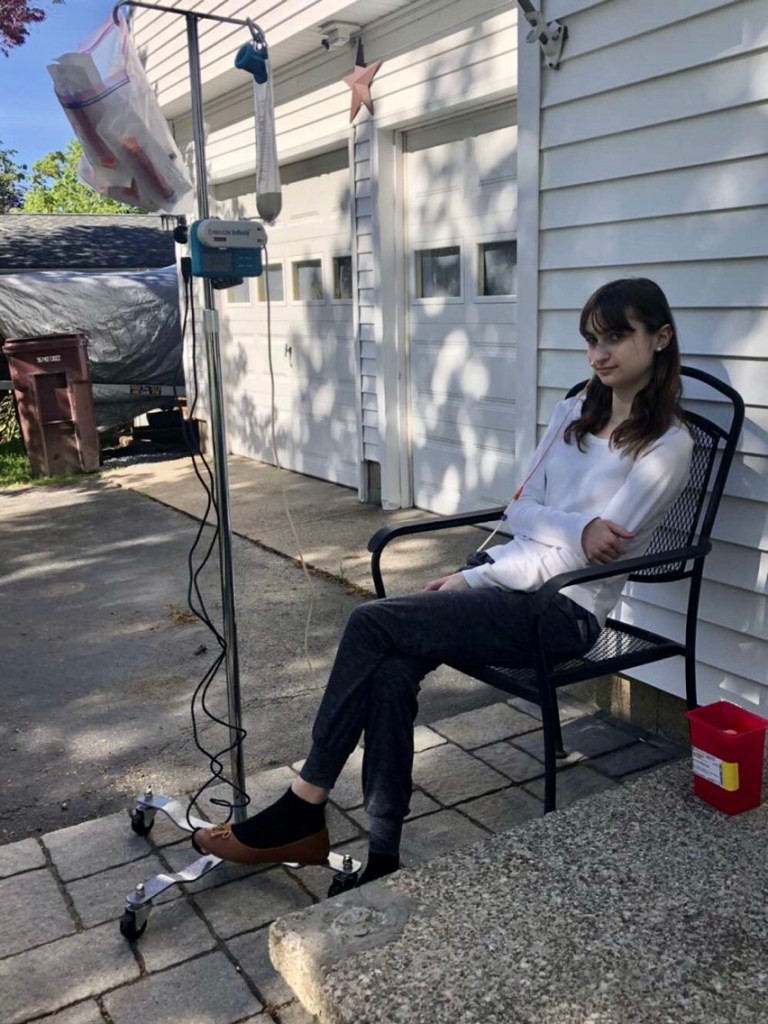
At an age when many teenagers are focused on school, friends and figuring out who they are, Grace was learning a different vocabulary: tests, treatments, infusions, injections, and surgery.
“I was so young, I felt so different from my peers around me,” she says. “I spoke fluent in healthcare, in tests, I was forced to grow up so fast.”
Her Crohn’s journey has included steroids, infusions, injections, tests, a feeding tube, and surgery. At 22, Grace says she is still chasing total mucosal remission and continues to deal with hidden inflammation.
“Will I be able to become a mom someday?”
And almost immediately after her diagnosis, another question entered Grace’s mind.
Would she ever be able to become a mom?
Grace says motherhood was on her mind within months of being diagnosed.
Part of that fear came from watching someone she knew with Crohn’s experience a life-threatening postpartum flare and be unable to have more children. That story stayed with her and illustrates one of the most difficult aspects of IBD whether you’re a parent or not: uncertainty.
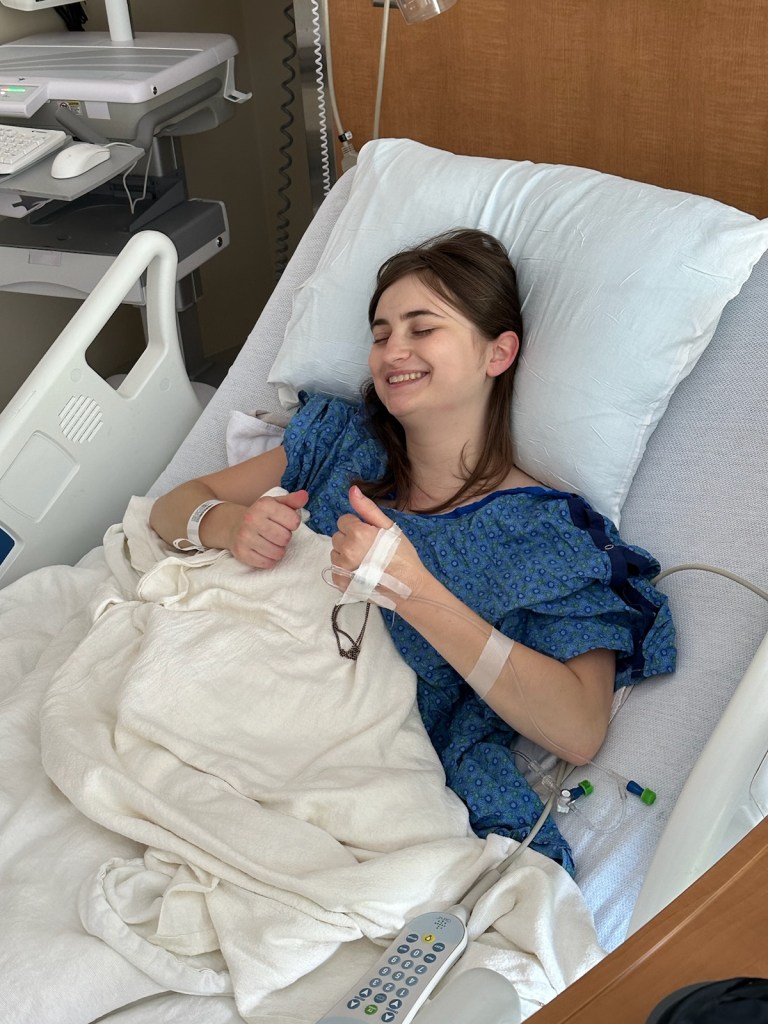
“The monstrous part about IBD is its uncertainty,” Grace says. “It never ceases to amaze me how for some individuals a round of medicine will get their body into remission, and another person will have unrelenting inflammation for years and years.”
For women with IBD, that uncertainty can intersect with some of life’s biggest decisions.
Grace knows this firsthand. Throughout various stages of her disease, she has wondered what a flare would look like during pregnancy or while caring for a young child.
What if severe diarrhea caused her to lose weight and made it difficult to get enough nutrients for a baby? What if medication affected her child’s immune system? What about breastfeeding and medication exposure?
Today, Grace takes Stelara, and she says she thinks about the fact that it can pass through breast milk. She has always dreamed of breastfeeding a baby but wonders how she would weigh that desire against the medical considerations.
And increasingly, another concern has emerged: the emotional experience of pregnancy itself.
“I worry most of all about having to work extra hard as a high-risk pregnancy and that I’d be obsessive about it all,” she says, “living outside of the special moments and experiences because of viewing it all through a clinical lens.”
That sentence captures something that statistics and clinical guidelines can’t always convey.
A pregnancy with IBD isn’t just a series of medical decisions. It can also be an emotional balancing act between wanting to enjoy a deeply meaningful life experience and being unable to completely turn off the part of your brain that is constantly monitoring your disease.
Seeing a gap in IBD research
As Grace learned more about IBD, she found comfort in understanding the disease from both scientific and sociological perspectives. She connected with other patients online and found women with IBD who had navigated motherhood and became role models for her.

That interest eventually led her to major in sociomedical sciences.
When it came time to develop an independent research project, she knew immediately that she wanted to study IBD and women’s health.
That project eventually grew into her current IRB-approved study. Grace noticed that while there is substantial scientific literature examining Crohn’s disease and ulcerative colitis during pregnancy and childbirth, there is far less research examining the qualitative experience of women living through motherhood with IBD.
In other words, researchers have studied many of the physical and medical questions. Grace wants to better understand the why behind women’s decisions, experiences, and emotions.
“This told me something was missing,” she says.
And the missing piece matters.
IBD is commonly diagnosed during reproductive years, meaning many women are forced to make decisions about fertility, pregnancy, breastfeeding, and family size while simultaneously navigating an unpredictable disease.
Could uncertainty itself be affecting women emotionally?
One of the findings that initially caught Grace’s attention was that women with IBD commonly report higher rates of psychological distress than men with IBD.
There are several explanations, but Grace wondered whether another factor deserved more attention.
Could the uncertainty surrounding fertility and motherhood contribute to that emotional burden?
“Could any of it have to do with how uncertain it can be for women to navigate a motherhood journey with an unpredictable illness such as IBD?” she asks.
That question became central to her research.

Rather than focusing solely on conception and pregnancy, Grace wants to understand the entire motherhood journey:
- What does it mean to parent while living with IBD?
- How do mothers explain their disease to their children?
- Does becoming a parent change the way women cope with their illness?
- How do women make decisions about breastfeeding or having additional children?
- And perhaps most importantly, how do those decisions make women feel?
“These are the questions I want to explore,” Grace says.
Motherhood doesn’t end at delivery
One of the most compelling aspects of Grace’s research is her focus on what happens after pregnancy.
So much of the conversation around IBD and reproductive health centers on conception and pregnancy. But motherhood is a lifelong experience and IBD doesn’t disappear once a baby is born.
Grace says some of the women she has heard from have described waiting for their doctors to give them the “go-ahead” before trying to conceive.
Others have described delaying or avoiding medical care when they were very sick because they didn’t want to leave their children or frighten them.
But the stories aren’t exclusively difficult.
Grace says she has also heard about positive experiences, including mothers who have noticed their children developing deep empathy toward other people because they grew up with a mother living with IBD.
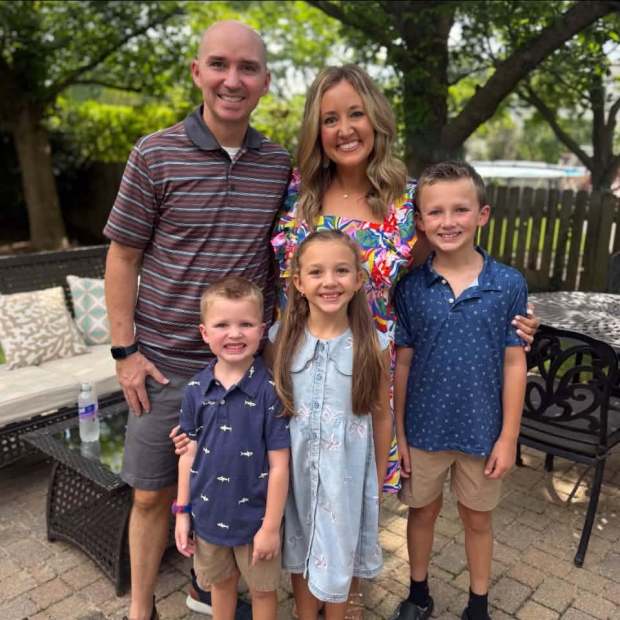
That is an important reminder: IBD can shape motherhood in challenging ways, but it can also shape families into beautiful ones. As an IBD mom of three kids (ages 9, 7, and 5) I can’t attest to this. Motherhood was the best decision I ever made and my kids are my constant motivation to push through, stay on top of managing my Crohn’s so I’m well for not only myself, but for them, and reminding me all my body is capable of despite my disease.
The decisions women make behind the scenes
One theme Grace has found particularly interesting is the way IBD can influence the timing of family planning. Some women wait for disease stability or medical approval before trying to conceive. Others make decisions about seeking medical care based on the needs of their children. These aren’t necessarily decisions that show up in a medical chart.
They’re the quiet calculations happening in the background of everyday life. And that’s exactly what Grace hopes her research will capture.
The study is designed to explore the experiences and emotional impacts behind these decisions, not simply whether a woman became pregnant or whether she experienced a flare. Because as we know, two women can have similar diagnoses and vastly different emotional experiences.
What Grace wants doctors to talk about earlier
Grace believes the conversation about fertility and family-building should begin much earlier in a woman’s IBD journey. She would like gastroenterologists to routinely ask young women at diagnosis whether they envision having children someday.
“I think it’s so important to get the conversation started and have it routine to discuss it,” she says.
Starting the conversation early can open the door to resources, questions, and appropriate reproductive counseling long before a woman is ready to have a baby. Grace also believes healthcare providers need to be honest about uncertainty.
“We need to be comfortable acknowledging what we don’t know,” she says, particularly when it comes to questions about the long-term effects of medications on children.
She also wants to see stronger communication between gastroenterologists and OB-GYNs.
She has heard women describe being confused about which physician to rely on during pregnancy and postpartum or receiving contradictory recommendations from their doctors.
“Greater communication between OB-GYN physicians, maternal fetal medicine doctors, and gastroenterologists on the topic of IBD and pregnancy is called for,” Grace says.
For patients, that kind of collaboration can mean the difference between feeling like they’re navigating pregnancy alone and feeling like they have a team.
Grace hopes her research changes the conversation
Grace hopes her research will expand how the IBD community thinks about women’s health. The physical side of IBD is important. But emotional wellbeing matters, too.
She points to the connection between psychological health and IBD outcomes, noting that emotional distress can influence disease activity. Her research suggests that the emotional stress of navigating motherhood alongside IBD may be one contributor to the psychological burden reported by women with the disease.
Her long-term goal is to highlight the need for more reproductive counseling and pregnancy programs specifically designed for women with IBD. Because women shouldn’t have to piece together this information on their own. And they shouldn’t have to wait until they’re ready to conceive to start asking questions.
“You will survive some of your biggest fears”
The most powerful part of Grace’s story isn’t the researcher speaking about the gaps in the literature. It’s the 14-year-old girl underneath it all.
If Grace could sit down with herself on the day she was diagnosed, she wouldn’t promise that IBD would become easy. Instead, she would tell her younger self that the disease would shape who she became and that some of that impact would become a source of purpose.
Her experiences would fuel her interest in healthcare and disability advocacy. She would meet healthcare workers who saw through her knowledgeable exterior and recognized the anxiety underneath. She would survive some of the things she feared most. And she would eventually find a partner who would make motherhood feel possible. But she’d also tell herself something many young people with chronic illness need to hear:
You don’t have to control everything.
“I’d tell her to enjoy being a young woman and let go of trying to control so much,” Grace says.
That’s easier said than done when your body has taught you from an early age that anything can change without warning. But that’s also why her message to other young women with IBD is so meaningful.
To the young woman with IBD dreaming about motherhood
Grace doesn’t know exactly what the future holds for her. She still has questions. She still has fears. She still lives with an unpredictable disease. But she isn’t letting uncertainty erase the possibility of motherhood. Her message to other young women with IBD is simple:
“Advocate for yourself and ask questions.”
She encourages women to establish an OB-GYN early and start talking about what pregnancy could look like in the future, even if motherhood is years away. And she wants women to know that they don’t have to abandon the dream simply because IBD may make the path more complicated.
“The reality is, it might be a little more sad and scary to manage,” Grace says. “But from what I’ve learned so far: no women have regretted the choice to pursue their dream, even if it looks different from what they expected.”
For a 22-year-old researcher who has spent much of her life learning to live with Crohn’s disease, Grace is asking a question that deserves far more attention:
What happens when we stop looking at motherhood with IBD solely through a medical lens and start listening to the women living it?
Her research is an important step toward answering it.
Interested in participating in Grace’s research?
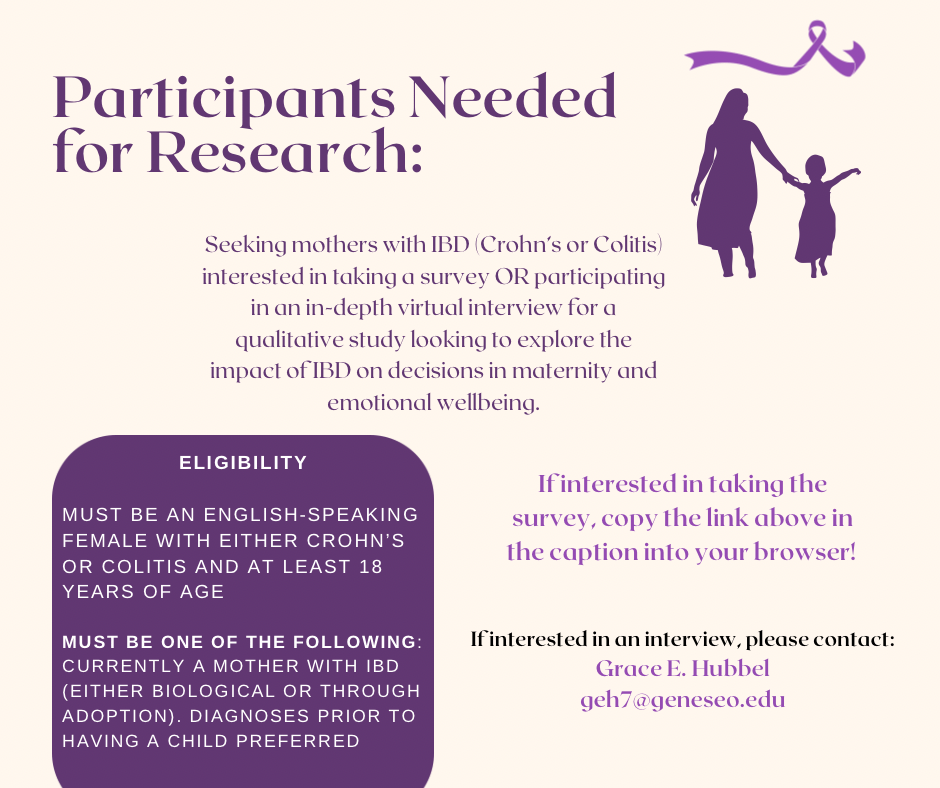
Grace is currently seeking women with IBD who are at least 18 years old, English-speaking, and currently mothers living with Crohn’s disease or ulcerative colitis, either biologically or through adoption. A diagnosis before having a child is preferred.
Participants can complete an anonymous survey or contact Grace for a virtual interview. Participation is voluntary, and information provided will be kept confidential.

 Currently, many patients and caregivers struggle to inject medications correctly, which means patients don’t always receive their full dose of medication. This can lead to symptoms worsening and a greater threat of a flare up.
 There’s also an online study—available to anyone in the United States—going on right now for those living with an immune system or digestive system condition. You can earn $15 for a 15-minute, online survey.
  lights camera crohn's