
This post was sponsored by Onegevity. All thoughts and opinions are my own.
When you live with IBD, the term ‘gut health’ sounds like an oxymoron. But, a group of researchers recently created a cutting-edge at-home test that paints a clear picture of what’s going on within your digestive system. Onegevity’s GutBio was developed to monitor bacteria related to inflammation, constipation, and diarrhea, as well as pathogens and micronutrients. The microbiome sequencing examines the abundance, type and balance of more than 39 trillion microbial cells in your body. The result—you receive an artificial intelligence-powered pattern analysis that is reviewed by a board-certified physician.
“Quite simply, GI conditions are costly diseases with limited preventive care available, explains Chief Scientific Officer,  Dr. Bodi Zhang. “For example, IBS has an average incremental healthcare cost of more than $4,000 annually. By putting simple solutions in front of consumers, we empower them to avoid expensive and costly rounds of medical testing and extreme diet changes that are not precisely matched, but also drastically decrease quality of life.”
As someone who was diagnosed with Crohn’s disease nearly 14 years ago, the GutBio test intrigued me. Even though I’ve been verbally told that I am in “remission” and haven’t been hospitalized with a flare up since August 2015, at times, I still experience disease symptoms.
The GutBio test is simple to do. Here’s how it works. Once you order your test kit, it’s shipped to your home with easy instructions. You send in a swab of your stool (which can be shipped at room temperature, no need for dry ice)—and within 3-4 weeks, you receive a detailed explanation of your genetic profiles.
“This test can help you monitor the bacteria related to your inflammation. Plus, we give specific recommendations that can combat the bacteria we have found, while helping to proliferate the commensal bacteria that mitigate the inflammatory response,” said Dr. Zhang.
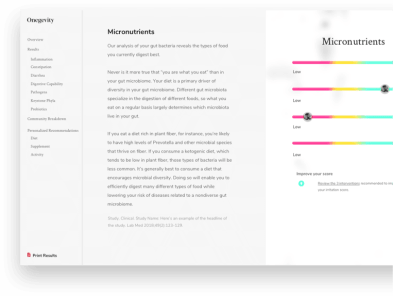 Honestly, the findings of my test shocked me—in a good way. Not only did the results provide me with peace of mind, they painted a clear picture of why I have been having minimal Crohn’s symptoms. Here’s a cliff notes version of my results (the findings shared are a lot more in depth and helpful and include infographics):
Good news! Based on the levels of more than 100 inflammation-associated bacterial species examined, your test result shows a low Inflammation Potential in your gut. This means the balance of inflammation-associated bacteria is optimized in your microbiome.
Our test results have revealed that you have low risk for constipation. We have calculated your constipation score by examining the pattern of hundreds of bacterial species that are known to positively correlate with constipation.
Based on the specific microbial composition of your stool, your test results reveal a low risk for diarrhea. Many bacterial species are known to protect against the development of diarrhea, which means that that having more of these protective microbial species in your gut will help lower the likelihood you will experience diarrhea (absent other influences, such as infection, food intolerance, and medication use). On the other hand, some bacterial species are known to contribute to diarrhea. We have calculated your diarrhea score by examining the pattern of hundreds of bacterial species that are known to positively correlate with diarrhea.
You are in the 85 percentile in microbial diversity, which indicates your gut microbiome is highly diverse. You are likely eating a varied diet. Studies show that individuals with low gut microbiome diversity are at greater risk for certain adverse conditions ‐ ranging from allergies to obesity. Healthy individuals tend to have high gut microbial diversity, while less healthy individuals tend to show reduced microbial diversity.
What does this mean for you? With diverse gut microbial content, you can respond to nutritional changes and you can digest many different types of food. And the good news is that your lifestyle choices will directly influence the microbial diversity in your gut. When you choose what to eat for dinner, you are choosing which bacteria in your gut get fed. For example, if you eat a diet high in fiber, then your fiber-loving beneficial bacteria will thrive, while other non-beneficial species are likely to starve and die.
Your test results indicate that your gut microbial population is not contributing significantly to your daily need of one or more of the B vitamins. Certain gut bacteria produce the B vitamins that support your dietary contribution to the recommended daily intake of folate (B9), B6, B12, and niacin (B3). It is important that you make sure to get adequate amounts of these B vitamins, with particular attention to those B vitamins from which your gut microbial population is estimated to be less than optimal.
Your test results indicate low or suboptimal levels of one or more key beneficial microbes in your gut. Our test analyzes specific beneficial microbes in the stool that are linked with commonly consumed probiotics. When you realize that the number of microbes that comprise the human microbiome is fixed ‐ there can only be so many troops on the battlefield ‐ then the more good microbes you can introduce, the stronger the front line gets. The good news is that you can increase the numbers of these beneficial microbes by consuming probiotics.
Good news! No known pathogens were found in your sample. Pathogens are the bacteria, viruses, and parasites that can cause disease. Pathogens can wreak havoc in the gut by contributing to inflammation that can result in symptoms like pain and diarrhea. In addition, pathogens can damage the intestinal lining, making it more prone to leaking, which in turn can result in food allergies and other adverse conditions.
The personalized diet recommendation is the whole food diet. The basic concept of a whole food diet is to eat foods in their most natural, least processed state. A whole food diet encompasses eating fresh vegetables, legumes, fruits, and unprocessed whole grains. All convenience food, processed food, and fast food are avoided.
Along with the findings and recommendations, recipes and specific probiotic supplements were listed.
After receiving your GutBio results you have the knowledge of what you can do to shift and improve your gut health. For me, I’m going to try and get more Vitamin B12 and possibly start a probiotic. This is also information I plan to share with my gastroenterologist.  Interested in decoding your gut? Click this link and use the promo code: NATALIE2019 at check out for $20 off! (The test costs $349 before the promo code).
To recap: Onegivity’s GutBio includes:
- Simple at-home fecal sample collection kit
- Gut profile and results that compare you to other individuals
- Core gut metrics aggregated and calculated to reveal levels of gut irritation
- AI-driven personalized interventions on diet, exercise, and supplementation that are scientifically based and reviewed by medical professionals.



 Find the people who lift you up. Trust in the bonds you create with those who are there for you because they want to be out of the goodness in their heart, not as an obligation. Hold on closely to the relationships that spark joy and don’t extinguish your flame. Lean on those who are willing to give you their hand to lift you up, even when you don’t ask for it.



 Meet Emily. This past February she received her chronic illness diagnosis. Even though she’s brand new to IBD life, she’s taking all the pain and all the setbacks in stride.
 Her mom was able to reach out to fellow parents on Facebook about a pen pal program.
 From a parenting perspective, the pen pal group has introduced Michelle to other mamas going through the same fears and experiences. The connections have brought her peace of mind as she navigates these new waters with her daughter.
 making new friends? Friends who understand and continually cheer you on, no matter how far they are. My hope is that Emily will make life long connections and that these letters will serve as a constant reminder that she is never alone.”

 studies suggest it may start with a bacterial imbalance in the gut, and several studies have shown that people with IBD were less likely to have been breastfed as infants. Furthermore, a study in Denmark showed that breastfed babies developed certain types of healthy bacteria in their digestive tract, which non-breastfed babies were lacking. A healthy amount of beneficial gut bacteria can promote a healthy immune system which fends off different diseases.
 It wasn’t easy, but I’m so glad I stuck with it. We lasted 16-months until he self-weaned and he has a very healthy immune system so far, despite the cesarean and me being on Humira. Best of all? I didn’t have a postpartum flare, which my doctor attributed to the combination of staying on my medications, following my diet plan and breastfeeding.
 as possible, especially in the first 24 hours, and provide plenty of skin-to-skin. After a c-section, the last thing I wanted to do was constantly get in and out of bed to pick up a newborn. Instead, I just spent my days with my son nestled on my chest so we could both sleep, heal, bond and get my milk flowing.
 Cut yourself some slack. Becoming a mother is stressful, but if you are feeling overwhelmed, talk to someone. Postpartum depression and anxiety are very real and as a mother with chronic illness, you may be more prone to those feelings. Seek out help from your spouse/partner, enlist nearby family/friends for support, and keep in close contact with your doctor to manage your symptoms.

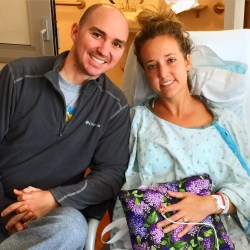 When you’re in the thick of a flare and when feel good days feel far from ever being a possibility, try and remember how fleeting these moments are.
 today he’s a rumbustious, adorable, little ball of energy. Sure, we age, too—but we also mature mentally when it comes to our illness. What felt like the biggest obstacle and scare of our life, evolves into something that is a part of who we are, an identity that while not ideal, helps to define us.
 But I can promise you, that as life goes on and as the years since that moment of diagnosis get further and further in the rear view mirror, you will find a comfort in this identity.
 lights camera crohn's