
As we bid farewell to 2018 there is much to reflect on. Each year brings new experiences, relationships and opportunities. Some years leave more of an imprint on our memory and on our heart, than others. When you think back on the past 365 days what were the highlights? What were the low points?
 For me—the past nine months I’ve been incredibly grateful to have another healthy pregnancy, that silenced my Crohn’s symptoms. I’m also celebrating 3.5 years of no IBD-related hospitalizations or ER visits! The cherry on top was the release of Citrate-free (pain-free) Humira this year! After more than a decade of giving myself the painful injection, the new formula has greatly improved my patient experience.
Here are my 5 wishes for you in the days ahead:
- Strength through difficult days
There’s no telling when the next flare will strike. We all know it’s not a matter of if, but when. When the going gets tough, take it one hour, one moment at a time. Try not to overwhelm yourself with worry. Go to your happy place and think back to past flares and all the hurt and pain you’ve overcome. Use the moments of your journey from the past that have tested you the most, to serve as your greatest source of empowerment. As the years go by, and your diagnosis seems like a different lifetime, use that to your advantage.
- Management of your symptoms
Remission is something that is possible, but there’s no telling how long it will last or for some, if it will ever become a reality. By getting your symptoms under control and well managed, whether that’s through medication, diet or both—your quality of life improves vastly.  Celebrate the feel-good days and soak up the moments where your IBD isn’t top of mind. You have an innate sense of when your body is giving you warning signs that rough waters are ahead. Be mindful of the inner conversation going on in your head and listen to your gut. Although it tends to be our nemesis, it has a way of alerting us when things are about to get out of our control.
- Perspective about your experience
Use your patient journey and that of others to give you perspective. Empathize with friends and family members going through health struggles, whatever they may be. Sure, many people have it better than us, but many have it a lot worse. It’s not a competition to see who is the sickest, but rather a way of shifting our mindset and understanding that many people have struggles and we are not alone in our experiences. Like the saying goes, until you “get” a chronic illness, you don’t really “get” it.
- Support from those around you
Having a network of close family and friends to lean on at a moments notice plays a major role in how we take on IBD. Don’t be afraid to ask for help. Communicate the good and the bad, without fear of being judged or ridiculed.  Trust that those close to you love you and appreciate you for everything that makes you, you—including your disease. Show appreciation for your caretakers—those who live with you and are in the trenches by your side, day in and day out. Find comfort in those who allow you to be vulnerable when you need to be. Stop putting effort into relationships and friendships that don’t add joy to your life—eliminate the negativity, cut the fat, there’s no need for people who bring you down or belittle what it’s like to live with Crohn’s or ulcerative colitis.
- A health care team who listens
Find IBD specialists and gastroenterologists who enable you to be your own best advocate, who listen when you’re worried and address your concerns without making you feel less than or like a number. By trusting in your doctors and the care they provide you, you’ll feel much less stress about the path you are on as a patient.


 Anthony has seen me fight for so long. It makes me feel like I’m not going through this alone,” said Alexandra.


 Chronic illness, while physically, mentally and emotionally taxing, also has the ability to show us the beauty of the world around us and all that we’re capable of. Instead of thinking how my Crohn’s holds me back—I think about how I’ve lived despite its restraints.
 My disease has helped me take on motherhood. It’s made me soak in the feel-good moments, take mental snapshots of the happy days and celebrate the beauty of life. My disease has forced me to press pause when I’m doing too much, it’s reminded me of the importance of self-care and taking time for me. It’s shown me which people are meant to be in my life and which are meant to be in the backstory.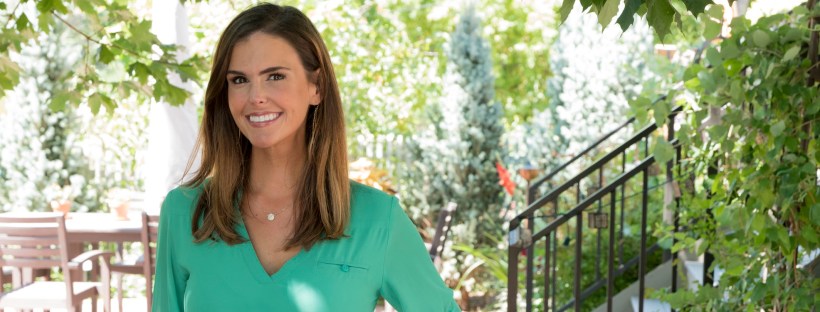
 Sickness and health truly take on a whole different meaning when you live with a chronic illness. Katy witnessed her husband Vince’s compassion and character while they were dating.
 “Operation: Good Health.” She made it a priority to get a minimum of eight hours of sleep a night, as lack of rest tends to be a trigger for her. She was on a mission to hydrate, hydrate and hydrate some more. To set herself up for success and limit any surprise flares, she planned out her meals the entire wedding weekend. For example, she does well with bland foods, like noodles, rice, chicken and (big one) avoiding alcohol. And finally, she delegated responsibilities (aka stress) to friends and family. Katy admits she’s pretty Type A and would much rather do things herself than hand them off. However, she wanted to enjoy her wedding and because of her proactive planning, she was able to do just that!
 Reagan, Grayson and Carter may not understand why their mommy is in bed or why she needs to pull over on the side of the road when she gets sick, but Katy’s Crohn’s has taught her children a great deal of empathy at a young age. A few weeks ago, she was in debilitating pain and her nine-year-old offered to make dinner for her brothers. She poured them each a bowl of cereal and that was everything.

 While I feel incredibly blessed to be in this position, it comes with its own unique set of worries.
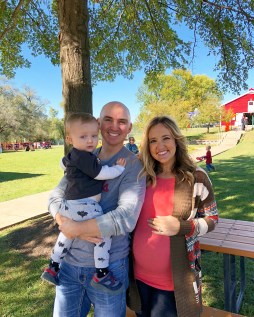 They will live within a home that talks about chronic illness and experiences it each day. Your little ones will learn compassion and perspective before they are even able to truly communicate. If you have a child and chronic illness, you know what I mean.
 Whether it’s with motherhood or with living life with Crohn’s, it’s important to remind yourself that everything goes through stages. There are highs and lows, but each moment is fleeting.
 She’s a ball of energy and a sweet little chatter box, wise beyond her years. Seven-year-old Brooke, of Missouri, was diagnosed seven months ago with Crohn’s disease. She spiked a fever on New Year’s Eve 2017 that lasted for eight days, and from that point forward, life was never the same.
 Brooke and her family were told she had Crohn’s disease on March 2, 2018. In a matter of months, she went from being an outgoing, energetic kid to a hospital patient on a laundry list of medications. She developed her first fistula while on methotrexate and was on prednisone for more than three months.
 d we do something to cause this? Were we making the right decisions for her treatment and care? Brooke has a HUGE personality. When she was first sick, and before her diagnosis, she just stopped talking. She would lie on the couch for hours and hours every day. This was not my Brooke. She normally can’t sit still for more than a few minutes! I was SO scared because I knew something wasn’t right. Watching her in pain and miserable for two months while we waited on this diagnosis was miserable. You just feel helpless…all we could do was love her and pray,” said Tara.
 When you’re going through this, you are spread so thin and it’s difficult to ask for help. We have another daughter, Haley, who is 10. Of course, when Brooke was in the hospital, either Josh or I were with her every minute. We live over an hour from Children’s Hospital in St. Louis, so it wasn’t possible to pop up for a quick visit. It was also hard for us to ask for support. We needed help mentally, financially, and logistically with many things. We have an AMAZING support system of family and friends who have helped us throughout this process.”
 Although I know she doesn’t know yet, what it really means to have Crohn’s, I am always so amazed by her strength. She talks about it very ‘matter-of-factly’. It doesn’t define her. I hope and pray constantly that anything that I encounter, I can deal with, the way she has dealt with this. It’s made our family stronger by seeing that we can face this together.”
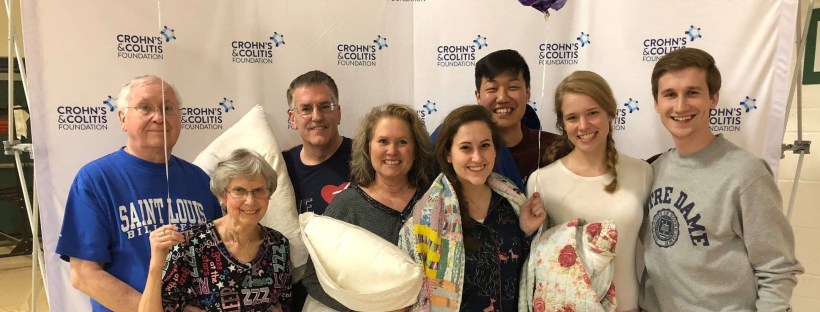
 Linde graduated from my high school and later moved to St. Louis. She currently resides in Atlanta, where she works for the CDC and does Policy work for the division of lab sciences.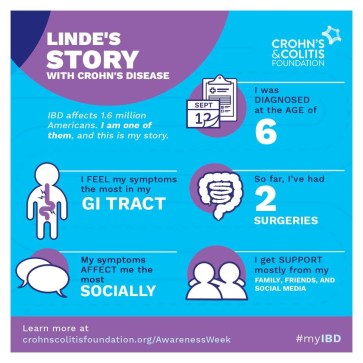
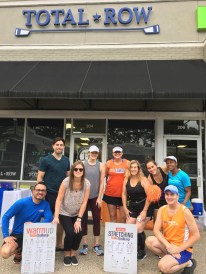 I’m training for a half marathon and taking on the biggest fitness and
 I like to take 2-3 extra days of daily medications and vitamins. Along with the daily dose, pack pain and allergy medications so you have it on hand and readily available, should you need it. As someone who battles Crohn’s disease, I’ve had to fly out of the country with my biologic injection. Be mindful of how your medication needs to be stored. If it needs to stay cool, keep it within a zipped-up bag with an ice pack and remember to throw in a few alcohol swabs for good measure. Also, keep your medication on you at all times, never in a checked bag!
 Whether it’s a business card or information that’s stored in your phone—make sure you have your doctor’s phone number readily available, should an emergency or flare up arise. It’s also helpful to keep a list of medications in your purse or wallet, so that you don’t have to worry about remembering the dosage you take or what you are on, should an emergency arise.
 it will help you feel your best and enjoy your trip. Pack a thermos or water bottle, and it’s as easy as using a water fountain or grabbing some bottled water and mixing up DripDrop on the go. This way—you can enjoy the sun and warm temperatures and keep your body on track for feeling its best.
 There aren’t a whole lot of “safe spaces” for those of us to feel understood and connected with.
 As someone who’s battled Crohn’s disease for over 13 years, I constantly find myself needing to take a step back and remember that the only person who’s lived my journey is me. It’s up for me to tell my story. It’s up for me to share it. It’s up to me to communicate to those when my feelings are hurt or I’m disappointed. But before I jump to conclusions, I need to assume the other person is trying to help me or learn more about my experience—rather than ruin my day or hurt my feelings. API all day, baby. Try it. Trust it. Live it.
 lights camera crohn's