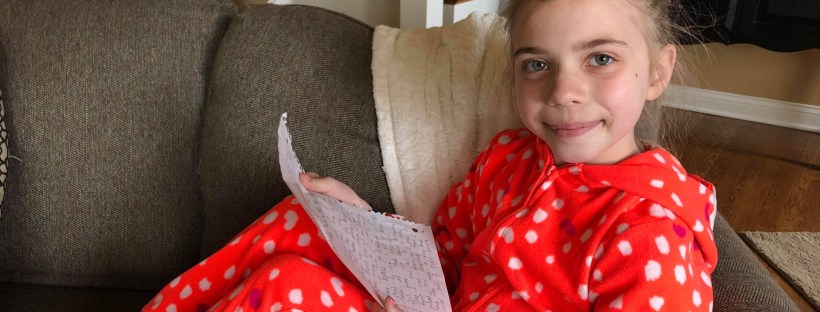
Who says snail mail is a thing of the past? For one 10-year-old in the Chicagoland area, connecting with fellow IBD pediatric patients is helping her cope, comfort and help others as she takes on Crohn’s disease herself.  Meet Emily. This past February she received her chronic illness diagnosis. Even though she’s brand new to IBD life, she’s taking all the pain and all the setbacks in stride.
Her mom, Michelle, says watching her young daughter go through Crohn’s has been a punch in the gut.
“It’s overwhelming, lonely, and mentally draining for everyone involved. Her little body has been put through so much in the last few months and she just goes along with it all. I wish I could’ve done all the horrible tests and take away every ounce of her pain. My heart breaks every time she gets poked, every time she takes medicine, every time she has to do a test, or when I send her to school, knowing she feels horrible.”
Emily’s courage and compassion for others has inspired Michelle. Her Crohn’s diagnosis has spurred an interest to connect with other IBD kids. Rather than take on the disease in silence, Emily finds there is strength in numbers, a purpose for her pain.  Her mom was able to reach out to fellow parents on Facebook about a pen pal program.
“How cool to come home from school and have a couple letters waiting for you from kids all over the country?!? Emily has already made 12 new friends with IBD from the U.S. and the U.K. I never want Emily to feel alone on this journey nor do I want any other kids to feel alone. I want Emily to see that other kids who have IBD are living a “normal” life and that she can, too! There may be days when I won’t understand what she’s going through, but her new friends will.”
 From a parenting perspective, the pen pal group has introduced Michelle to other mamas going through the same fears and experiences. The connections have brought her peace of mind as she navigates these new waters with her daughter.
“Emily and I are firm believers in spreading positivity and what you give out, you get back. It’s up to us to find the good in this situation and what better way than 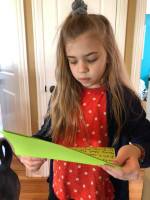 making new friends? Friends who understand and continually cheer you on, no matter how far they are. My hope is that Emily will make life long connections and that these letters will serve as a constant reminder that she is never alone.”
Interested in joining this pediatric pen pal group? A Facebook page is in the works. In the meantime, you can get involved by emailing Emily’s mom, Michelle: positivelyshelly@gmail.com.

 I never dreamed I’d be walking around a toy store looking for gifts to comfort and distract my cousin’s darling, smiley, 21-month-old son. But here we are.
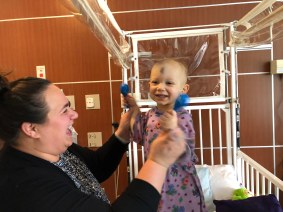 When we got the call March 19th that my cousin Nicole’s sweet boy Lukas was diagnosed with ALL (acute lymphoblastic leukemia) my mom and I let out deep guttural cries. It felt like an out of body experience. The tears poured down our faces. Life stopped in that moment. My husband had to run our 23-month-old son upstairs so he wouldn’t witness our despair. Our boys are only eight weeks apart. Our boys were supposed to have a play date two days later. But now, sweet Lukas was getting chemo in the hospital instead.
 In the blink of a moment—she went from having two perfectly healthy sons—to finding out her baby was in for the fight of his life. A fight that would involve 3.5 years of chemotherapy. A fight that would involve countless nights in the hospital, setbacks, highs and lows with dire consequences, and having to watch your child take on the beast that is cancer.
 She held her baby tightly, sobbing in silence as he looked around the room, unaware of the poison getting pumped through his veins. It killed me to see her go through this. It’s truly the unthinkable to watch someone you love hurt so badly as they take on the unknown.
 He’s going to give life a whole new perspective. He’s going to thrive. Lukas is going to navigate these unknown waters and open our eyes to the beauty of a feel-good day.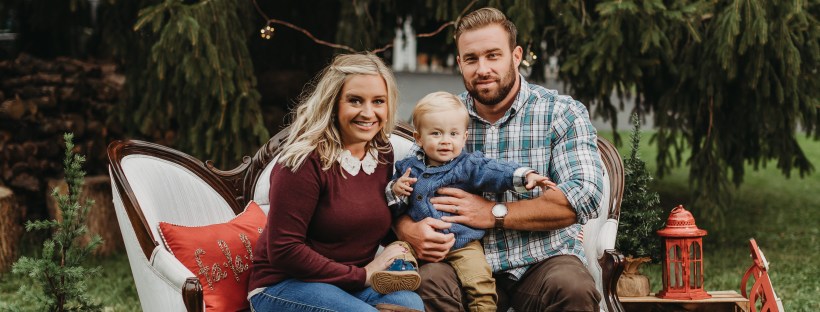
 I’ve had my fair share of surprises and obstacles with Crohn’s disease. My patient journey includes numerous surgeries, multiple doctor appointments a week, sitting in hospitals getting Remicade infusions, switching up medications to tame a flare and my all-time favorite, hospitalizations for days at a time. Please note the sarcasm in that last sentence.
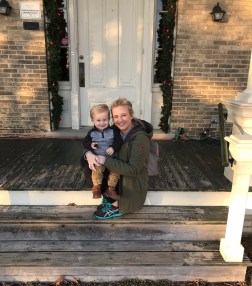 When the pain presented, I tried everything I could to avoid the trip. I just wanted to stay home and live my life with a newborn, enjoy the snuggles and oddly enough the 3 am feedings. Then, the time came when I couldn’t even get through a feeding without needing to set him down so I could run to the bathroom. I knew it was time.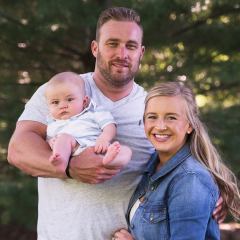

 It was a brisk January morning. Tears filled my eyes as I was overcome with emotion. Our rainbow baby is here, safe and sound. Another pregnancy behind me, a pregnancy that silenced my Crohn’s disease and provided sweet reprieve from my chronic illness. It was time to take Sophia home and start our life as a family of four.
 Each time I have a procedure or deal with painful symptoms, I see their faces, I say their names in my head, and it brings me a sense of calm. My goal when Reid was born, was to stay out of the hospital until he could walk, luckily that’s been the case. He’ll be two in March. Now, I have that same goal following the arrival of my daughter.
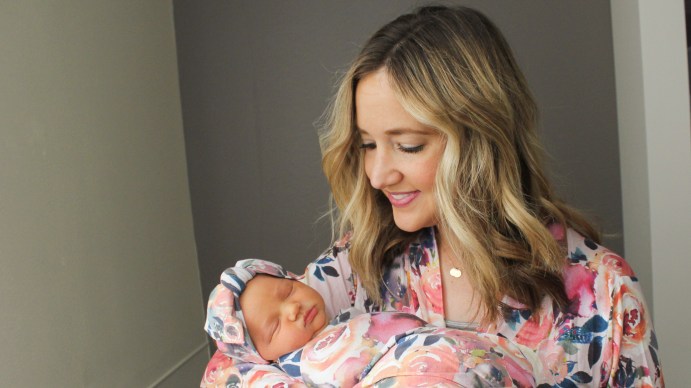 Motherhood and IBD can be a difficult and challenging balance. Some days the fatigue and symptoms are so debilitating you feel like you’re falling short. At the same time, the days where you’re feeling well, remind you that you are so much more than your disease. Just because you have a chronic illness, doesn’t mean you are robbed of experiencing the beauty of life and what it feels like to have your very own family.
 It all starts with recognizing where you are in your patient journey and then determining when your symptoms and body are in the best shape to get pregnant. While everyone’s disease experience is different—the worries, concerns and fears associated with parenting and chronic illness are often the same. Always know you are never alone. Communicating these feelings with those around you, makes all the difference. Lean on our patient community and all those who’ve lived your reality.
 When Sophia Shea entered the world January 14, 2019, our family received a wonderful gift. Between our son Reid and our baby girl, we could not be more blessed. My chronic illness has given me such an appreciation for health and for life in general. With the pregnancies behind me, I often reflect on where I started back at age 21 in 2005. At that time, in my eyes, I was Natalie and I had Crohn’s disease. There was no telling what my future would hold. Now, nearly 14 years later, at age 35, I’m so much more. I’m a mom to two under two. I’m a wife. I’m a daughter. I’m a sister. I’m an aunt. I’m a friend. And I also have Crohn’s.
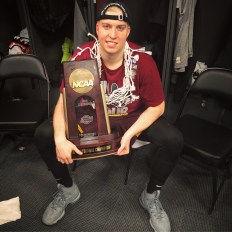 At the time, Nick DiNardi was a senior walk on and served as a scout to prepare players for each game. Aside from his skills on the hardwood, Nick has battled Crohn’s colitis since he was 11.
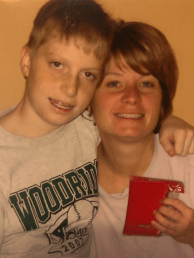 My grade school friends had no idea why I was crying in class, oftentimes teasing me while I was in pain,” said Nick. “My parents and siblings were always there to do everything they could to make me feel better, but I just never felt like anyone related to the pain I was in.”
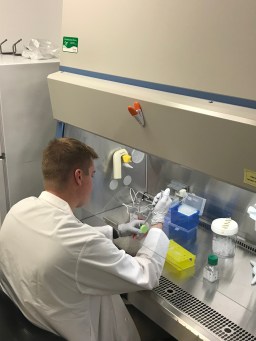

 For me—the past nine months I’ve been incredibly grateful to have another healthy pregnancy, that silenced my Crohn’s symptoms. I’m also celebrating 3.5 years of no IBD-related hospitalizations or ER visits! The cherry on top was the release of Citrate-free (pain-free) Humira this year! After more than a decade of giving myself the painful injection, the new formula has greatly improved my patient experience.
 Celebrate the feel-good days and soak up the moments where your IBD isn’t top of mind. You have an innate sense of when your body is giving you warning signs that rough waters are ahead. Be mindful of the inner conversation going on in your head and listen to your gut. Although it tends to be our nemesis, it has a way of alerting us when things are about to get out of our control.
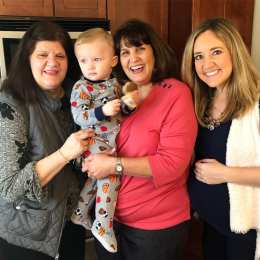 Trust that those close to you love you and appreciate you for everything that makes you, you—including your disease. Show appreciation for your caretakers—those who live with you and are in the trenches by your side, day in and day out. Find comfort in those who allow you to be vulnerable when you need to be. Stop putting effort into relationships and friendships that don’t add joy to your life—eliminate the negativity, cut the fat, there’s no need for people who bring you down or belittle what it’s like to live with Crohn’s or ulcerative colitis.
 You’ve reminded me of what is possible and what I’m capable of. You’re already an inspiration to me and you don’t even know it.
 You and your brother serve as my greatest motivation to push through the pain and be strong. You’ll see how your dad loves and nurtures unconditionally and rises to every challenge that comes my way.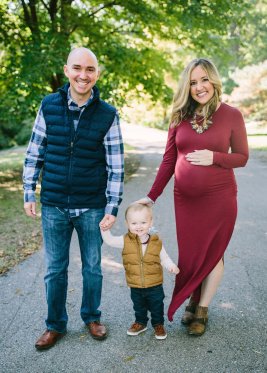

 She is a news reporter for a community television station in the Minneapolis/St.Paul area. Sonya is also a Crohn’s patient, diagnosed with the digestive disease in 1985 while she was in college. I’ll let her take it from here:
 However, it took me a minute to adapt a positive inner attitude. You see, in public I put on a good, cheerful attitude. There were times when I wanted to crawl up into a big ball and shut out the world. The first few weeks of constantly wearing a backpack full of IV fluids were very hard. I did not like what I saw in the mirror. I was angry at my situation. It wasn’t until I visited a pediatric Crohn’s and Colitis Foundation support group that I changed my way of thinking. Seeing young people living with the digestive diseases, and going about their lives despite their circumstances, motivated me to do better.


 Chronic illness, while physically, mentally and emotionally taxing, also has the ability to show us the beauty of the world around us and all that we’re capable of. Instead of thinking how my Crohn’s holds me back—I think about how I’ve lived despite its restraints.
 My disease has helped me take on motherhood. It’s made me soak in the feel-good moments, take mental snapshots of the happy days and celebrate the beauty of life. My disease has forced me to press pause when I’m doing too much, it’s reminded me of the importance of self-care and taking time for me. It’s shown me which people are meant to be in my life and which are meant to be in the backstory.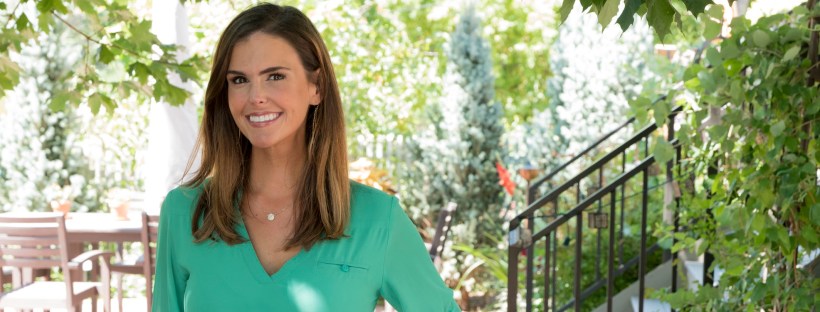
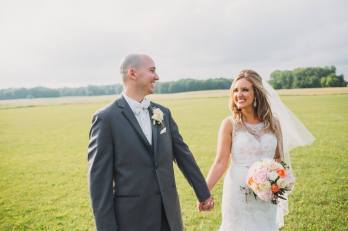
 Sickness and health truly take on a whole different meaning when you live with a chronic illness. Katy witnessed her husband Vince’s compassion and character while they were dating.
 “Operation: Good Health.” She made it a priority to get a minimum of eight hours of sleep a night, as lack of rest tends to be a trigger for her. She was on a mission to hydrate, hydrate and hydrate some more. To set herself up for success and limit any surprise flares, she planned out her meals the entire wedding weekend. For example, she does well with bland foods, like noodles, rice, chicken and (big one) avoiding alcohol. And finally, she delegated responsibilities (aka stress) to friends and family. Katy admits she’s pretty Type A and would much rather do things herself than hand them off. However, she wanted to enjoy her wedding and because of her proactive planning, she was able to do just that!
 Reagan, Grayson and Carter may not understand why their mommy is in bed or why she needs to pull over on the side of the road when she gets sick, but Katy’s Crohn’s has taught her children a great deal of empathy at a young age. A few weeks ago, she was in debilitating pain and her nine-year-old offered to make dinner for her brothers. She poured them each a bowl of cereal and that was everything.
 lights camera crohn's