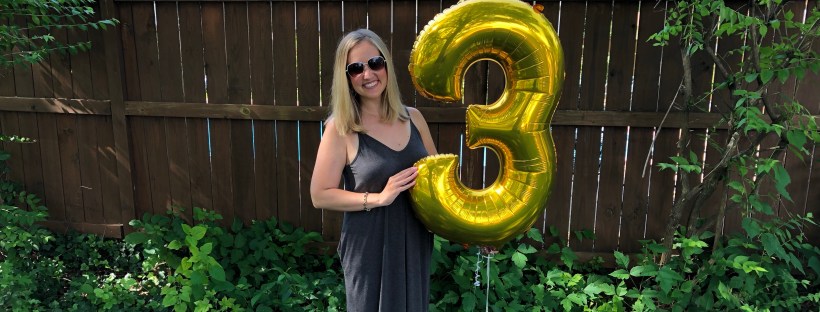
Tomorrow (July 23, 2019) marks three years since Lights, Camera, Crohn’s became a reality. Three years since I closed my eyes and took a major plunge, wondering if my words and effort would make a difference. Three years since I decided it was time to stop living my IBD life in the shadows, and instead bring my personal struggles and triumphs to the forefront.  I chose to blog and become a patient advocate for several reasons. I was tired of feeling isolated. I wanted to be a voice for the newly diagnosed, as well as the veteran patient. And, as a journalist, I’ve always had a love for the written word. For me—expressing myself through writing comes a lot easier than saying the words out loud.
July 23rd is a big day on the calendar each year for me—it’s the anniversary of my Crohn’s diagnosis (14 this year!), my dog Hamilton’s birthday (He’s turning 11) and it’s the day I met my husband online (6 years ago!). If that’s not a sign that things happen in threes, I don’t know what is! Knowing this, I had to launch my blog on this day. Rather than focus on how many years I’ve been riddled with a chronic illness, it’s a way to celebrate how far I’ve come on my patient journey.
I’m going to do a little humble brag right now. Since launching my blog in 2016, I have never missed a week of posting fresh content. Through two pregnancies and being a stay at home, IBD mama with a now 2-year-old and six-month-old, I found a way to stay true to my own personal deadlines, because this blog, and this community and IBD family are so important to me.  In that time, I’ve shared 171 new articles (because some weeks I post on Mondays AND Wednesdays). Over the last three years, more than 105,000 people from around the world have checked out Lights, Camera, Crohn’s. Could the articles be organized better? Yes. Could the design be snazzier? Yes. But, my focus as an IBD blogger and advocate is to give you the nitty gritty. I’d rather spend my time and energy on content vs. design.
One of the most common questions I receive is, “How do you become a patient advocate?” or “How do you become a blogger?” It obviously takes time, passion, and commitment.
Here are my top 10 pieces of advice for you, that I wish I would have known before blogging.
- Write for the reader and for yourself. As patient advocates and bloggers, it’s generally our own personal experiences that shape the content we share. That experience and viewpoint is invaluable, but remember—the reader isn’t here to check out your diary. They are here to learn ways to improve their patient journey, to educate themselves. When you write, write to the people reading. Don’t bore them with every.single.detail. of your doctor appointment. Use that experience as the foundation and springboard into a larger discussion that is easy for others to relate to. Think “news people can use”…otherwise, why read your stuff?
- Be bold. Be vulnerable. It can be very stressful and overwhelming to put your whole health story out there to the public. If you’re like me, I kept my disease to myself and close family and friends for a decade. Going from that—to sharing my story with thousands, is polar opposite. But, I can tell you, once you open up, you won’t regret it. The moment you break down your own barriers and show your true stripes, you open yourself up to endless support and quickly come to realize how many others understand your reality.
- It’s not a competition of the sick. Just because you haven’t started a biologic, just because you haven’t had surgery, just because you don’t have a bag, doesn’t mean your patient journey is any less significant or important. IBD impacts each and every one of us differently, but there are so many parallels along the way. Trust that what you are going through physically, mentally, and emotionally is something many people can relate to. I haven’t been hospitalized for my Crohn’s since August 2015 (before my blog went live!), but in my 14 years living with the disease I’ve experienced so many highs and so many lows, so many flare ups and so many feel good days. It all matters. And it’s all a part of it. People don’t just want to see you in the hospital or struggling, they want to see other aspects of your life, too.
- Be patient with yourself through the process. Writing about life with IBD can be emotional. It can be draining to bring up old memories that were the most difficult days of your life. It can also be cathartic. Write stream of consciousness-style. Rather than thinking about each word and constantly hitting the delete button, just let it flow. Edit yourself later, not in the moment.
- Have a thick skin. Being a patient advocate and a blogger isn’t always sunshine and rainbows. You are going to receive both public and private messages from naysayers. People may question why you aren’t “healing yourself with food” or “why you need a biologic”. The only person you need to answer to is the person looking back in the mirror, along with your physicians. No matter how much you share online, no one has the FULL story of your own personal experience. Let the judgers, judge…and keep on trucking. Keyboard warriors have a way with words, don’t allow others to bring you down or stress you out. That’s the last thing we need living with IBD. I’ve come across a few instances on Twitter, where banter got pretty heated. When my heart started racing and my stomach started hurting, I knew it was time to block them and move on. Don’t be afraid to block when needed.
- Remember you are a patient, not a medical professional (unless you are both!) It gets dangerous when patient advocates spout off medical advice to those desperately looking for answers. When people come to you for support or with questions about how to handle their care—always advise them to talk with their care team, and remind them you are not a doctor, but this is what has worked for you. Yada Yada Yada.
- Lean on others in the IBD family for guest posts/sharing your content on social media. Advocacy is not a competition. There is room at the IBD family dinner table for ALL of us. Interact with other people’s blog articles and social posts. Show them the love, chances are, that love will be reciprocated. Oftentimes, it can feel like everything you are doing is falling on deaf ears (thanks so much, Facebook algorithm)…that being said, don’t focus on the “likes” and the “comments”…if your article or your words help one person or one family, you’ve made a huge difference.
- Always be on the lookout for content. The former TV news anchor and reporter in me always has my eyes and ears open for the next story. Look at social media and see what’s trending in the IBD community. Ask your followers what topics they’d like to see more on. Set up Google Alerts in your email to see the latest about IBD research and news. Pay attention to people’s stories. When someone reaches out to me with a question, I often dig a little deeper and see if this is something that would make for a good article. Every single person has a story to share, it’s just a matter of discovering what that story is.
- Be authentic and true to who you are. Oftentimes businesses and companies will reach out to patient advocates looking for promotion or support. Don’t be a “yes-(wo)man”. Only promote causes and products that you genuinely believe in. Don’t sacrifice your hard-earned credibility for a few bucks, because your credibility is priceless.
- Stop selling yourself short. Your IBD life and story is valuable. Gone are the days when big pharma and businesses can tap into us as resources for free. We’ve all gotten smarter about this. Your painful journey hasn’t been easy. But, with that journey, you’ve gained a perspective that businesses are thirsty for. They NEED our insight. They NEED our input and perspective. Unless you live with IBD personally, you can’t fully grasp what it’s like. Sure, volunteer work for the Crohn’s and Colitis Foundation is one thing, but as soon as someone wants you to be an “influencer” or speak at an event, etc. know your worth and don’t ever be afraid to ask what the compensation is.

I’m hopeful that three years from now on July 23, 2022, I’ll still be blogging and will still be a vocal voice for the IBD community. Thank you for sharing in my journey and for pushing me to be better. Thank you for reading and for caring. Thank you for being a listening ear and a watchful eye. Thank you for walking alongside me through pregnancies and motherhood as a woman with IBD. I promise to deliver more content that helps guide you through your journey and show you just how capable you are of being everything you ever hoped for. God bless.
XO,
Natalie

 While attending IBD Social Circle at Digestive Disease Week in San Diego, I listened to a panel with Dr. Neilanjan Nandi, MD, FACP and Dr. Aline Charabaty, MD about the patient and health care practitioner dynamic.
 Switching physicians and entrusting someone new with your well-being is not easy. Trust your gut (for once!) and advocate for care that makes you feel like you have a voice. Think about how you feel leading up to an appointment, while you’re face to face with the physician and the emotions you may experience on that drive home. If anything makes you feel less than or not heard, connect with fellow patients in your area to see who makes up their care team. Do research about IBD specialists within drivable distance and take the steps you need to feel like you have your best ally against this disease.
 Ziyad shares how his experience taking on Crohn’s inspired his decision to become a radiographer and show fellow patients they are much more than just a number. I’ll let him take it away…
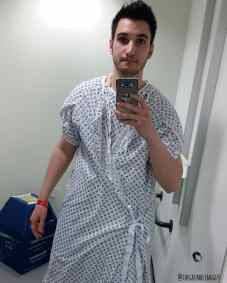 I was afraid of what people might say, what they might think of me or if they might start treating me differently – I didn’t want to be anything other than the supposedly ‘healthy’ 17-year-old with a ‘normal’ life. As a result, I spent twelve years living with Crohn’s in silence. I was embarrassed, because let’s face it, talking about your bowel habits isn’t the most glamorous topic.
 It can be easy to fall into the ‘conveyor belt’ motion of one in, one out, to try and manage the workload. But it is in these busy moments, where taking a few extra seconds to ask a patient who looks upset, scared or frustrated if they’re OK, that can make all the difference.
 I hope you take this week to enjoy time with loved ones, relax and find time to care for yourself!
 She is a news reporter for a community television station in the Minneapolis/St.Paul area. Sonya is also a Crohn’s patient, diagnosed with the digestive disease in 1985 while she was in college. I’ll let her take it from here:
 However, it took me a minute to adapt a positive inner attitude. You see, in public I put on a good, cheerful attitude. There were times when I wanted to crawl up into a big ball and shut out the world. The first few weeks of constantly wearing a backpack full of IV fluids were very hard. I did not like what I saw in the mirror. I was angry at my situation. It wasn’t until I visited a pediatric Crohn’s and Colitis Foundation support group that I changed my way of thinking. Seeing young people living with the digestive diseases, and going about their lives despite their circumstances, motivated me to do better.


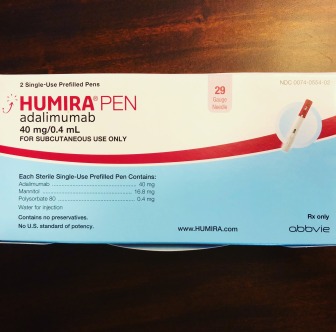 It changed in a way that I never knew was possible. I have so many flashbacks of my journey with Humira. The tears as I felt sickly in my 20s sitting alone in my apartment and wondering why me. The dread, anxiety and anticipation every other Monday and the strength I had to muster up within myself to once again receive my medication. Holding the injection in my hand, getting in the zone and focusing my thoughts on brave family members and friends as I held down the plum colored button and felt the burn. The sad look on my son’s face as he looked in my eyes and witnessed his mama hurting.
 Linde graduated from my high school and later moved to St. Louis. She currently resides in Atlanta, where she works for the CDC and does Policy work for the division of lab sciences.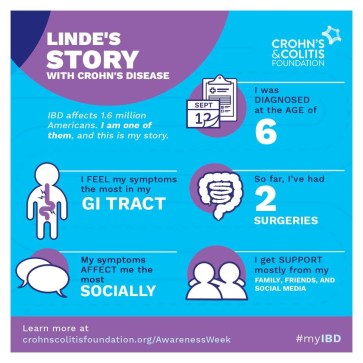
 I’m training for a half marathon and taking on the biggest fitness and
 There aren’t a whole lot of “safe spaces” for those of us to feel understood and connected with.
 As someone who’s battled Crohn’s disease for over 13 years, I constantly find myself needing to take a step back and remember that the only person who’s lived my journey is me. It’s up for me to tell my story. It’s up for me to share it. It’s up to me to communicate to those when my feelings are hurt or I’m disappointed. But before I jump to conclusions, I need to assume the other person is trying to help me or learn more about my experience—rather than ruin my day or hurt my feelings. API all day, baby. Try it. Trust it. Live it.
 As a patient advocate, you also become somewhat of a confidante and voice of reason for your peers in the community.
 What I do want—is for people to recognize what compassion fatigue is…and how as chronic illness advocates and caretakers we need to be mindful of how we’re feeling and internalizing the struggles of those around us.
 I offer support from the bottom of my heart, but as a mom and a wife, I do need to recognize when it’s time to unplug and take time for myself. When my baby naps each morning—I spend that “break” on my computer writing articles about IBD, participating in Twitter Chats, and talking on the phone with those who want to hear about my patient experience.
 As part of my self-care and disease management I need to de-stress, so I don’t put my own health at risk. This article is painful for me to write—I can’t stand admitting that I am struggling to do it all. But, compassion fatigue has been something I’ve been feeling for a few months. I want to be the best advocate for others and do all I can to make a difference and show there’s so much life to be lived outside of your disease. I want you to see how much you can thrive with this disease and all that you can accomplish. I want to be the person I needed the day my world turned upside down when I was diagnosed. I want to be all the things. But it’s not possible. It’s not fair to me, it’s not fair to you.
 We have the opportunity to serve as patient advocates and leaders in our respective health communities and be a voice for those who suffer in silence. As advocates, we can share the challenges and the triumphs. We can articulate where the roadblocks are, where we struggle and come up with lifechanging solutions—not only for ourselves, but countless others.
 From the submissions, 10 finalists are selected to present at the Innovation Challenge in late July. All finalists are flown to the summit in Minnetonka, Minnesota and treated to two days of interactions with other finalists, the jury and with Lyfebulb and UnitedHealth Group employees during one on one meetings, group meetings, presentations and meal gatherings.
 lights camera crohn's