
There’s never a good time to receive a diagnosis of inflammatory bowel disease. The earth shattering news tends to flip your world upside down. For 27-year-old Alyssa Alda Clements of New Jersey, her Crohn’s disease diagnosis could not have come at a worse time. Alyssa was in her first year of medical school and had recently lost three family members.
“The hardest part about my diagnosis was the time I spent in the hospital or being homebound, because it took me away from my schooling. Having to take medical leaves from my DREAM was so heart breaking. I had wanted to be a doctor since I was three. In time, I started to feel better when we got things under control and was able to go back to medical school and, knock on wood, I am still hanging in here,” Alyssa says.
Being sick never made her want to quit, if anything it made her realize how much we need doctors, especially ones who care. Alyssa says her patient perspective provides her with insight when it comes to the type of doctor she wants to be and the type of care she aspires to provide day in and day out to those who depend on her. 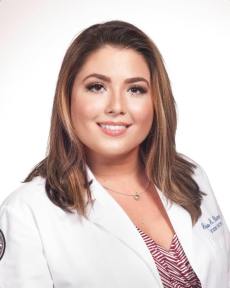
“My first trip to the ER nearly killed me because the doctor didn’t believe my pain, told me it was in my head and that I was a crazy medical student, and didn’t even touch or listen to my abdomen. It turned out to be an obstruction and thankfully I listened to my gut and went to a different ER the next day,” Alyssa recalls.
Fast forward a week later, Alyssa woke up from her first colonoscopy to learn she has severe Crohn’s disease in her large intestine, small intestine and rectum. The GI spoke candidly and said her odds of ever becoming a doctor were slim, due to her health. But, Alyssa didn’t let the naysayers stop her from following her dreams.
Becoming a doctor while living with Crohn’s
As many know, working in the medical field is not for the faint of heart.  The profession entails a great deal of stress, both physically and mentally. Not only are the hours long, but you are exposed to a ton of people who are sick, while you are immunocompromised.
“I have learned so much about empathy and sympathy as a patient, the way some physicians made me feel pushed me to continue in medical school and be a better caregiver than they were to me at my worst moments. I have learned to listen to the patient because I have been ignored. I know just what being a patient feels like, how scary, uncomfortable, painful, that being sick can be, and I want to be there for others who are in that position. When I finally found my amazing care team that I have now, I became hopeful that I could be that person for someone someday,” Alyssa says.
As far as advice for fellow IBD’ers, Alyssa says be honest with yourself and what you can handle. Don’t let your disease limit you, but also know that it’s ok to be kind to your body and slow down when you need to. Alyssa says she’s modified her life so that she’s able to handle medical school and keep her well-being in mind at the same time. She relies heavily on the support of her family and boyfriend and makes self-care a part of her daily life.
Big city, bright lights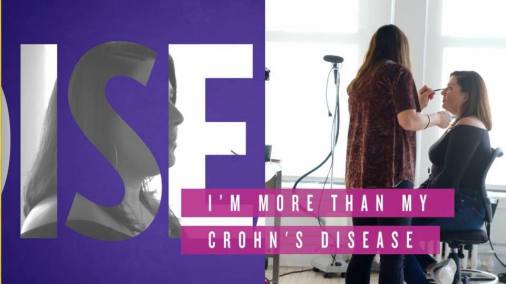
Alyssa was recently featured by People Magazine, that’s how her and I connected on Twitter! I saw her inspiring story and immediately wanted to share it with you. She went to New York City and was interviewed as a woman who is overcoming chronic illness. Talk about a great person to represent those of us in the thick of fighting this disease.
Her attitude is admirable, “I want to show anyone that they can be strong and resilient and still achieve their dreams after a diagnosis. I want to show young women and girls with illnesses that they are still beautiful, that their bodies might be constantly changing, but they are still themselves, they are still amazing.”
Bouncing back from difficult days
In her first year of diagnosis, Alyssa was in and out of the hospital. She endured more than 12 bowel obstructions, a PICC line, NG tube and tests galore. While at Disney World that November, Alyssa fell to the floor of her hotel room. She came to find out she had multiple abscesses and fistulas. After four weeks of total bowel rest, she had an ileocecectomy. A total of 13 inches of her intestine was removed. In her eyes, the surgery saved her life. Alyssa has been on Humira for almost five years. She says the new citrate free formula has changed her life (and I must agree!!)
“Days can be hard, filled with pain, fatigue, never ending symptoms, but always know that you are not alone. There is an army of us fighting diseases you can’t see.” You got that right, Alyssa!

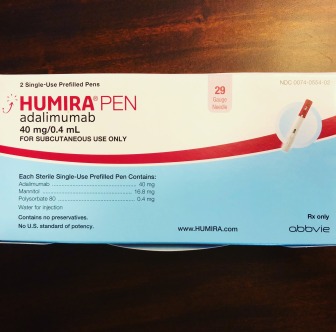 It changed in a way that I never knew was possible. I have so many flashbacks of my journey with Humira. The tears as I felt sickly in my 20s sitting alone in my apartment and wondering why me. The dread, anxiety and anticipation every other Monday and the strength I had to muster up within myself to once again receive my medication. Holding the injection in my hand, getting in the zone and focusing my thoughts on brave family members and friends as I held down the plum colored button and felt the burn. The sad look on my son’s face as he looked in my eyes and witnessed his mama hurting.

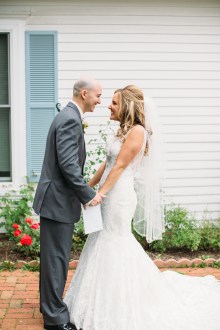 “You’re an incredible partner—you’re my rock when I’m sick and you know how to lift my spirits when I’m down. You have a way of easing my worries and bringing me clarity when I’m uncertain. Each day spent with you—is an extraordinary blessing. I feel so incredibly lucky that God brought us together and chose you to be the one person among millions who lights up my soul.”
 At times, living with a chronic illness and being the one who doesn’t feel well, can bring about guilt. It also brings out the best in us. When I’m vulnerable and need a boost, I see my husband rise up to the challenge, time and time again. I’m constantly reminded I chose to live my life alongside someone who has more compassion in their heart than I knew imaginable.


 I was immediately at a loss for words. But in a good way. I’ve been those people in that commercial. I’ve witnessed family members look at me sympathetically as I excuse myself from the room. I’ve held my stomach and grimaced in pain, doing all I can not to miss a moment of a social gathering. I was recently at the movie theater with my husband, gazing with jealousy at people who could eat popcorn…willing myself not to buy any.
 I’ve been on Humira almost 10 years. I don’t need to be sold on the drug. But this campaign means the world to me. It represents what my parents, husband and son endure by my side. This disease impacts more than just the patient. It’s a family affair. When my son is old enough I want him to be empowered by my strength, but able to empathize with my struggles. Thank you, AbbVie for recognizing this and giving the world an inside look at the IBD patient and family experience. The commercial ends with “To be continued”… I can’t wait to see what’s next.
 lights camera crohn's